
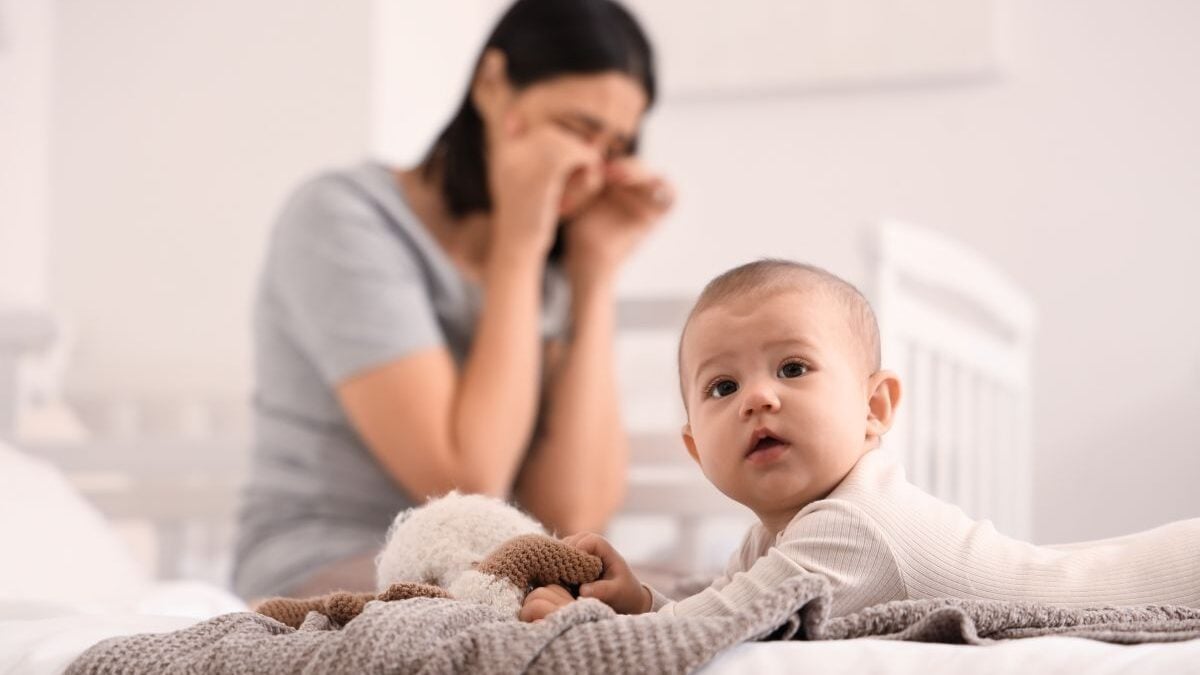
According to the report of the Confidential National Survey on Maternal Dead (ENCMM), presented by The Parisianthe mental health of young mothers appears to be a major issue. Each year, around 17 deaths linked to a suicide of psychiatric origin are identified.
To respond to this reality, the Economic, Social and Environmental Council (EESC) offers 23 recommendations aimed at strengthening prevention and support in mental health among young mothers.
Prevent maternal suicide, to avoid dramas
According to the ECMM report, 60 % of maternal suicides could be avoided. Moreover, certain measures already exist, such as the strategy of the “first 1000 days”, launched in 2021, which provides for early and postnatal prenatal interviews. But it only affects only 30 % of women today.
“”What makes us angry is that the tool to prevent them already exists with the government policy of the first 1000 days. But it is not sufficiently applied, even dormant“Land on Marie Josée Balducchi, rapporteur du Eeste.
To strengthen prevention, the institution recommends better coordinate maternity, general practitioners and psychiatric care services. Objective: to locate the warning signals earlier and intervene before distress became dramatic.
The 23 recommendations revolve around 4 main axes
Prevent – strengthen the role of PMI (maternal and child protection)
- Increase budgets and enrollment to guarantee local medical, social and psychological monitoring;
- Integrate the evaluation of social and environmental risks from prenatal maintenance;
Objective: to identify vulnerabilities (depression, precariousness, violence) early and reduce inequalities from perinatality.
Inform – Breaking taboos around perinatal health
- Launching national mental health campaigns in perinatal period;
- At 100 % reimburse early postnatal maintenance;
Objective: to release speech, promote screening for distress and better support young mothers.
Balance – share the load between parents fairly
- Introduce the concept of equality of parental responsibility.
- Reform paternity and parental leave with more attractive compensation.
Objective: to reduce professional and family inequalities linked to maternity.
Support – Structure the policy of the first 1000 days (from pregnancy to 2 years of the child)
- Secure funding, improve governance and strengthen interdepartmental coordination;
- Deploy health mediators, mobile permanence and review the criteria for closing maternities;
Objective: to act early for the health of the child and maternal well-being, by better targeting vulnerable families.
The EESC proposes to act upstream (prevention, information), in parallel (parental equality), and over time (overall support of the first 1000 days) in order to reduce health inequalities and better protect women and children.
A taboo that persists despite a freer word
What are the reasons for these suicides? This is mainly postpartum depression, increasing in recent years. According to the results of an OpinionWay survey for Qare, postpartum depression affects one in ten women in 2025, compared to 7 % in 2021.
However, 78 % of the mothers concerned say that this subject is never addressed during consultations related to pregnancy and childbirth.
“”Speech is released, information progresses, but postpartum depression remains a massive reality“Underlines Dr. Julie Salomon, pediatrician and medical director of Qare.”The postpartum body remains too often invisible. The lifting of taboos, better training of health professionals and early support are essential to change the situation permanently“.
Baby Blues or real depression? Here’s how to make a difference
Still too often, finally, postpartum depression merges with baby-blues. But how to make a difference?
70 % of young mothers know the symptoms of the baby blues, but this temporary depression is distinguished from postpartum depression.
“”The real difference between these two forms of depression is temporality. If the baby blues occurs a few days after childbirth, depression, it is anchored over time. It can last weeks or even months “ confided to us Dr Odile Bagot, gynecologist member of the Committee of Experts of True Medical, in a previous article.
Françoise Molénat, child psychiatrist, recalled the extent of the phenomenon. “”It is estimated that perinatal depression affects 10 to 12 % of women who give birth “. A figure that echoes the survey for Qare.
It also insists on the need for early screening. “”There is a strong correlation between the meadow and postpartum. When discovering a postpartum depression, there are generally upstream precursor signs, which had not been perceived. However, conventionally, the diagnosis is made between two months and a year after birth“. A deadline that must imperatively be improved, to save more lives.