
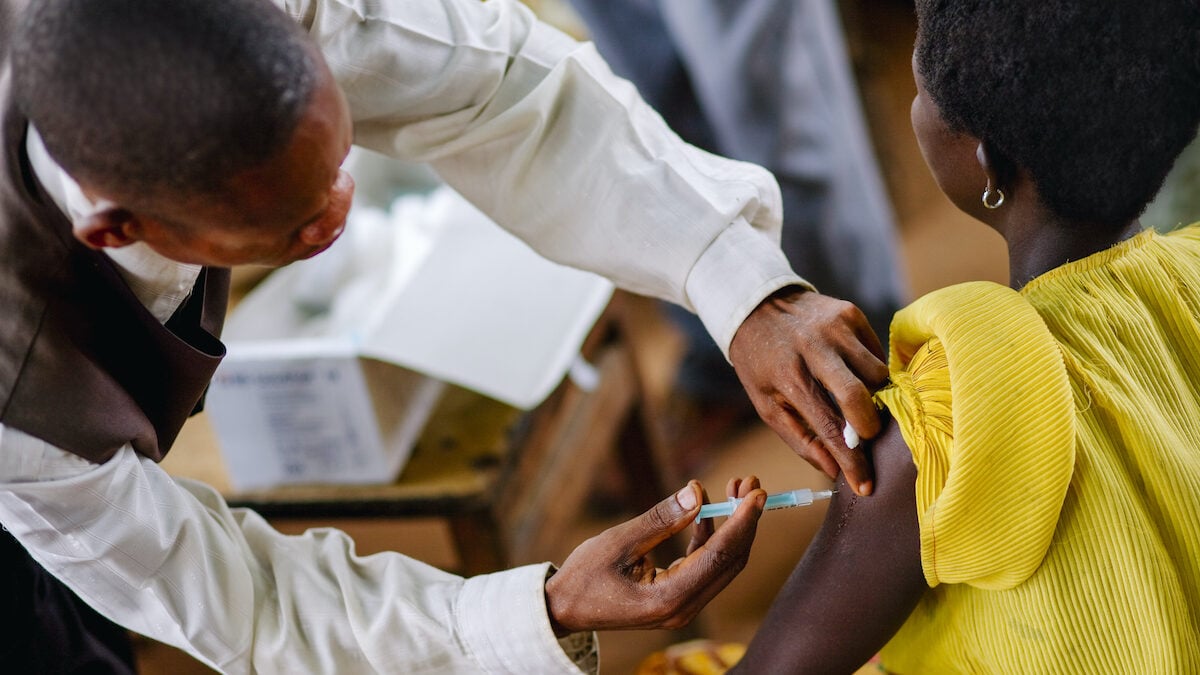
Two bites per year, instead of a daily pill, and at a derisory price (compared to the $ 28,000 invoiced today in the United States) to be accessible to all. The Lenacapavir, developed by the American biotech Gilead Sciences, already appeared as a small revolution at the end of 2024. Baptized Yeztugo, it will be offered in 2027 in generic form by Indian laboratories, for a symbolic rate of $ 40 per year.
“”Ending the HIV is within our reach!“”
These agreements, concluded between Unitaid, the Gates Foundation and several drug manufacturers, aim to make this treatment accessible in more than a hundred countries with low and intermediate income. Concretely, voluntary licenses granted to six generic manufacturers should make it possible to provide this product in 120 countries. “”It is a revolutionary and essential breakthrough to expand prevention against HIV “, Haded Carmen Perez Casas, HIV strategic manager at Unitaid.
“With this product, we can end HIV, it’s now within our reach” she says.
Two injections per year, simpler than the current prep
Lenacapavir is the first drug with prolonged action for pre -exhibition prophylaxis (PREP). Where current treatments require daily intake, two injections per year are enough here. A major and better accepted asset for people most exposed to the virus, who sometimes find it difficult to follow a daily routine or simply have access to treatments.
In addition, clinical trials have shown greater efficiency than conventional treatments. This advance could therefore change the trajectory of the epidemic, especially in areas where access to care is limited and to take a tablet every day is a challenge.
Unitaid has already signed a partnership with the Clinton Health Accessive Initiative, the South African Research Institute Wits RHI and the Indian Laboratory Dr Reddy’s. The Gates Foundation, for its part, relies on the HETERO pharmaceutical group. “”Production will start in India, but we are already working to regionalize it for the future “, specifies Carmen Perez Casas.
A price also divided by … 700
From $ 28,000 to $ 40: the gap is dizzying. This spectacular reduction also aims to remove one of the main brakes to HIV prevention, its cost. A necessary fall.
In 2024, in fact, 1.3 million new infections have been identified worldwide, according to UNAIDS, despite a 40 % drop since 2010. Lenacapavir’s large -scale dissemination could reverse the trend and protect millions of people.
Some experts compare this advance to the arrival of the first antiretroviral treatments in the 1990s, which had transformed the lives of HIV positive patients.
The prudent opinion of French researchers
If enthusiasm is strong, some researchers nevertheless call for caution. As with Sandrine Halfen, head of the Human and Social Sciences department of Anrs-MiE, and Ventzislava Petrov-Sanchez, head of the clinical research department, contacted by True Medical.
“As part of our vision for elimination of HIV, the arrival of generics of Lenacapavir in prep at 40 dollars per year is very good news. But we must ensure that this treatment can be truly accessible to all, and in particular to populations most distant from prevention and care. It is an important challenge: to arouse demand and go to populations”.
And faced with the assertion of Unitaid of End “HIV”, The two experts temperate: “It is indeed a key step in the perspective of eliminating HIV. However, we must quickly set up research work to determine the acceptability of this strategy and improve its implementation. Oral prep has existed for almost 10 years already, and yet some populations who could benefit from it do not have access to it or do not adhere to it “.
For this purpose, the Anrs-Mie thus constituted at the end of 2024 a working group piloted by Pr. Jean-Michel Molina (AP-HP), associating researchers in France and in several countries with weak and intermediate income, in order to better prepare the integration of this new prevention tool.
A historic chance for global health
The World Health Organization regularly recalls that universal access to prevention is one of the key levers to end the AIDS epidemic. In this context, the arrival of effective, simple and inexpensive treatment promises to be a major hope.
If the distribution follows, this treatment could quickly affect the most vulnerable populations, especially young women in sub -Saharan Africa and marginalized communities in major cities. The first deliveries were expected at the end of 2025 in an African country, before a worldwide dissemination from 2027.