
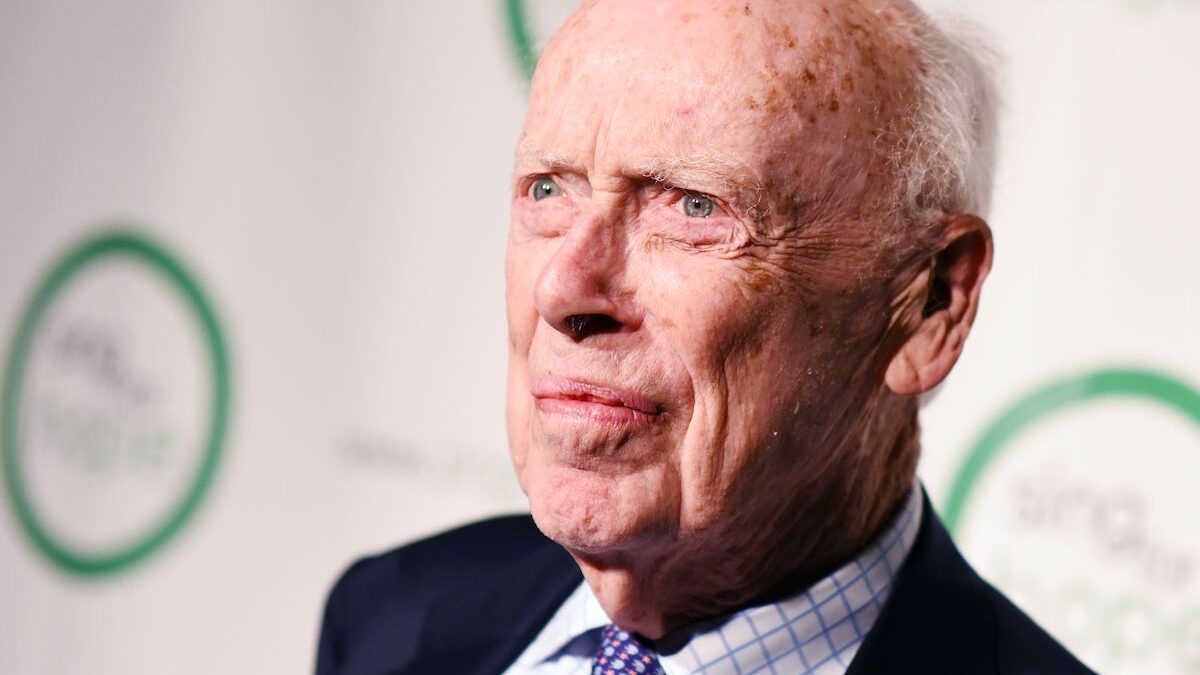
He offered the world the key to life before embodying its darkest excesses. James Watson, dead at 97, leaves behind a major discovery – the double helix of DNA – and a deeply ambivalent legacy. The scientific genius revolutionized modern biology, but his racist and sexist remarks have permanently tarnished his name.
The young prodigy who changed biology forever
Born in Chicago on April 6, 1928, James Dewey Watson was not destined to shake up science. Passionate about birds, he first studied ornithology before turning to biology. It was following a conference in Naples, where new work on deoxyribonucleic acid was presented, that he became fascinated by this mysterious molecule that carries heredity.
In 1953, aged only 25, he published a founding article with the British Francis Crick in Nature. The two researchers describe for the first time the double helix structure of DNArevealing that the four bases—adenine, cytosine, thymine, and guanine—assemble in pairs. This elegant and luminous model finally explains how genetic information is copied and transmitted from one cell to another.
“We believe that DNA is a code. In other words, we believe we have found the basic copying mechanism that gives rise to life from life.”Crick wrote to his son (NatureApril 1953).
Nine years later, in 1962, Watson, Crick and Maurice Wilkins receive the Nobel Prize in Medicine for this major discovery, which would pave the way for molecular biology, modern genetics and, decades later, personalized medicine.
A discovery with persistent shadows
But the story of this scientific revelation has its dark side. The decisive image that allowed Watson and Crick to understand the helical shape of DNA — the famous Picture 51 — had been obtained by the British researcher
Rosalind Franklinspecialist in crystallography. Without his permission, his collaborator Maurice Wilkins showed it to Watson and Crick.
Franklin, who died of cancer in 1958, never received the recognition she deserved. Its role, long minimized by Watson himself, will be rehabilitated much later by historians of science.
Watson recounted this adventure in The Double Helixa popular work as much praised as criticized for its casual tone and the sexist judgments it makes about Franklin. A way, already, of revealing the double face of a man who is both visionary and provocative.
The fallen genius: controversies, isolation and fall
After the Nobel, Watson taught at Harvard then became head of
Cold Spring Harbor Laboratory in New York, which he transformed into a mecca for genetics research. In 1990, he was appointed to the management of human genome sequencing projectwhich he left two years later, refusing to allow patents to be filed on human genes. In 2007, he became the first man whose genome is completely sequenced — a dizzying symbol, he who had pierced the secret of the living.
But the same year, his reputation collapsed. In an interview with Sunday Timeshe states that “Africans are not as intelligent as white people.”. Faced with global outcry, he then acknowledges “the absence of any scientific basis for such a belief“. The Cold Spring Harbor Laboratory, where he had worked for forty years, immediately suspended him. In 2019, he was deprived of all his honorary titles after repeating his remarks in a report on PBS.
His past as an “enfant terrible” then resurfaces: sexist remarks about Rosalind Franklin from the 1950s, eugenic comments on abortion in 1997. Feeling the scientific world turning away from him, in 2014 he sold his Nobel medal at auction for $4.7 million — bought by a Russian billionaire who will return it “as a sign of admiration”.
He had unlocked the secret of life. He walks into controversy.
James Watson died quietly on November 7, 2025 at the age of 97. His name will remain inseparable from the greatest biological discovery of the 20th centurybut also the excesses of a brilliant mind incapable of getting rid of its prejudices. History will undoubtedly remember that genius does not provide immunity against blindness – and that science, like the men who carry it, is also built on gray areas.