
Pregnant with her first child, Kayleigh Summers couldn’t wait to meet her baby: the first look, the first cry, the first hug… With a “dream” pregnancy, she could even hope for an easy delivery. But on the big day at the hospital, nothing goes as planned.
From dream to nightmare in the work room
As she relates in the media Peopleas the term approaches, Kayleigh feels her blood pressure rise sharply.
“As a precaution”, she is told in the emergency room, the medical team plans to induce her labor. The matter takes time. But two days later, Kayleigh presented with a fully dilated cervix. She breathes, concentrates, prepares to push… When a strange sensation passes through her: a sudden discomfort, a dull intuition that something is wrong. She just seems to have time to warn her husband and the midwife that she is sinking.
The heart that suddenly stops…
In the room, chaos sets in within seconds. Kayleigh is gone. No more pulse, no more breathing, she is in cardiovascular arrest. Faced with her stunned husband, the caregivers immediately understand what is happening: an absolute emergency, one of the most feared in obstetrics, called amniotic embolism.
In a previous case, Dr. Jonas Benguigui, obstetrician, described it in simple terms:
“This happens when amniotic fluid or certain elements from the fetus pass through the mother’s blood and block the pulmonary passages. This causes respiratory collapse, a sudden drop in blood pressure… then cardiac shock.”
Unpredictable, without risk factors, amniotic embolism fortunately remains rare, around 1 in 10,000 or 30,000 deliveries according to the expert.
An emergency birth, while the mother struggles
But when Kayleigh collapses, the baby is not yet born. It is therefore a fight against time which begins.
“In these cases”, explains Dr. Benguigui, “We have to take the child out extremely urgently, then treat the shock, the cardiac arrest, the hemorrhage. Everything happens very, very quickly.”
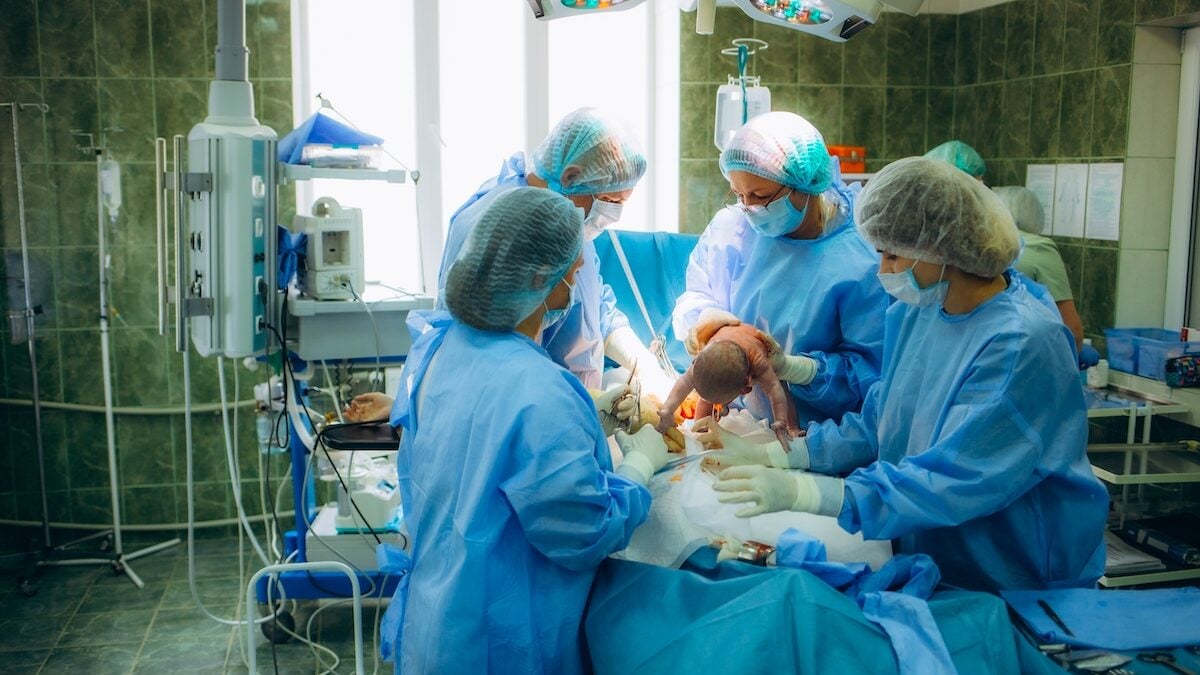
The team rushes to the operating room. In just six minutes, while resuscitation continued on his mother, little Callahan was born by cesarean section. He too is unconscious and must be brought back to life.
Meanwhile, in the room, Kayleigh continues to sink. The embolism triggers what is called
disseminated intravascular coagulations (DIC), a coagulation failure that causes massive hemorrhage. She’s losing blood faster than we can give her. His heart gives out a second time.
The doctors then try everything, hooking Kayleigh up to an ECMO, a machine that temporarily replaces her heart and lungs. A hysterectomy is also necessary to try to save his life.
A tiny pump to bring a heart back to life
Despite everything, his heart refuses to restart properly. So the doctors try a last option: a heart pump of a few centimeters, the Impella CP, which is introduced through the femoral artery to the left ventricle. A kind “miniature wind turbine”they explain to his family. And against all odds… it works. Slowly, very slowly, Kayleigh’s body begins to function again.
Four days after the embolism, she opened her eyes. The next day, she meets her son for the first time. It was only on the sixth day that she learned, speechless, that she had come close to death twice.
A trauma that cannot be seen
She spent two weeks in the hospital, underwent five operations, and moved from one department to another. His body suffers, but it is his mind that wavers the most in the face of the ordeal experienced. How can we believe in safety when we almost died in good health, giving life?
Dr. Benguigui emphasizes precisely this point:
“It is a traumatic ordeal, not only for the mother, but for the entire family. The loved ones who witness the scene, the spouse who believes they have lost everything, and even the child, later, can feel guilty. Psychological follow-up must be part of the care.”
Fortunately, Kayleigh recovered and her heart became fully functional again. But changed forever, today she gets women who have experienced a traumatic childbirth talking, on a dedicated podcast. And as she says so well, she is one of the rare women who can say that she gave life… at the very moment when she was losing hers.