

The prices displayed seem irresistible for these light-up toys, these unbranded plush toys and these multi-colored slime boxes. Moreover, on marketplaces, these products are at the top of searches in the run-up to Christmas, attracting families who are watching their budget. But be careful: behind these “good deals” lies a danger for children.
Toy Industries of Europe (TIE) publishes a report that sounds like a bolt from the blue: out of 70 toys purchased from sellers outside the European Union, 96% do not comply with European rules.
Christmas under high vigilance: up to 96% of non-compliant toys
Presented on November 19 in Brussels, the study also reveals more than 8 out of 10 toys are considered dangerous. TIE is once again sounding the alarm, one year after a first survey already showing worrying rates. Indeed, in 2024, the organization had tested more than 100 toys sold by third-party sellers, European or not.
Result: 80% were non-compliant and many products contained small detachable parts, powerful magnets or accessible button batteries.
A year later, the situation is getting worse. Investigators focused on 70 toys sold by non-European sellers on seven major platforms, including AliExpress, Amazon Marketplace, CDiscount, Fruugo, Joom, Shein and Temu.
Here again, the results are clear: according to TIE, “of the 70 toys examined, 96% were non-compliant and 86% had serious safety issues“.
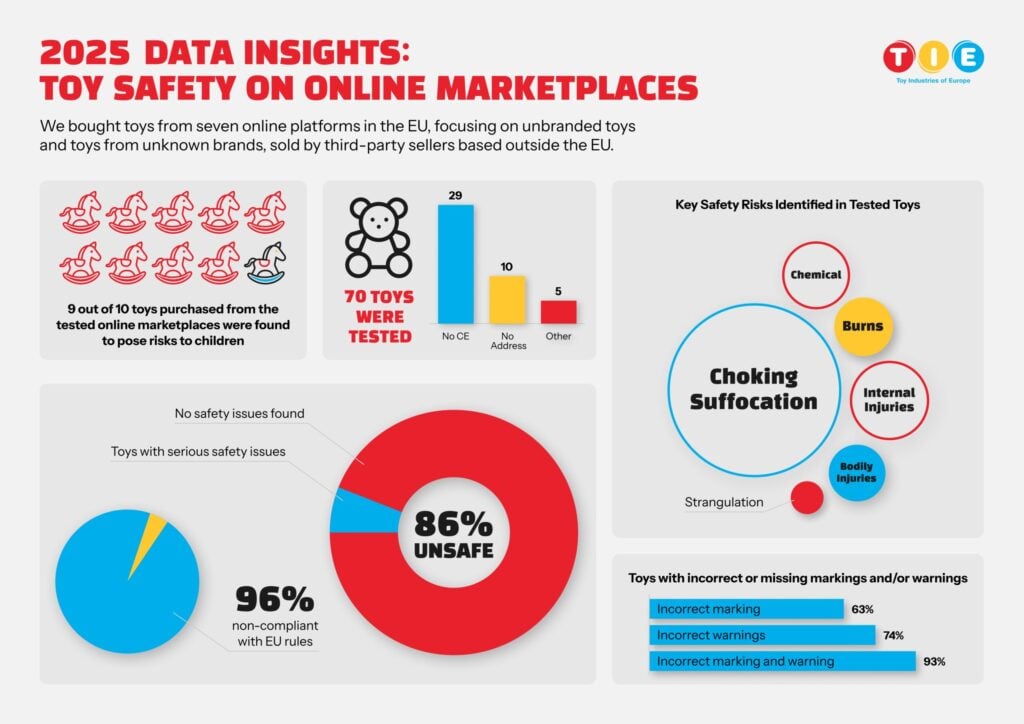 © Toys Industries of Europe
Concrete risks: suffocation, internal burns or poisoning
These toys, often without an identifiable brand, appear in a good position in the recommendations thanks to their very low prices. But behind these “good deals” lie very real physical dangers. In the 2024 and 2025 reports, the laboratories noted:
- Slimes containing boron up to thirteen times above the European limit;
- Soft toys whose eyes come out easily;
- Toys with loose metal parts;
- Magnets that can perforate the intestines if swallowed;
- Accessible button batteries, including lithium batteries, capable of causing internal burns.
The tests also highlighted toys sold the previous year and still online in 2025, sometimes from the same sellers. TIE denounces a simple and massive circumvention of the rules.
“These results demonstrate once again that the European Union rules, which are the strictest in the world on toy safety, can easily be ignored and circumvented when third-party sellers are based outside the EU.”
Why do these dangerous toys abound on marketplaces?
Non-European third-party sellers take advantage of a gray area: they can market unbranded toys, sometimes even without an identified address, on platforms open to all. Controls are difficult there, and traceability is almost non-existent.
For families, the trap is formidable, the toys seem good in every respect. In reality, the majority of them completely escape European requirements, which explains the extent of the defects noted by the tests.
Europe reacts: new rules and digital toy passport
Faced with the explosion of these dangerous toys, the European Union adopted a new regulation on October 14, 2025. This text strengthens limits on chemical substances, including endocrine disruptors, and introduces a “digital passport” for each toy placed on the market. The objective is to facilitate traceability and accelerate withdrawals in the event of risk.
In November 2025, the European Parliament imposed direct responsibility on these sites: they will have to verify the conformity of the toys they offer and quickly withdraw dangerous products throughout the European market.
France has also intensified its controls. In October 2025, the DGCCRF withdrew 28 dangerous products on several platforms, including toys and childcare articles. The National Assembly has finally adopted a tax of 2 euros on small parcels of non-European origin, with a value of less than 150 euros.
But despite these efforts, sellers located outside the EU remain difficult to identify, and certain items regularly reappear online.