
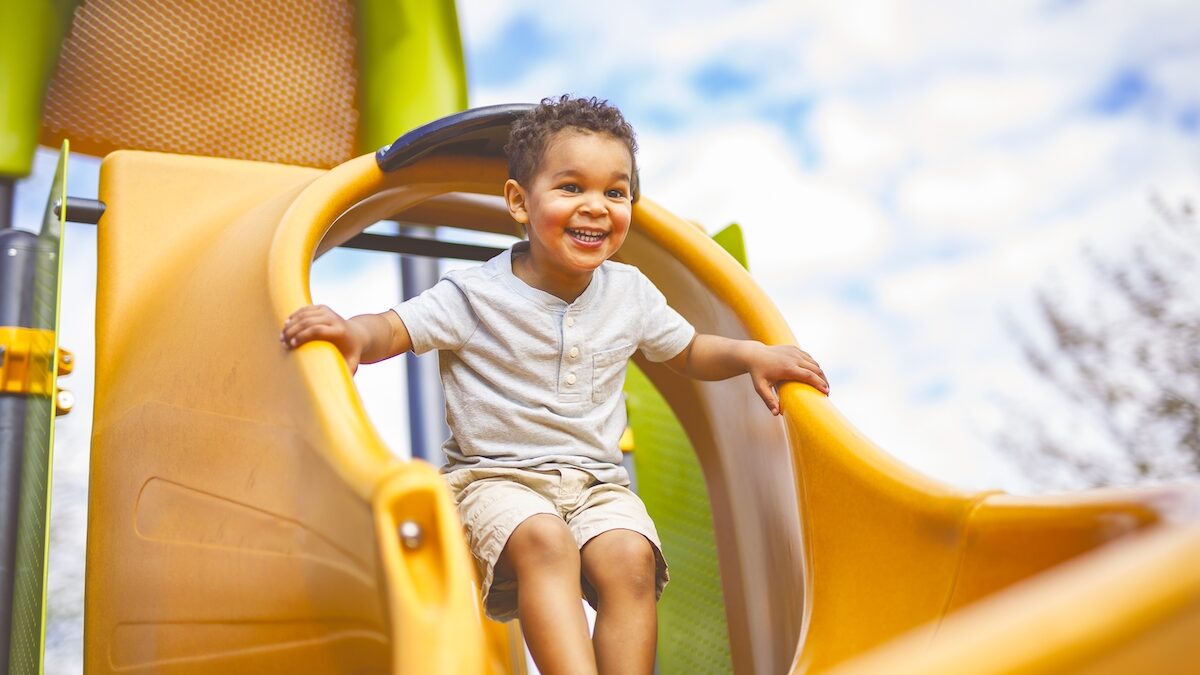
At home, in daycare or kindergarten, little ones’ days are spent increasingly seated, between car journeys, calm games and screens that quickly capture their attention. However, for children to grow well and healthy, the World Health Organization recommends that children under 5 move at least 180 minutes per day“whatever the type and intensity”. From 3 years old, part of this time should be spent on moderate to vigorous activities, such as running, jumping or playing ball.
A new study carried out in the United Kingdom shows that these objectives remain very far from being achieved among the youngest. By following 419 children aged 2 to 4 years old equipped with accelerometers for a week, researchers from the University of Bristol showed that only 23% of them achieved the recommended 180 minutes of daily activity, i.e. three out of four young children who do not move enough. Among 3 to 4 year olds, only 2.4% reach the hour of moderate to vigorous activity recommended by the WHO. An observation which echoes the French situation and which already worries specialists.
Physical activity for young children: recommendations
The British study is based on international recommendations. The WHO recommends at least 3 hours of movement per day for children under 5 years of age, including free play, travel and more energetic activities. The National Health Nutrition Program in France goes in the same direction: until the age of 5, it is advisable to move at least 3 hours a daythen to ensure from the age of 6 at least one hour of daily dynamic physical activity, including intense activities three times a week. This activity is not limited to organized sport, it includes all movements that take the child out of a sedentary lifestyle.
The doctor in sports sciences Sylvain Quinart recalls that “The World Health Organization (WHO) defines physical activity as “any bodily movement that increases energy expenditure compared to that of rest”. The PNNS defines dynamic physical activities as any activity whose intensity can range from moderate to high intensity.. For younger children, these dynamic activities can take very simple forms. “For children and adolescents, dynamic physical activities correspond to active travel (walking, scootering, cycling, etc.), Physical and Sports Education during school hours and all leisure physical activities (park, ball games, family outings, games in the garden, etc.) including sports activities carried out independently or in association“, explains Sylvain Quinart in an interview with the National Nutrition Health Network.
Three out of four young children don’t move enough!
In the work carried out in England and Scotland, 419 preschool children (2 to 4 years old) wore a belt equipped with an accelerometer for a week. The researchers compared their activity levels on days spent in childcare and days at home. As a result, children were on average 15 minutes more active when they attended a daycare or kindergarten. Despite everything, their activity level remained below WHO recommendations for the vast majority of them. The authors speak of a “critical gap” regarding physical activity for toddlers.
The study also highlights marked differences between children. “Girls were significantly less likely to meet these guidelines than boys, while older children were more likely to meet the targets“, add the authors. Another social bias appears: the most disadvantaged children are less active than those from privileged backgrounds when we look at the days spent outside of structures. “On the other hand, when they attended childcare facilities, their activity levels were similar,” note the experts.Although early childhood settings provide a more active environment, most children still do not achieve the levels of movement necessary for healthy growth and development,” laments lead author Dr. Kim Hannam.Our study highlights the need for coordinated strategies between policymakers, educators and families to support physical activity in young children“, she continues, quoted by the University of Bristol. For her colleague Ruth Kipping, “Low levels of physical activity in early childhood can impact children’s healthy development and increase the risk of various chronic diseases in adulthood,” a risk that calls for action without delay.
How to get young children to move more at home and in daycare
In France, the Ministry of Health recalled similar figures: almost three quarters of children and adolescents do not reach the physical activity standards recommended by the WHO, and children have lost around 40% of their cardiovascular capacity in 25 years. For Sylvain Quinart, it is therefore essential to establish active routines very early on: “In the short and medium term, regular physical activity promotes motor development, socialization and psychological development in children and adolescents as well as harmonious growth.. He also underlines, based on the French study “Inverser les Curves”, the clear drop in the maximum aerobic speed of middle school students, linked according to him to the reduction in physical activity.
Local authorities have a structuring role. “The main role played by communities in promoting physical activity among children and adolescents is to encourage the implementation of physical activities during school and extracurricular times by professionals.“, explains Sylvain Quinart. Neighborhood development, safer journeys to school, local facilities and sports projects are all levers.”Communities are key players in promoting physical activity for health. In addition to encouraging young people to move, it is also important to make them aware of the reduction of time spent sitting, the sedentary lifestyle often linked to screens among young people.. On the side of caregivers, the High Authority of Health insists on the importance of systematically addressing the issue in consultation: “The practice of physical activity and the reduction of sedentary behavior should be systematically addressed in consultation with the child and his parents, like the risks linked to tobacco and alcohol consumption in adolescents.. Between parents, health professionals, reception structures and communities, the challenge is shared so that movement once again becomes a daily reflex from the first years of life.
1. How to help a young child move more on a daily basis?
Suggest simple actions. Alternate short motor games and calm moments. Avoid long periods of sitting. Provide a ball, a tunnel or a homemade course. Vary the locations. Motor routines build confidence. A few active minutes, repeated often, effectively stimulate development.
2. What should I do if my child prefers quiet games or screens?
Install stable rules. Limit screens in the morning. Suggest an active activity right after. Give a choice between two physical games. A small success motivates quickly. Children move more when an adult briefly accompanies play, even for five minutes, and then lets them continue on their own.
3. How to involve nursery or kindergarten in physical activity?
Communicate regularly with the team. Ask how the engine times are organized. Suggest simple games outside. Share your child’s needs. Structures easily adapt short routines. Predictable environments keep toddlers safe and encourage them to explore more, especially when they find the same landmarks every day.