
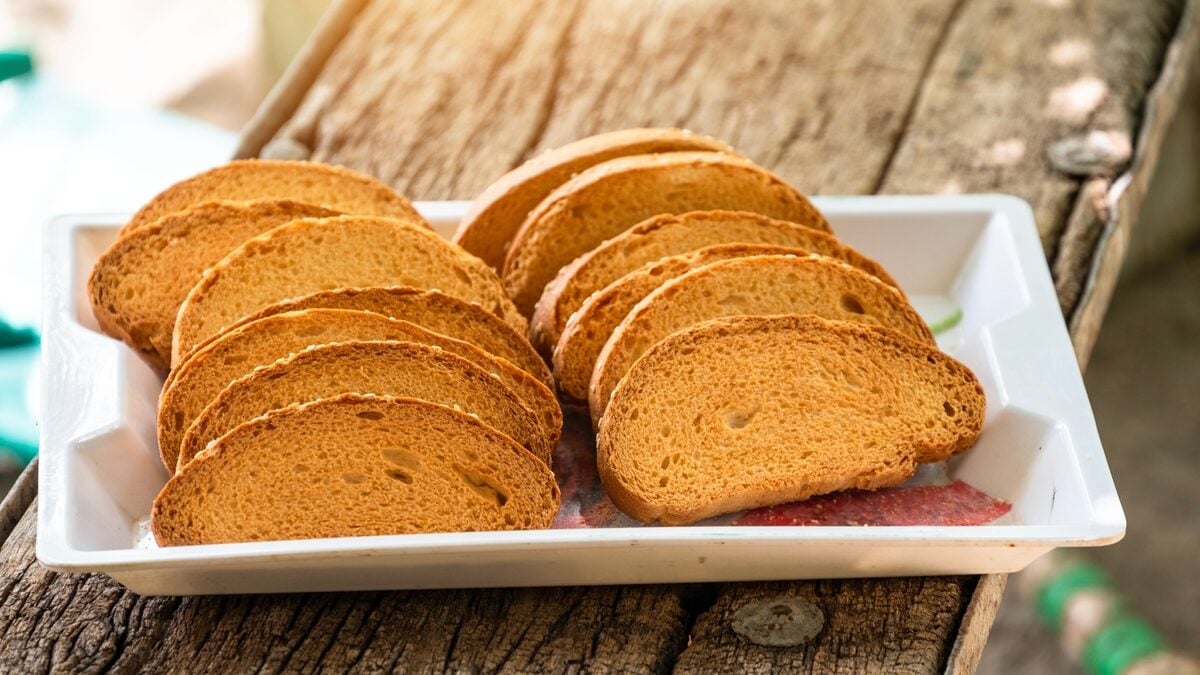
Very appreciated by young and old alike, rusks occupy a special place on the breakfast table. The problem ? Many references, although on the front line at the supermarket, are harmful to your health.
What do the rusks actually contain?
Crispy, rich in fiber and often gluten-free… On paper, rusks seem to tick all the boxes. However, this alternative to white bread hides defects that the labels do not show.
“Made from refined flour, sometimes enriched with fat and sugar, their crispy texture is obtained through double cooking, which slightly increases their energy density. Their glycemic index is often as high, or even higher, than that of white bread, in particular because of the low hydration rate. They therefore do not constitute a much more interesting option from a nutritional point of view.“, warns Julie Boët, dietician-nutritionist.
An opinion also shared by the nutritionist, Dr. Jean-Michel Cohen:
“Rusks and other toasted breads, by their double cooking, make the starch more digestible, but this drying also makes them more caloric. It is therefore necessary to monitor the quantity and quality of the added fats”, advises the nutritionist.
Moreover, if the Nutri-score of these pancakes is extremely variable (ranging from A to E), 35% of them have a score labeled C and 31% D.
So many arguments which should push you to keep your eyes open in the shelves…
The 4 rusks to no longer buy in supermarkets
And in the rusk section, the verdict of the famous nutritionist doctor is clear.
“Pelletier” wheat toast
While the “traditional” image of this package is skillfully worked here, the recipe for these rusks is disappointing.
“A great classic in the section, a great brand which does not at all play the game of a clean formula for the health of regular consumers. Added to this is one of the highest salt levels in this section. Unfortunately, the findings are the same for the other products in the range, whole wheat and brioche”, says the doctor.
Grilletine without added sugar “Pasquier”
A maximum Nutri-Score (A) which does not reflect the poor composition of the product.
“The packaging highlights a product without added sugars with a reassuring Nutri-Score A. However, the second ingredient is maltitol, a mass sweetener (nutritive) which has a sweetening power close to sucrose and provides around 2 kcal/g. It is non-cariogenic, but in excess it can cause digestive disorders! In addition, 9% fat also remains significant”, warns the nutritionist.
Full life rusks without added salt “Heudebert”
Certainly, these rusks contain little salt. But this good point is not enough to convince the famous nutritionist.
“Salt-free rusks are most often a choice linked to a health imperative requiring a limitation of salt consumption. However, here, apart from the reduction in salt, glucose-fructose syrup is the second ingredient, followed by palm oil! We are not convinced by the positive impact on health of regular consumption of this product”, admits the expert.
Original wheat cracker “Lura”
Despite its high cereal content (98%), this product is rich in sugar, salt and palm oil.
“A deceptively light product, containing palm oil and too salty. The extrusion of flour for its manufacture makes it a food with a high glycemic index that is not very filling”, confides the practitioner.
What alternatives should you turn to at the supermarket?
Good news: several rusks stand out on the shelves for their simple recipes without additives or their richness in fiber. These are the following products:
- Wasa fibers;
- Pasquier wholemeal rolls;
- Pasquier whole wheat bread toast;
- Crunchy organic buckwheat toast without added salt Jardin BiO étic.
Of course, if these solutions are not attractive due to their practicality, and help out on busy evenings, wholemeal bread still remains (by far) the best healthy alternative!