
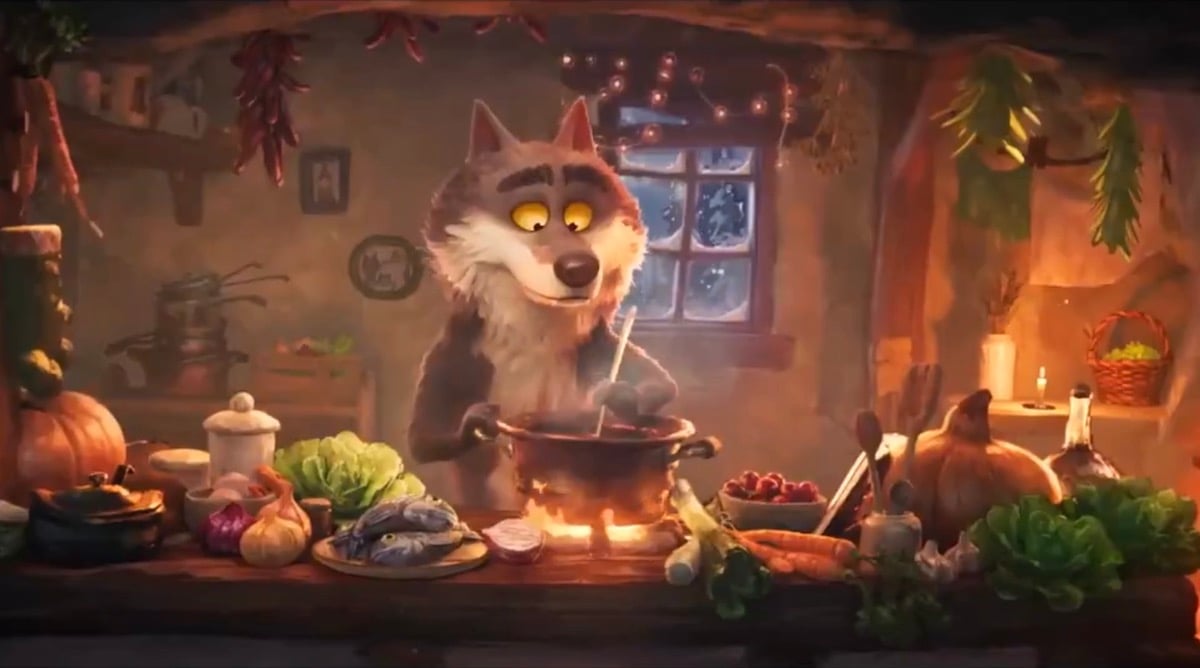
The story is the opposite of the one we usually tell about the big bad wolf. This Intermarché advertisement, broadcast since December 6 on TF1 for the holidays, has won over Internet users on social networks… including abroad.
It opens with a scene of family life celebrating Christmas Eve. A little boy receives a wolf stuffed animal as a gift before becoming frightened. His uncle then decides to tell him a story…
A wolf who changes his eating habits
In an animated film, we discover a wolf, tired of being unloved, who gradually loses his carnivorous instinct to become vegetarian. With the help of a hedgehog trainer, he ends up being accepted by other animals, which until now he was used to eating. Forest animals, snow, wooden chalet, illuminated garlands… all the ingredients of the Christmas story are there, with the song by Claude François, “Le Mal-Aimé” in the background.
On social networks, Internet users praised the staging and the message behind this story, which received several million views in a few days.
The wolf who (really) wanted to become vegetarian
Intermarché’s brand and communications director, Anne Guivarc’h, explained that the brand wanted to “play the emotion card 200%” while promoting “eating better.” The underlying message: put the emphasis on vegetables and berries, rather than on meat consumption.
If the message is attractive, dietitian Claire Trommenschlager recalls the need for rigorous nutritional substitution.
“We must remember the importance of consuming less meat, that’s a fact, but not only for the benefit of vegetables. We cannot replace meat only with vegetables from a nutritional point of view because we simply do not find the proteins we need in vegetables.”
Less meat, yes, but how to replace protein?
To reduce meat without risking a deficiency, it is essential to replace it with quality protein sources, mainly plant-based.
According to Claire Trommenschlager, plant sources of protein are legumes, namely: peas, lentils, chickpeas, split peas, dried beans (red beans, white beans, etc.). She also cites soy, “an excellent source of vegetable proteins and which has the advantage of being a so-called complete source and which contains all the essential amino acids“.
She also recalls the existence of meat substitutes. “All imitation meats, which are generally based on legumes or soya anyway, are also an alternative. However, be careful with the composition of these products: you must ensure that they remain fairly raw and not ultra-processed, with unattractive ingredients.“.
For those who want to become vegetarian (as opposed to vegan), eggs, dairy products and cheese are also good sources of protein.
Red meats and cold meats: healthy limits not to be exceeded
Choosing to eat less meat is not only a question of nutritional balance, but also of preventive health, particularly with regard to red meat and cold cuts. The dietician recalls the official recommendations:
- For red meat: “It is recommended to limit yourself to 500 g per week maximum, as excess can increase the risk of colorectal cancer.
- For cold meats: the recommendation is not to exceed 150 g per week. “This restriction is due to the presence of nitrites, salt and the high fat content in certain products. Even for lean cold cuts such as white ham, it is recommended to limit yourself to this quantity as well.” specifies the specialist;
- White meat: “There is no strict recommendation on frequency, but we advise favoring it. A portion is generally around 100 to 150 g for a meal per person.
How to change your habits gradually?
To make your transition, Claire Trommenschlager advises going in stages. “You can start by modifying your weekly menu and integrating a few vegetarian meals. The key is to go gradually until you reach the objective you have set for yourself.”
Finally, how to include more vegetables in your meals? “You can force yourself to eat raw vegetables every lunchtime, so that you already have a portion of raw vegetables every day. And you can do the same in the evening, with soup, for example.“.
The dietitian’s other tip is to include vegetables in your favorite dishes, for example carrots, mushrooms or eggplant in lasagna.
Finally, his last advice is to compose your meals based on vegetables and not starches, as we are used to. “This allows you to prioritize vegetables in your menu.”she concludes.