
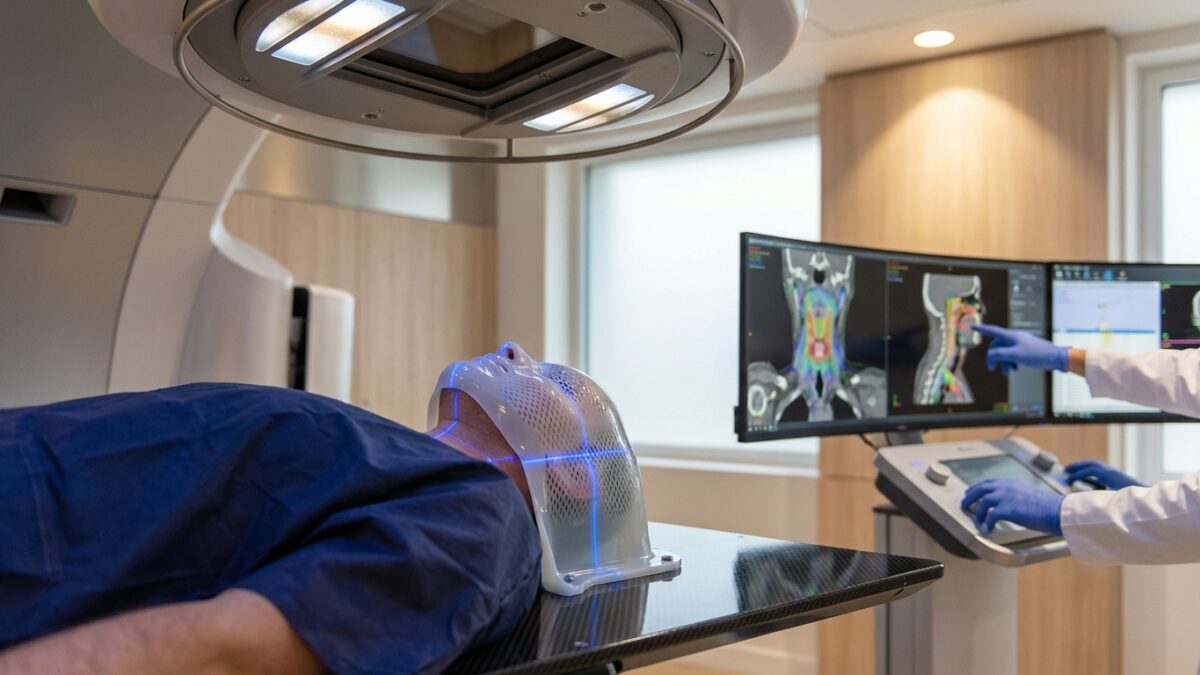
Every year in France, more than 15,000 people learn that they have a
throat cancer. Behind this term, often aggressive tumors, which require surgery, chemotherapy and especially radiotherapy, with sometimes serious after-effects on the voice, diet or taste. Many patients then wonder if a more targeted treatment could really change their life expectancy.
A large clinical study conducted in the United States and published in December 2025 in the journal The Lancet provides part of the answer. In patients with oropharyngeal cancer, a common form of throat cancerso-called “proton” radiotherapy has resulted in more survivors and fewer complications at five years than the current reference technique. Enough to shake up the recommendations in ENT oncology.
Proton therapy: more precise radiotherapy for the throat
Conventional radiotherapy, or intensity-modulated conformal radiotherapy (IMRT), uses photons that pass through the body without stopping. This results in radiation dose entering and exiting the treatment in non-targeted areas and can cause collateral damage to healthy tissue.
Proton therapy, also known as intensity-modulated proton therapy (IMPT), has unique physical and biological properties. According to the Institut Curie, proton therapy uses beams of protons that pass through the body but deposit almost all of their energy exactly at the depth of the tumor, with very little dose beyond or to the sides. This targeting further spares healthy tissues around the throat and salivary glands, while allowing a high dose to be sent to the tumor. In France, three centers offer this
proton therapy.
The large American study made it possible to compare these two techniques in the face of throat cancer. Oropharyngeal cancers, which are cancers of the head and neck, are among the most frequently treated with proton therapy due to their proximity to sensitive organs and tissues, making them a good option for this type of large-scale randomized phase III trial.
A benefit in terms of survival and quality of life
Between 2013 and 2022, 440 adults with stage III or IV oropharyngeal cancer were randomized between two groups: 221 received intensity-modulated proton radiotherapy, 219 received conventional radiotherapy. All received high-dose radiotherapy, combined with chemotherapy or other systemic treatment. At three years, progression-free survival was similar. At five years old, the overall survival reached 90.9% after proton therapy compared to 81.0% after traditional radiotherapywith a statistically significant difference.
Disease control remained equivalent between the two techniques. On the other hand, severe complications decreased with IMPT: fewer deaths linked to treatment (3 versus 6), fewer deaths from progression (9 versus 18), and a less marked drop in lymphocytes, with 76% of severe lymphopenia under IMPT versus 89% under IMRT. Other key findings from this study include that proton-treated patients were less likely to experience difficulty swallowing (34% to 49%), feeding tube dependence (26.8% to 40.2%), dry mouth (33% to 45%), or severe lymphopenia – a decrease in a specific type of white blood cell (76% to 89%) – compared to traditional radiation therapy.
“This is important level 1 evidence demonstrating that proton therapy improves survival and quality of life in these patients and should become the standard of care for advanced cases of oropharyngeal cancer.”said Dr. Steven Frank, executive director of technology and innovation and deputy chief of the Radiation Oncology Strategic Programs Division. “These results demonstrate the benefits of proton therapy for patients with head and neck cancer, and this study could pave the way for increased access to this treatment for patients who may benefit from it.”.
Throat cancer: who can benefit from proton therapy?
The authors emphasize that these results concern advanced stages of oropharynx tumors, in patients in good general condition, treated in specialized centers. “What patients need to understand most of all is that these trials demonstrate beyond doubt that proton therapy and conventional radiotherapy are excellent treatment options.”Frank said. “That said, these results indicate a survival benefit for proton therapy in patients with oropharyngeal cancer, as well as a reduction in high-grade toxicities during treatment and less reliance on tube feeding. These results, combined with other recent data, highlight the importance of continuing to identify patients most likely to benefit from proton therapy, both in the short and long term.”
In practice, access to proton therapy goes through a discussion in a multidisciplinary consultation meeting, after advice from an oncologist or an ENT surgeon. If a benefit is expected, the file is sent to an equipped center, where the patient follows a protocol similar to classic radiotherapy, with 30 to 40 sessions on average. French teams, like those of Gustave Roussy, anticipate a growing role for this technique in certain complex ENT cancers and oropharynx cancers linked to papillomavirus.