
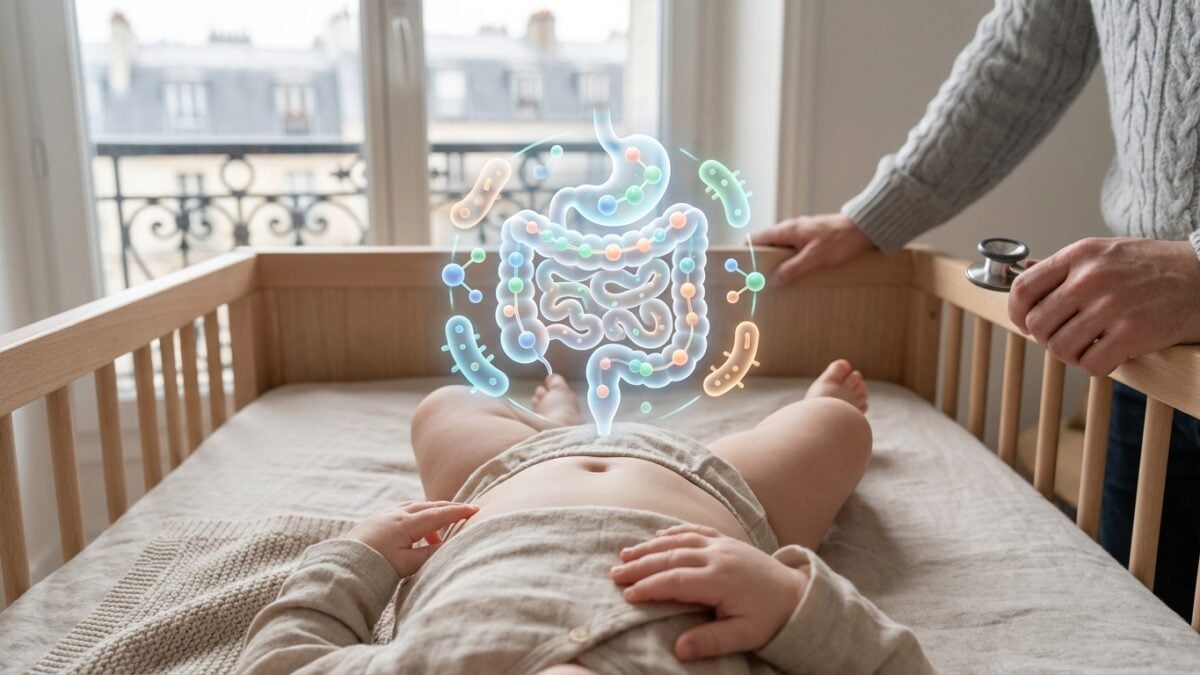
What if protection against allergies started in the very first bacteria that colonize a baby’s gut? While cases of eczema, food allergies andasthma
increase in children, an international team led by the Technical University of Denmark (DTU) has just revealed an unexpected mechanism linked to microbiota of babies.
Their work, published in the journal Nature Microbiologyshows that certain bifidobacteria in the digestive tract produce a small molecule capable of slowing down allergic reactions from the first months of life. In France, where between 7 and 10% of children are asthmatic and nearly one in three have an allergic disease, this type of lead inevitably attracts attention.
Babies’ microbiota: bifidobacteria that act as a brake on allergies
Researchers followed 147 children from birth to age 5 in three cohorts in Sweden, Germany and Australia. By regularly analyzing stools and blood, they mapped the intestinal bacteria. At the same time, blood samples were used to measure IgE antibodies, these markers which signal sensitization to allergens and often announce eczema, rhinitis or asthma.
They then found that infants have a large population of certain bifidobacteria in their intestines from a very young age and benefit from the metabolites produced by these bacteria. In particular, 4-hydroxyphenyl lactate (4-OH-PLA) which appears to reduce the tendency of the immune system to overreact to allergens. In the laboratory, natural concentrations of this molecule caused the production of IgE to drop by around 60%, without modifying the other antibodies.
“The main advance lies in the identification of a specific mechanism capable of suppressing the development of allergic reactions within the immune system in early childhood. If we can translate this knowledge into a preventive strategy – for example, through probiotic supplements or fortified infant formula – this will be a major advance in the fight against allergies and asthma, which currently affect millions of children worldwide” says project leader Susanne Brix Pedersen, professor at DTU Bioengineering.
Childbirth, breastfeeding and everyday germs: what protects certain babies
The scientists then looked for what promotes colonization by these beneficial bacteria. Their data show that vaginal birth gives the newborn about 14 times more chance of acquiring bifidobacteria from its mother than cesarean section, while leaving an important role for the environment.
Two other factors clearly emerge in the first year of life:
- Exclusive breastfeeding during the first months;
- Early contact with other young children, through siblings or daycare.
According to the authors, our modern lifestyle makes these bifidobacteria rarer, which justifies exploring preventive measures for infants who do not acquire them naturally.
Probiotics and targeted infant milks: allergy prevention in sight?
The results suggest that the integration of 4-OH-PLA or probiotic bacteria capable of synthesizing this molecule could represent a new approach to prevent allergies and asthma. Researchers see potential in the creation of food supplements for exclusively breastfed babies or infant formulas enriched with these bifidobacteria or their metabolites. This would allow interventions to be concentrated during the critical phase of the first months of life, when the immune system is developing.
The DTU has filed a patent on the use of 4-OH-PLA against allergies and asthma, and the BEGIN study, carried out at Aarhus University Hospital, will say whether a prevention strategy can be offered to infants in a few years, before possible treatments for already sick patients.