
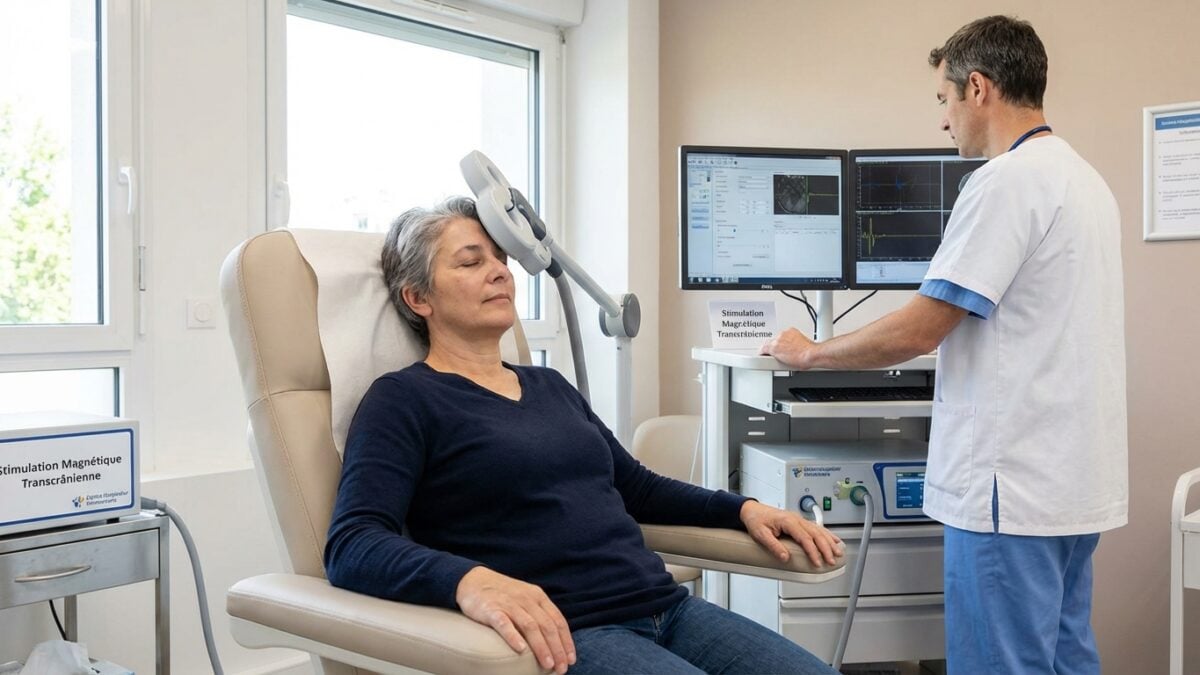
What if a treatment for depression that usually requires six to eight weeks of appointments could take just one week? That’s the hypothesis tested by a UCLA team, which compressed transcranial magnetic stimulation into an intensive five-day protocol for patients with resistant depression.
Transcranial magnetic stimulation: an effective treatment spread over two months
Depression affects approximately 5% of adults worldwide, and more than a third of people with major depressive disorder do not achieve remission despite antidepressants and psychotherapy. For them, the
transcranial magnetic stimulationor TMS, already offers another path, but its treatment schedule remains very heavy: the idea of condensing it into five days changes the situation.
In the standard protocol, transcranial magnetic stimulation involves sending targeted magnetic pulses to an area of the brain linked to mood, the left dorsolateral prefrontal cortex. The patient comes to the clinic once a day, five days a week, for six to eight weeks, or around thirty sessions in total.
Large studies have shown that this treatment significantly reduces symptoms in 60-70% of people, with 25-35% remissions, including after multiple medications have failed. The downside is the daily organization of appointments over almost two months, sometimes impossible for those who work, take care of children or live far from an equipped center.
5×5 Accelerated Protocol: Five Intense Days to Treat Resistant Depression
To ease this burden, UCLA researchers tested an accelerated scheme called the protocol 5×5 : five sessions of transcranial magnetic stimulation per day for five consecutive days, or 25 sessions concentrated over one week. In a retrospective analysis published in the Journal of Affective Disordersthey compared 40 patients who received this 5×5 to 135 patients treated with a classic protocol once a day for six weeks.
In both groups, depressive symptoms significantly decreased, and the researchers did not find a statistically significant difference between the two transcranial magnetic stimulation regimens at the end of treatment. “For patients with treatment-resistant depression, having to come to the clinic every day of the week for at least six weeks can be a real obstacle.” explained Michael Apostol, a doctoral student at UCLA’s Semel Institute for Neuroscience and Human Behavior and lead author of the study.
“This study suggests that it would be possible to offer these same patients significant relief in less than a week by concentrating 25 sessions of transcranial magnetic stimulation (TMS) over just five days.“.
Effects sometimes delayed and a protocol still to be confirmed
Another key finding concerns a subgroup of 5×5 patients who appeared to be unresponsive immediately: Two to four weeks after the five days ended, their depression scores had dropped by an average of 36%. “None of the patients in this study had benefited from multiple trials of antidepressants, although they benefited greatly from the 5×5 treatment. Some patients have to wait a few days or weeks before feeling the benefits, and we encourage them not to give up too quickly if they don’t feel better immediately.“, commented Andrew Leuchter, lead author of the study, professor emeritus and director of the transcranial magnetic stimulation (TMS) service in the Department of Psychiatry and Biobehavioral Sciences at UCLA.
He also states that “We find that the benefits of the 5×5 treatment can be even greater with an additional day or two of treatment after two weeks“.
The team emphasizes that these data, from a non-randomized retrospective analysis, will need to be confirmed by large clinical trials. Alongside their research into accelerated TMS, UCLA scientists are examining new applications, such as obsessive-compulsive disorder and chronic pain, placing TMS at the heart of future brain therapies for mental well-being.
Questioned in the context of a previous article on this technique, Dr Wilfrid Casseron, neurologist in Aix-en-Provence, underlined the interest of this technique but regretted its still very limited access. “Transcranial magnetic stimulation is a technique whose effectiveness has been demonstrated by numerous publications, particularly in neuropathic pain and depression. But unfortunately, it remains poorly accessible, particularly in the private sector, because there is no codification allowing these acts to be rated.