
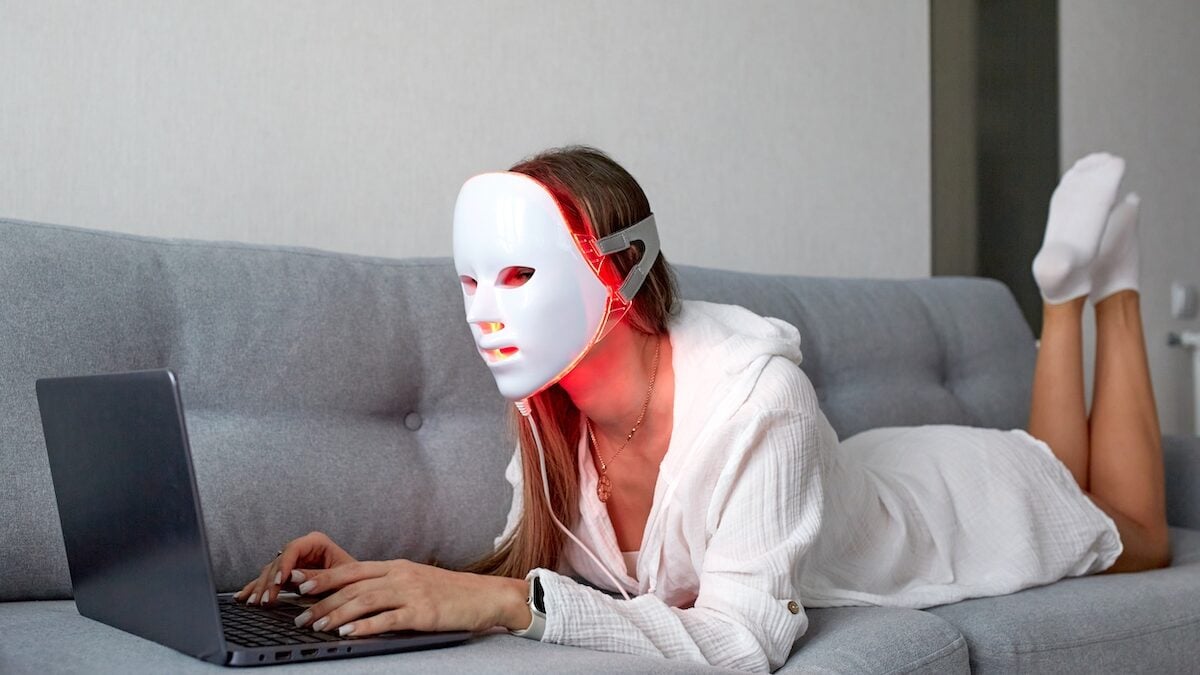
Impossible to miss on social networks: LED masks, also called red light masks, are becoming part of the beauty routines of more and more French people (and giving us funny faces!). Long reserved for medical practices and institutes, these high-tech devices are now sold in mainstream stores and on the internet, riding the rise of “beauty tech”, this technology-enhanced beauty.
Presented as a gentler, less invasive and sometimes less expensive alternative to certain cosmetic procedures, they promise firmer skin, brighter complexion and reduced acne. But behind the marketing hype, what does the science really say? And what can we really expect from it?
Photobiomodulation, the scientific principle behind LEDs
LED lamps used in dermatology rely on a mechanism called photobiomodulation. Concretely, they emit specific wavelengths of cold light which penetrate the skin in order to influence cellular activity, in particular that of fibroblasts, responsible for the production of collagen.
As dermatologist Pauline Tetu explains, the principle depends above all on the wavelengths used:
- There red light (approximately 630 nm) stimulates collagen production and improves skin elasticity;
- There blue light has an antibacterial action, particularly used against acne;
- Infrared is rather associated with healing and skin repair.
“Red light will stimulate the production of collagen, therefore improving the elasticity of the skin. Blue light has more of a bacterial action, useful in particular against acne”, she specifies.
A major gap between consumer masks and medical machines
But be careful, not all LED masks are equal. According to Pauline Tetu, the quality of the device is decisive.
“The most important point is the quality of the machine. There is a huge gap between the masks that you can buy in consumer stores and the machines that you find in medical cabins, where there is a much greater concentration of LEDs.”
In other words, a mask sold at a low price will not necessarily have sufficient power or light density to produce effects comparable to those observed in a dermatological office. Even between models available online, performance can vary considerably.
Real effects… but moderate and progressive
Contrary to certain viral promises, LED masks are not miracle solutions. Their effectiveness, when it exists, takes place over time.
“It is not miraculous, and these are moderate effects. Effectiveness is not based on intensive use, but on the long term”underlines Pauline Tetu. The dermatologist generally recommends use once or twice a week, integrating it into an overall skincare routine.
In practice, the potential benefits are instead:
- A slight improvement in skin elasticity;
- A more even complexion;
- Help in the management of acne (depending on wavelength).
But these results remain slow and vary depending on the individual.
Low risks, but essential precautions
On the risk side, however, it is quite simple. Overall, LEDs are considered safe devices when they are of good quality. Side effects remain rare and generally mild.
” This can cause a little local irritation, possibly a little skin stress, but this is fairly anecdotal.“, summarizes the dermatologist.
However, certain situations require caution:
- Taking photosensitizing medications;
- Skin prone to pigment spots;
- Pregnancy, a period when melasma (mask of pregnancy) is more common.
Indeed, certain wavelengths, notably blue and infrared light, could worsen hyperpigmentation in predisposed people.
A “little extra” to take care of yourself, but not a revolution
The rise of LED masks is part of a broader trend: that of technological beauty, accessible at home. Their success is also based on their marketing positioning as a non-invasive alternative to more expensive techniques.
But for Pauline Tetu, these devices must be put back in their rightful place: “It’s useful, but on condition of having a good quality device. I see it more as a little extra, to integrate into a routine, and also as a moment for yourself.”
In summary, LED masks can provide a slight and progressive benefit, provided they are well chosen and used regularly. They do not replace dermatological treatment, good habits, or targeted in-office care.
Rather than a miracle solution, they therefore appear as a complementary tool: interesting for those who already take care of their skin, but far from keeping all the spectacular promises relayed on social networks.