

Through feedback from 200 agencies in the illiCO Travaux network, this study paints a portrait of women involved at each stage of renovation projects. Far from clichés, it highlights a posture made of projection, rigor and anticipation. A sensitive illustration of couple dynamics faced with a project that involves much more than walls.
When renovation becomes a matter of balance
A construction site does not start with a hammer. It begins with a conversation. Sometimes long, sometimes hesitant. Often loaded with intimate issues: expanding the family, teleworking better, finally feeling at home.
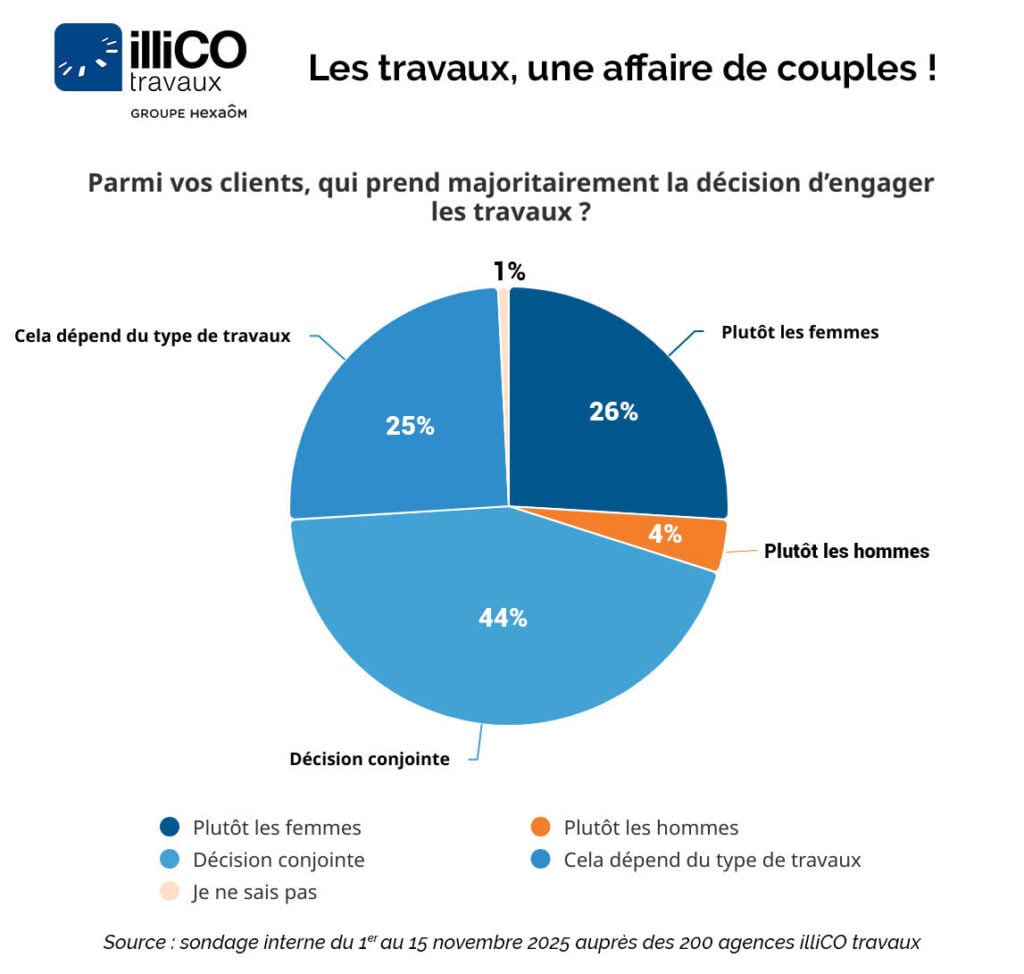
According to the survey carried out by illiCO travails among its franchisees, the decision to undertake work is taken jointly by both members of the couple in 44% of cases. A shared decision, therefore. But in a quarter of situations, agencies observe that the initial impetus comes more from women. In another quarter, everything depends on the nature of the work.
In the field, professionals describe lively, sometimes lively exchanges. “It is essential that both members of the couple are present during the first meeting. This helps align visions and define the project from the start. It happens that everyone has very specific ideas about the work to be carried out… without necessarily agreeing! We sometimes witness real debates. But it must be recognized that, regularly, it is Madame who has the last word“, underlines Maxime Moers, head of the illiCO Travaux Sambre – Avesnois Nord agency.
 © illico works
The presence of women on the first date is not trivial. “If Madame is not present at the first meeting, we know that the project, and therefore the estimate, will need to evolve further during a next meeting during which both members of the couple will be present. It is certain that women have great decision-making power in matters of work.“, adds Ophélie Largeau, head of the illiCO works agency in Thouars.
Behind these observations, a deeper reality: renovation is not just a material investment. It engages a vision of everyday life, a projection of the home. However, this projection, in many cases, is carried with particular acuteness by women.
The sensitive fabric of the living space
Choosing a worktop, a color of paint, a splashback or a floor covering is not trivial. These decisions shape the atmosphere of the home, its comfort, its coherence. The survey reveals that female influence is particularly exerted on this aesthetic dimension: kitchen, bathroom, colors, lighting, layout of living spaces.
These arbitrations sometimes give rise to long discussions. “When I accompany my clients to suppliers to choose materials, I never make another appointment immediately afterwards“, confides Maxime Moers. “This can last five minutes if Mr. and Mrs. have a common crush… but up to two hours if they don’t agree. The discussions continue, everyone argues. And in the vast majority of cases, it is Madame who decides, Monsieur often preferring to give in on these aesthetic aspects…“
 © illico works
This “last word” goes beyond the simple question of taste. It refers to an implicit responsibility: that of creating a place where everyone will feel good, a space that tells something about the couple, the family, its history. Underlying this is the search for harmony. And sometimes, the desire to reconcile functionality, identity and desire.
In this phase, professionals describe women attentive to details, to the circulation of spaces, to light, to the actual use of rooms. So many elements which, combined, transform a house into a home.
Budget: vigilance focused on the future
The other area where their influence is felt is that of the budget. Contrary to certain preconceived ideas, agencies note that women mainly influence downward decisions. Not out of reluctance, but out of concern for optimization.
Prioritization of essential positions, balance between aesthetics and technique, comparison of quotes, identification of negotiation margins: the approach is intended to be methodical. The quotes are reread with precision, questioned, sometimes dissected line by line.
Thierry Abriat summarizes this involvement as follows: “Renovation projects are always life projects in which women play an essential role. They provide a global vision, budgetary requirements and attention to details which secure and structure the entire site. Their role is not secondary: it is central to the success of the work and the construction of a sustainable living environment.“.