
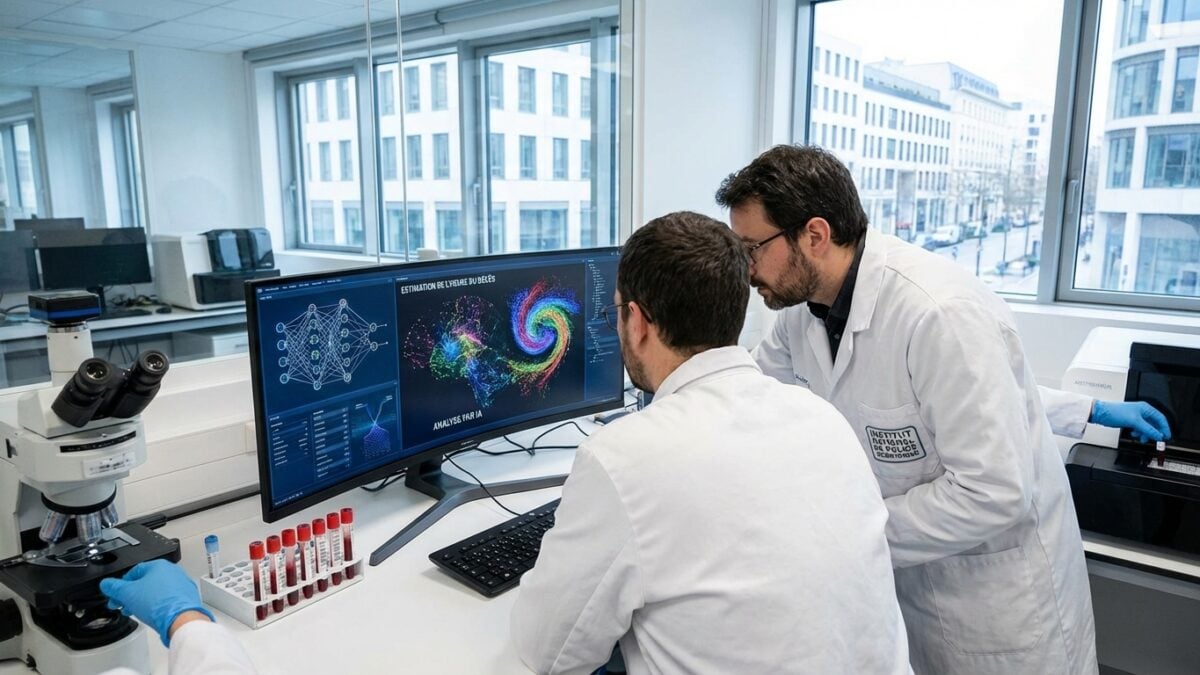
At a crime scene, a few hours can be enough to change an alibi. Gold fix thetime of death remains a puzzle for forensic medicine. In Sweden, a team is testing a artificial intelligence which reads a chemical clock in the blood.
Until now, experts estimated the post-mortem delay due to temperature, stiffness or potassium in the eye. These benchmarks work best in the first 24 to 72 hours. A study published in 2026 in Nature Communications promises to extend this precision.
A chemical clock hidden in blood metabolites
“Death is a strong biological signal“, summarizes Rasmus Magnusson, researcher at Linköping University. When the body stops, organs deteriorate and small molecules in the blood, metabolites, evolve in a predictable way over time. “This allows us to assess the actual time of an individual’s death, which is very important for forensic investigations but also for police work. For example, it must focus its resources on the right witnesses, at the right time in the deceased person’s life.“, underlines Henrik Green, professor of forensic science at the University of Limerick.
Current techniques for estimating time of death, also known as postmortem interval, include measuring body temperature, rigor mortis, and potassium levels in the vitreous body of the eye. However, these approaches become less reliable after several days following death.
The technique developed by researchers at Linköping University, in partnership with the Swedish National Board of Forensic Medicine, relies on the use of artificial intelligence to examine metabolites present in blood samples collected during autopsies.
An AI powered by more than 45,000 real autopsies
In ten years, the Swedish National Board of Forensic Medicine has accumulated blood samples from more than 45,000 autopsies. Among them, 4,876 cases where the post-mortem time was known, between 1 and 67 days, were used to train artificial intelligence, based on the principle of the neural network. “It’s a gold mine of data at the National Board of Forensic Medicine. But we also showed that it is not necessary to have as much data as we thought. A few hundred individuals are enough to build similar models, making our method useful even in laboratories around the world that do not have access to as much data“, explains Rasmus Magnusson.
In total, 97% of cases were between 1 and 13 days after death; over this range, the AI predicts the time between death and autopsy with an average error of
1.45 daysand approximately 1.78 days in a second independent batch of 512 cases. This is a clear improvement over current methods.
“We knew that many external factors affect body decomposition and we were surprised that the signal from metabolites was so strong in predicting postmortem time. The dataset we have today shows the date of death, but we don’t know the time“, explains Elin Nyman.
Towards an ever finer estimate of the time of death
The researchers now want to collect cases where the time of death is precisely known, and then train models that will provide more reliable estimates of the post-mortem interval and also be able to determine at what time of day death occurred. “Forensic evaluations often resemble puzzle-style detective work. This new tool gives us better possibilities to assess how long someone has been dead, even when a lot of time has passed, which is of great importance, especially in more complex cases. We are now working on developing even more precise models“, emphasizes forensic pathologist Carl Söderberg.
The authors report that accuracy decreases for extreme delays and request further validation on other case series.