
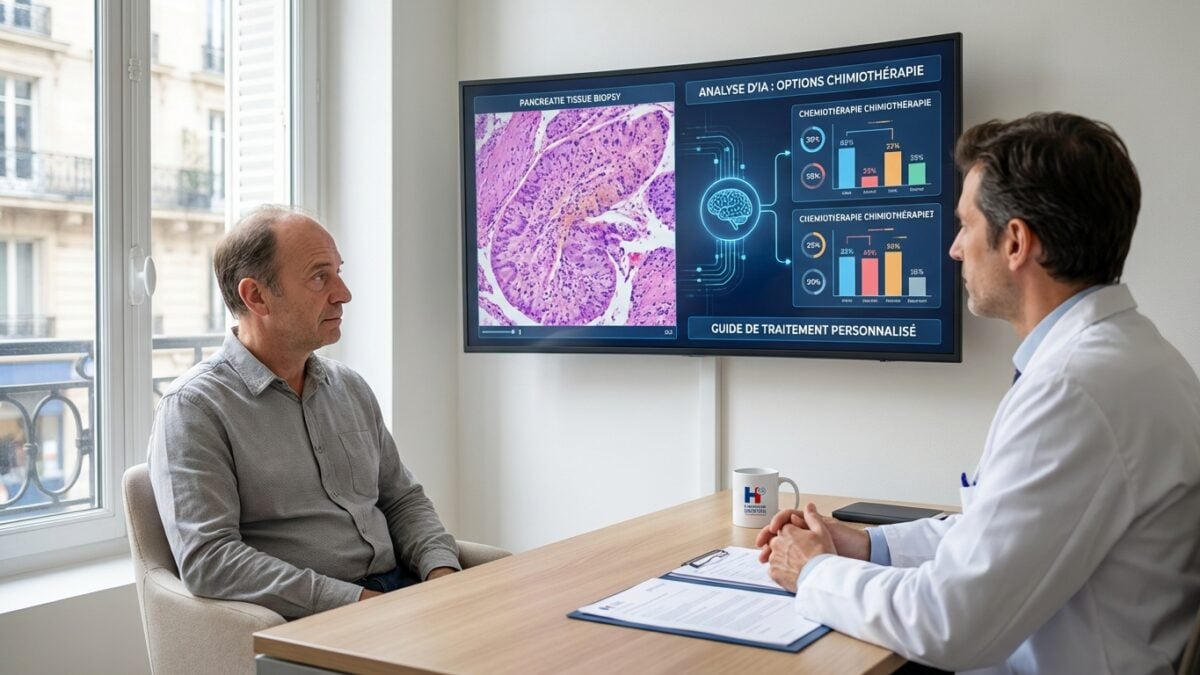
Faced with a
pancreatic cancer often diagnosed too late, oncologists have two major first-line chemotherapies at their disposal, without knowing which will give the best chance for a given patient. A team from Cedars-Sinai, in the United States, has just presented a tool forartificial intelligence (AI) which promises to help decide.
Two heavy chemotherapies, but no obvious choice
Until now, the choice is made mainly on the general condition and experience of the doctor. “Currently, we do not have conclusive data showing which of the two chemotherapy regimens approved for patients with advanced pancreatic cancer is more effective. So we start with one, do our best to quickly assess the patient’s response, and change if necessary“, explained Andrew Hendifar, medical director of the Pancreatic Cancer program at Cedars-Sinai Cancer, quoted by Cedars-Sinai. Enough to make you want to know more.
The most common form, pancreatic ductal adenocarcinoma, remains one of the deadliest cancers, with a median survival of just over one year in a metastatic situation. In the first line, two chemotherapy regimens dominate:
FOLFIRINOXa cocktail of four drugs, and the association gemcitabine plus nab-paclitaxel. The trials did not show a clear preference between the two.
For the patient, first receiving the “bad” chemotherapy means several months of heavy toxicity with limited benefit, then a change of treatment sometimes too late. Biomarkers exist in other cancers to guide these choices, but no such signature was available for the pancreas.
CHAI, the AI that reads biopsy slides to guide chemo
Researchers used digital pathology platform
CHAIfor Computational Histology Artificial Intelligence. The idea: scan the images of microscopic slides containing samples of tumor tissue, colored to highlight the tiniest details of the cells, then let the algorithm analyze, pixel by pixel, the shape of the nuclei, the organization of the cells, the presence of fibrous tissue or immune cells, among more than 30,000 possible characteristics. Almost all patients already have this slide at the time of diagnosis.
Starting from samples of 25,000 patients with pancreatic cancer treated by one or the other protocol, the team constructed a biomarker called GvF, which classifies each tumor into two profiles: F-pref (FOLFIRINOX preference) or G-pref (gemcitabine preference). Thanks to the platform’s artificial intelligence capabilities, it was possible to analyze more than 30,000 different characteristics of tissue samples. The researchers then correlated these tissue characteristics with treatment response to create a predictive tool.
When they tested the tool on data from a large clinical trial using both pancreatic cancer treatment regimens, they found that it was able to accurately predict each patient’s response to the treatment they received.
Months of potential gain, an AI still in clinical validation
In the validation cohort, 57.9% of patients were classified as F-pref and 42.1% as G-pref. Among F-pref, those who actually received FOLFIRINOX-type chemotherapy lived a median of 14.4 months, compared to 11.7 months with a gemcitabine regimen. In G-pref, gemcitabine made it possible to keep the disease under control 9.6 months before switching lines, compared to 7.2 months with FOLFIRINOX – with no difference in overall survival. In total, almost one in two patients would theoretically have received another treatment if AI had been used from the start.
“If the probability that a given treatment will benefit a patient is 50%, which is quite common in oncology, then this tool could prove very useful in helping doctors and patients make decisions.“, Hendifar said. “In addition, we can train this digital tool to choose not only between two available treatments, but also between several”.
The tool has another very concrete advantage. “Unlike most biomarker tests, which require additional tissue or blood collection, this test only requires a digital image of the patient’s biopsy slide. Simply send the image electronically to quickly receive a result indicating the recommended treatment. We don’t just know which treatment is preferable; we also discover how much more effective it is likely to be“, detailed Andrew Hendifar.
The team insists, however: new studies, including other protocols and more fragile patients, remain necessary before routine use, but this type of AI could ultimately be extended to many solid cancers.