
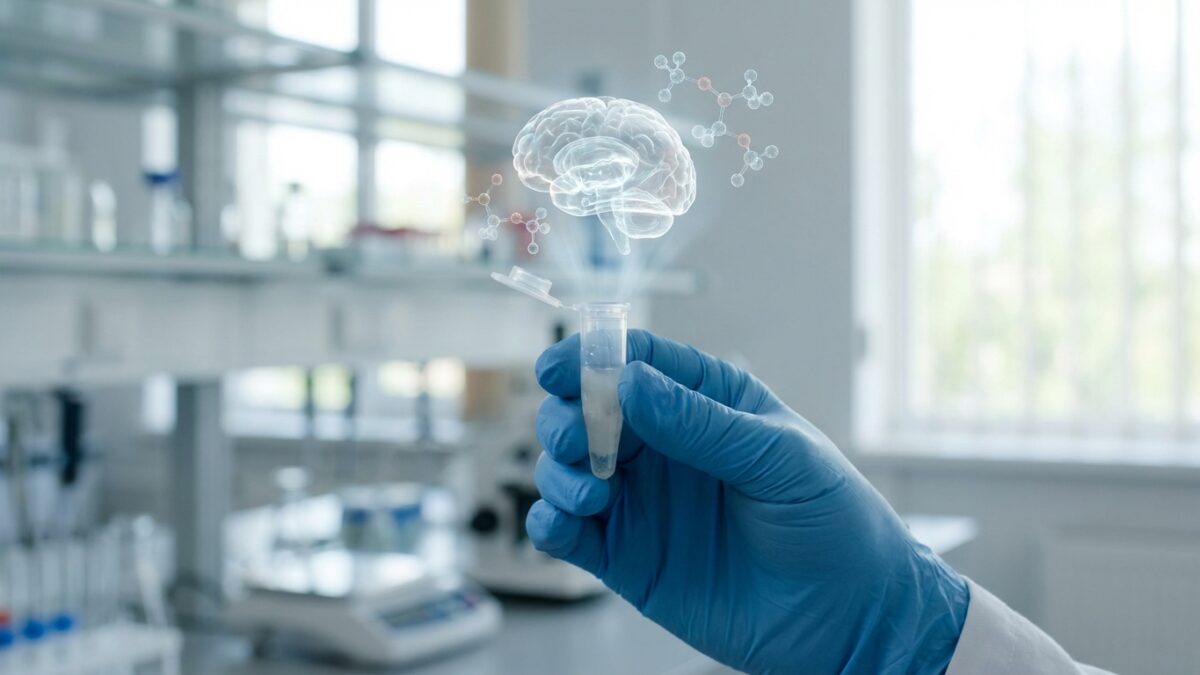
A simple saliva sample to read the state of the brain: the idea sounded like science fiction. However, a Korean team has just demonstrated that one drop is enough to spot early signals ofepilepsyParkinson’s disease or schizophrenia, without blood testing or invasive examination.
This work, published on January 24, 2025 in the journal
Advanced Materialstarget neurological disorders that affect millions of people around the world. Researchers are relying on ultra-sensitive salivary biomarkers of neurological diseases to detect changes invisible to the naked eye in brain proteins. The heart of this new saliva test plot.
A unique saliva test to detect early brain diseases
Behind the project was a team led by Dr. Sung-Gyu Park at the Korea Institute of Materials Science (KIMS), with Korea University and the Catholic University of Korea. Together, they developed a platform called Galvanic Molecular Entrapment (GME) – Surface-Enhanced Raman Spectroscopy (SERS), capable of amplifying the signal of biomolecules by more than a billion times.
Concretely, nanostructures combining gold and copper oxide trap the neuroproteins present in saliva. The laser beam of surface-enhanced Raman spectroscopy then reads their “vibrational levels” of the proteins and distinguishes their normal forms, called monomers, from their forms aggregated into fibrils. The ability to distinguish neurological disorders based on basic pathological indicators – namely structural changes in proteins rather than their total concentration – is a major advance.
The researchers targeted amyloid-β (Aβ42) and tau protein, already known in Alzheimer’s, and showed that these signals remain detectable up to concentrations of around 10^-12 grams per milliliter under controlled conditions.
How a drop of saliva differentiated epilepsy, Parkinson’s and schizophrenia
The study involved 67 saliva samples: 13 patients withepilepsy21 with schizophrenia, 10 with Parkinson’s disease, and 23 healthy volunteers. After centrifugation, 100 microliters of each sample were analyzed by the GME-SERS platform. A statistical model then classified the salivary spectra into healthy or diseased groups.
According to the authors, the method achieves a sensitivity of 93.2%, a specificity of 96.7% and an overall accuracy of 93.9%, with precision reaching up to 98% for some cases.
“A new era is dawning: that of diagnosing brain diseases using a simple saliva analysis, without resorting to costly PET imaging or cerebrospinal fluid analysis. The publication of this work in a leading international journal gives this technology worldwide recognition for its originality and innovative character.” said Dr. Sung-Gyu Park, principal investigator at KIMS.
From the laboratory to future home diagnostic devices
Prof Ho Sang Jung, from Korea University, emphasizes the accessible nature of the method: “Due to its non-invasive and inexpensive nature, this technology has considerable potential for use at home, beyond hospital outpatient services.“.
The team plans to develop portable diagnostic devices based on Raman sensors and promoting technology transfer to companies in the medical and life sciences sectors.