
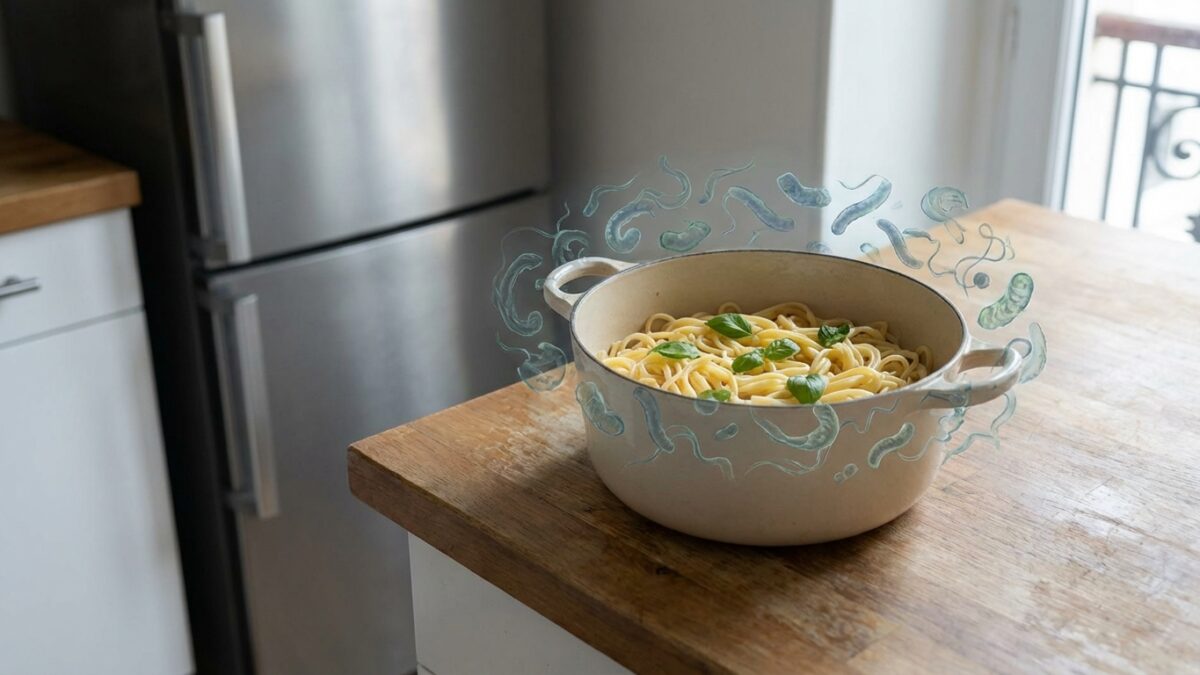
A remainder of cooked pasta forgotten in its saucepan on the work surface, a pasta salad prepared the day before for lunch… These kitchen scenes seem banal. We often tell ourselves that we will refrigerate the dish later, or that a good microwave will take care of everything the next day.
For virologist Océane Sorel, known on Instagram under the nickname “The French Virologist”, this habit nevertheless represents a real open door to bacteria. It warns of a very common conservation error, which promotes the proliferation of spores of Bacillus cereus on our plates. And the rest is not trivial.
Cooked pasta lying around: when the invisible risk sets in
Océane Sorel points out that these bacteria, invisible to the naked eye, naturally populate the environment and are found in many dry foods, such as pasta or rice. Cooking destroys most microbes, but not their spores. When the dish remains at room temperature for a long time, these spores find ideal conditions to wake up.
A tragedy that occurred in 2008 illustrates this scenario. A Belgian student reheated spaghetti that had been left in the open air for five days. Suffering from abdominal pain and nausea, he was found dead the next day. The autopsy revealed necrosis of the liver and the presence of Bacillus cereusas reported by Journal of Clinical Microbiology. An extreme case, but very real.
Bacillus cereus: spores that survive and produce toxins
This bacteria forms spores that are very resistant to heat. After cooking, if the pasta cools slowly between 4°C and 55°C, these spores can germinate, transform into active bacteria and produce toxins. These cause nausea, vomiting, abdominal cramps, sometimes diarrhea, without always changing the smell or taste of the dish. “The real problem is not in batch cooking, but in our bad habits when handling and storing food.“, explains Océane Sorel.
The virologist also insists that other starchy foods are concerned: “Bacillus cereus spores are not limited to just pasta and rice. Other foods such as semolina, reconstituted mousseline puree, rehydrated sachet soups, and many others, may also be affected...” In all cases, poorly cooled and then poorly stored food becomes a discreet vector of food poisoning.
Good reflexes for keeping cooked pasta safe
To limit the risk, Océane Sorel recommends quickly placing dishes based on rice or pasta in the
fridge after cooking, ideally within two hours. The faster the cooling, the less time Bacillus cereus has to produce its toxins. It’s best to transfer the pasta into shallow containers, let cool briefly, then cover and refrigerate.
Once in the refrigerator, these dishes can be consumed within three days. After this time, the risk increases and it becomes prudent to throw away. These same rules apply to batch cooking: preparing several meals in advance is not dangerous if you respect a strict cold chain, for pasta, rice but also semolina or reconstituted purees.