
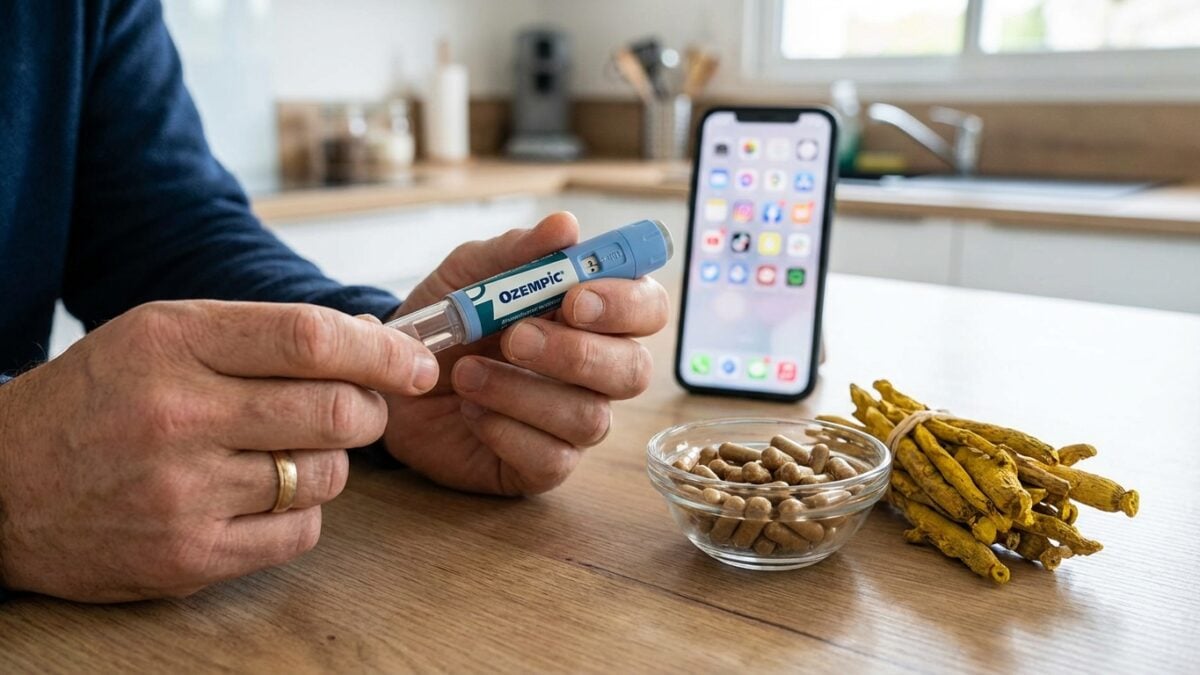
On TikTok, Instagram or health forums,
berberine has become the new star: this plant-based supplement is presented as a “natural Ozempic” which would melt away the pounds and rebalance blood sugar, without the constraints of an injection or prescription.
A vast review published in 2025 in theInternational Journal of Molecular Sciences by the Medical University of Wroclaw nevertheless dismantles this story that is too good to be true. The authors describe a much more complex molecule, whose effect begins in the intestine and strongly depends on the
intestinal microbiota. Reality begins in the gut.
Berberine and Ozempic: two mechanisms that have nothing to do with each other
Ozempic (semaglutide) is an injectable drug, an analogue of a gut hormone (GLP-1). It binds to a specific receptor, reduces appetite, slows stomach emptying and improves blood sugar, with weight loss measured in large clinical trials and standardized dosages.
Berberine is a plant alkaloid sold as
food supplement. Researchers point out that it does not work like a hormonal drug and does not target a single receptor. “Best understood is the microbiotic level and its impact on the intestinal barrier and inflammatory processes,” says Dr. Anna Duda‑Madej.Therefore, the gut-brain axis remains the most promising, but its clinical significance still requires much research.,” she adds.
A microbiota modulator, not a “universal metabolic supplement”
In the review, the Polish team describes mainly a local action, with little passage into the blood, but intense contact with the intestinal wall. In practice, this means that berberine does not directly “control” metabolism, but rather modulates the biological conditions in which it occurs. The bacteria transform the molecule into bioactive derivatives, capable of modifying inflammation, the permeability of the mucosa and the composition of the intestinal flora.
The effects therefore vary enormously depending on the person. “Berberine does not act independently of the intestinal microbiota, and its effects largely depend on the composition and functioning of the latter.” notes the researcher. After antibiotic therapy or in the event of dysbiosis, the response may be weaker or delayed, sometimes mainly with an anti-inflammatory effect, sometimes more with an action on the intestinal barrier or on certain metabolic parameters. This explains why berberine does not act in the same way in everyone. Nothing to do with the powerful and predictable effect of a GLP-1 agonist.
Slimming promises with a low level of proof but very real risks
The author is categorical about the marketing discourse: “The term ‘universal metabolic supplement’ is completely inaccurate,” she emphasizes. “A more appropriate term would be: modulator of the microbiota-intestinal-immune system axis“, notes Dr. Anna Duda-Madej. The solid data mainly concerns experimental models of colitis and inflammatory bowel diseases, and not weight loss trials comparable to those of Ozempic.
On the safety side, the warning is just as clear. “According to information provided by the National Center for Complementary and Integrative Health, berberine use is primarily associated with adverse effects on the gastrointestinal tract, such as nausea, abdominal pain, bloating, constipation, and diarrhea. It is important to note that berberine interacts with many drugs by inhibiting the enzymes involved in their metabolism, including cyclosporine, metformin, antidiabetic drugs, anticoagulants and sedatives. Additionally, it can be dangerous during pregnancy and breastfeeding, as it can affect the fetus or infant, leading to bilirubin buildup and risk of brain damage. For this reason, berberine should be used with great caution and only under medical supervision.“, underlines the author.
From a scientific point of view, berberine is therefore not the equivalent of a pharmacological treatment and allows us to better understand the importance of the microbiota, at the level of overall metabolism.