

Motor neuron diseases – of which the famous Charcot disease (or amyotrophic lateral sclerosis) represents 90% of cases in adults – are among the most formidable pathologies in neurology. They cause progressive and fatal paralysis, with death generally occurring between 2 and 5 years after diagnosis.
To better understand the evolution of these poorly understood diseases without curative treatment, Public Health France has updated its surveillance data for the period 2010-2021 across the entire territory (excluding Mayotte).
National stability
The first lesson from this report is a relative stability of the figures: around 2,500 new diagnoses and 1,840 deaths are recorded each year. These pathologies mainly affect men aged 70 to 79.
As stated by Dr Wilfrid Casseron, neurologist interviewed by True Medical“Public Health France publishes indicators showing that these incurable diseases remain rare“.
If the overall incidence is stable, around 3 to 3.5 cases per 100,000 inhabitants – which is close to European rates – the analysis however reveals a non-homogeneous geographical distribution.
Brittany, Occitanie, Auvergne: the three red zones
It is by zooming in on the regional and departmental levels that the study reveals striking disparities. While Guyana has the lowest rate (1.06 cases per 100,000 inhabitants), Brittany peaks at 3.77. Three areas of “over-incidence” have been formally identified:
- The Nîmes/Avignon/Alès sector (557 cases observed against 449 expected);
- The Guingamp-Lorient axis (520 cases against 417 expected);
- The Clermont-Ferrand area (315 cases against 241 expected).
Areas of specific excess mortality also appear around Saint-Étienne and the Lorient/Vannes axis. These differences do not seem to be linked to better local screening, because, as SPF points out, the completeness of the data is excellent due to the burden of care.
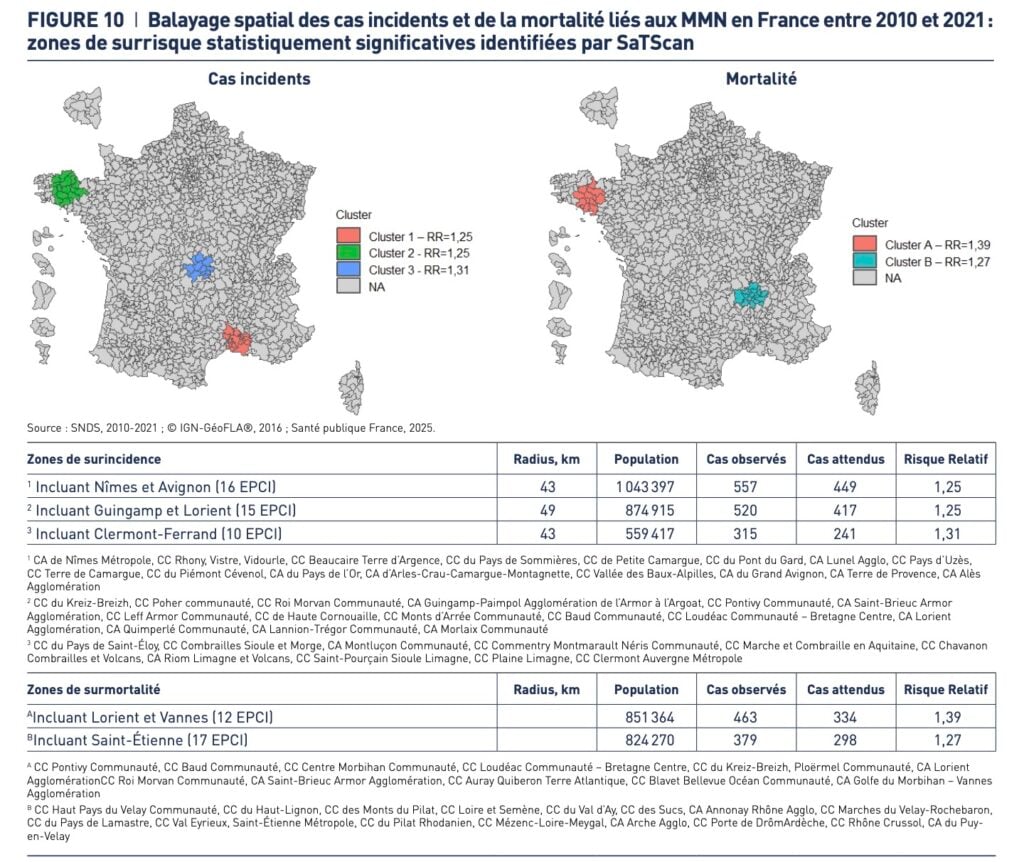 © Frequency of motor neuron diseases (including Amyotrophic Lateral Sclerosis) and territorial disparities in France. Data 2010-2021
The enigma of causes: tobacco, shellfish and the environment
If 10% of cases are of genetic origin, the remaining 90% remain a challenge for research. The study mentions various risk factors, but Dr Casseron sheds specific light on certain local and behavioral avenues.
“It seems that fairly solid studies show that smoking could be a probable risk factor in motor neurone diseases. Likewise, the cyanotoxin BMAA was suspected in the cases occurring in Hérault, around the Thau pond. The Montpellier team has also published work suggesting that the bioconcentration of this toxin in certain shellfish could be partly responsible for the aggregation of certain cases.”
He also recalls that certain profiles, such as high-level athletes or farmers exposed to pesticides, sometimes present groupings, possibly linked to complex interactions. “There are probably epigenetic interactions: certain genes can see their expression modulated by the environment. But for ALS, it is almost impossible to precisely trace a patient’s exposure over the last ten years to establish a direct causal link.
Hypotheses cited by the Public Health France document: “Several hypotheses are put forward in the literature, in particular the influence of certain environmental or professional factors (exposure to pesticides, heavy metals including lead, atmospheric pollution, formaldehyde). ALS is possibly the result of an interaction between the genome and the exposome with a gene-time-environment hypothesis. Experts are not returning to the hypothesis which linked a toxic mushroom with several cases in Savoie.
A call for scientific caution
Despite the highlighting of these “clusters”, Dr. Casseron invites residents of these regions not to give in to worry.
“We must exercise caution. Although it is not impossible, the identification of environmental factors in a scientific manner remains extremely complex. We cannot draw definitive conclusions in terms of immediate regionalization; living in Brittany does not mean that we run a systematically higher risk” he concludes.