
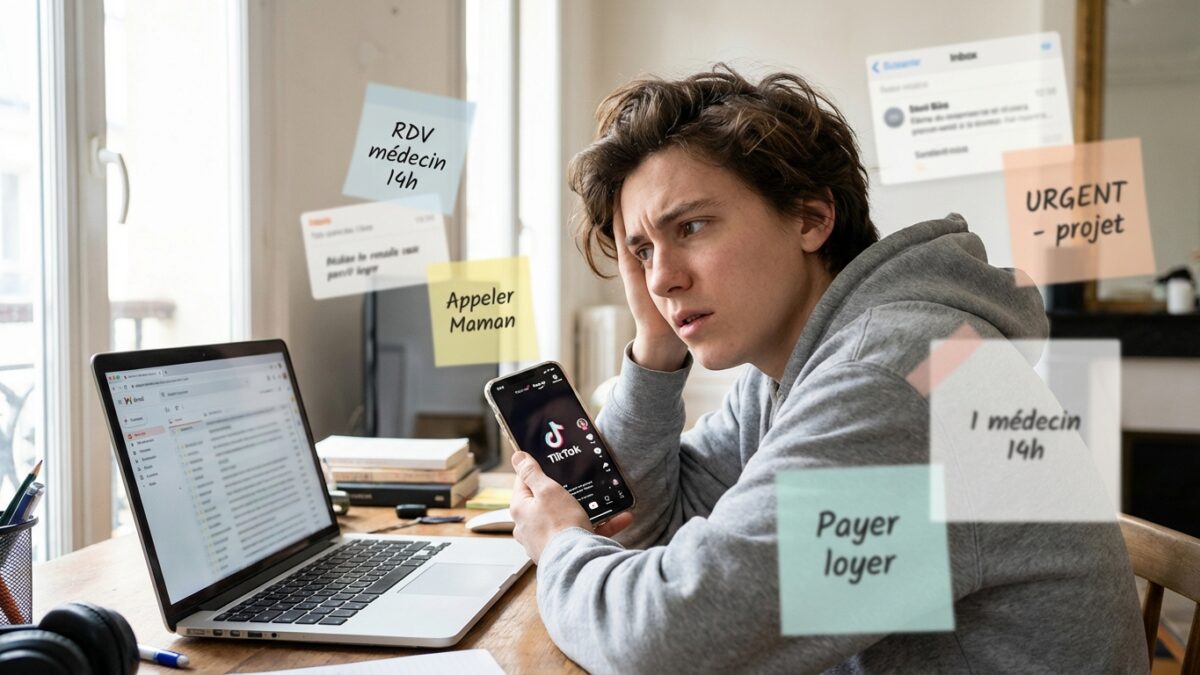
Between fear of missing information, compulsive use and saturated mind, researchers describe a subtle but potentially harmful sequence. An alert without catastrophism, which invites us to look at our digital habits differently.
When the screen captures everything… and lets the rest slip away
It’s a diffuse, almost banal feeling. A forgotten appointment, a poorly remembered instruction, difficulty staying focused for more than a few minutes. For some TikTok users, these little everyday “failures” seem to be multiplying.
Far from being a simple impression, this phenomenon caught the attention of researchers at the University of Macau. Their study, published in Addictive Behaviors Reportshighlights a link between problematic use of the platform and what scientists call “daily cognitive errors” — in other words, those moments when attention slips.
But behind these oversights, another factor enters the equation: a form of anxiety well known to social network users, the fear of missing out.
The fear of failing, an invisible driver of our behavior
Researchers are interested in a concept that is now widely documented:
FoMO (Fear of Missing Out), this persistent fear of being excluded from information, an event or a social interaction. They distinguish two forms. On the one hand, the “FoMO trait”, an enduring disposition in certain people. On the other, the “FoMO state”, which arises in specific contexts — typically when an avalanche of notifications or content stimulates attention.
In this environment, TikTok acts as an amplifier. The continuous flow of videos, designed to capture attention without interruption, nourishes this feeling of urgency: watch, don’t stop, don’t miss anything.
Professor Christian Montag sums up the issue cautiously:
“Currently, there is debate around the world about whether social media should be banned for young people, and one reason is the supposed addictive nature of these social media products (note that ‘social media addiction’ is not officially recognized in the WHO ICD-11 at this time)”.
An important perspective: if the idea of addiction is debated, certain uses can nevertheless become invasive.
A study which highlights a worrying sequence
To explore these connections, researchers analyzed the responses of 720 German adult TikTok users, with an average age of 38.
Three dimensions were evaluated:
- The level of FoMO;
- The frequency of cognitive errors (forgetting, distractions);
- And the degree of problematic use of TikTok, described as “TikTok Use Disorder”.
The results paint a consistent pattern.
- First, the higher the level of FoMO participants present, the more cognitive errors they report: forgetting an appointment, missing important information, or not noticing a detail in the environment;
- Then, these same individuals more often report use of TikTok that is difficult to control — use that encroaches on daily obligations;
- Finally, this problematic usage behavior appears to be a key intermediary: it would link social anxiety and cognitive failures.
In other words, it is not only anxiety that affects attention, but also the way in which it pushes us to consume content.
A fragmented brain, between overload and dispersion
Behind these results, a hypothesis emerges: that of fragmented attention. The very way TikTok works – short videos, rapid succession, constant stimulation – requires the brain in an intense but fragmented way. Over time, the ability to maintain sustained attention could erode.
This phenomenon is not new in neuroscience. But here it takes on a particular dimension: it is part of a loop where anxiety, compulsive use and cognitive fatigue feed each other.
However, researchers remain measured. The study is based on declarative data, collected at a given time. It is impossible, at this stage, to assert a cause and effect relationship. Perhaps people already prone to attention deficit disorder or anxiety are also those who use TikTok most intensively. Or perhaps intensive use accentuates these fragilities. The reality undoubtedly lies at the crossroads of the two.
Rethinking our relationship with attention, without giving in to alarmism
What this study highlights is not an immediate danger, but a silent dynamic. A way in which our digital habits can, gradually, influence our way of thinking, of memorizing, of being present.
Above all, it invites us to take a step back. Not to demonize social networks, but to question their place in our lives — and the way in which they respond, sometimes too effectively, to our vulnerabilities.
Because behind the statistics, there are very concrete experiences: those of individuals who feel overwhelmed, distracted, sometimes mentally exhausted without always understanding the reason.
There remains an underlying question: in a world saturated with stimuli, how can we preserve full, stable attention capable of settling? An intimate question, but also deeply collective, as these uses become the norm.