
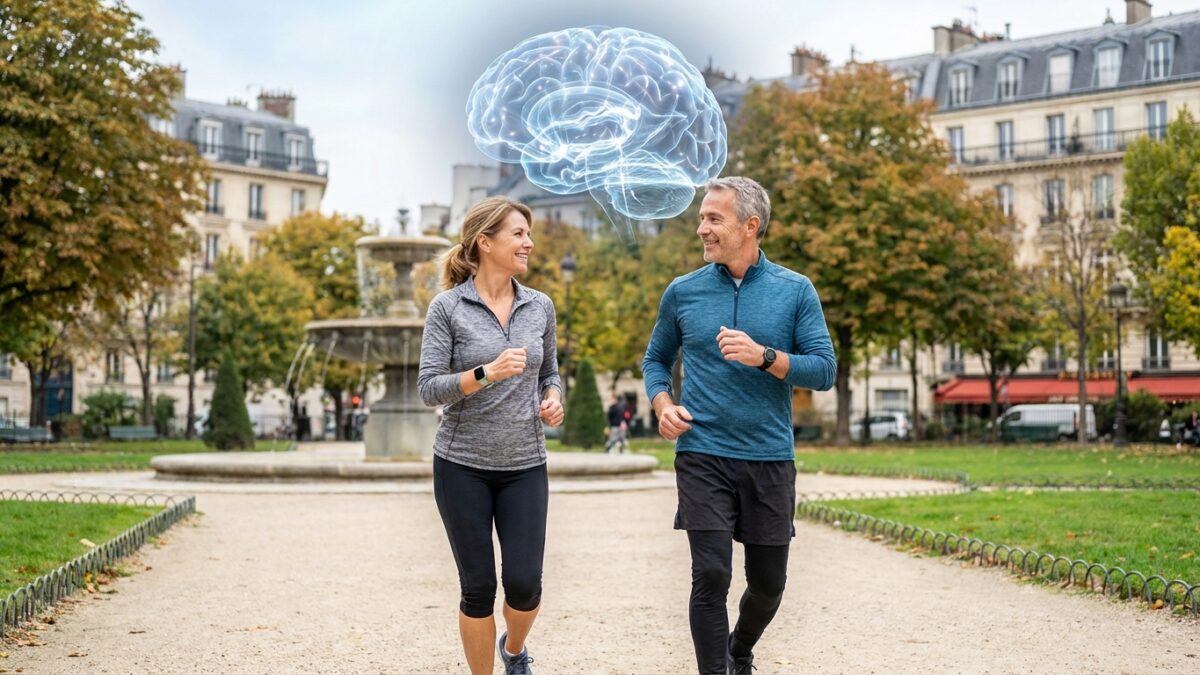
Evidence is accumulating: moving not only helps protect the heart, it also helps the brain age well. For a long time, we mainly looked at the total number of steps or the duration of exercise over the week. A recent study suggests that these indicators only tell part of the story.
The authors looked at the precise structure of the sessions: duration, frequency, walking speed. Their goal was to understand what types ofphysical activity
help improve brain health.
Frequent sessions for a healthier brain
Researchers followed 279 adults aged 40 to 91, all dementia-free, who wore a Fitbit bracelet for 30 consecutive days. An algorithm made it possible to isolate intentional sessions: at least 10 minutes of walking at 40 steps per minute or more. Those who completed at least one of these sessions were classified as “exercising”, the others as “non-exercising”.
To assess the effect of physical activity, researchers performed high-precision MRI scans to examine the size of certain areas of the brain and the condition of white matter. They also invited participants to engage in cognitive games aimed at assessing their memory, mental processing speed and problem-solving skills.
MRI images showed that participants with more frequent and faster sessions had less hyper-intensities of white mattermarker of damage to small cerebral vessels. They also obtained better scores on tests of executive functions. These links appeared clearer among women. Among non-exercisers (21%), a higher number of daily steps remained associated with more favorable brain health.
What a short but sustained session represents in real life
In this study, a session therefore corresponded to at least 10 minutes at 40 steps per minute or more. This threshold remains modest; in practice, a really brisk walk far exceeds this pace. The interest of this definition is above all to identify, thanks to connected watches, the moments when we go from a simple standing position to a continuous and intentional movement: a few examples speak for themselves.
- Walk briskly for at least 10 minutes to reach an appointment;
- Take the stairs rather than the elevator on several floors;
- Cycling in town or uphill, without breaks, for around ten minutes.
How these sustained efforts affect executive functions
Executive functions include the ability to plan, change strategy, stay focused or slow down an impulse. They are based on fronto-parietal networks and the
white matteroften described as the information superhighways of the brain. Numerous meta-analyses published since 2014 show that regular aerobic training improves this performance, but also working memory and processing speed.
The work collected by this team suggests several mechanisms underlying the improvement in brain health of active seniors: an increase in cerebral blood flow, better vessel health, a reduction in inflammation and a release of growth factors favorable to neuronal plasticity.
In this context, the key result of the Fitbit study makes sense: shorter and more frequent sessions of sustained physical activity would be more effective in preserving the cognitive health of older people. Furthermore, any increase in activity level, even modest, remains better than inactivity in protecting your brain.