
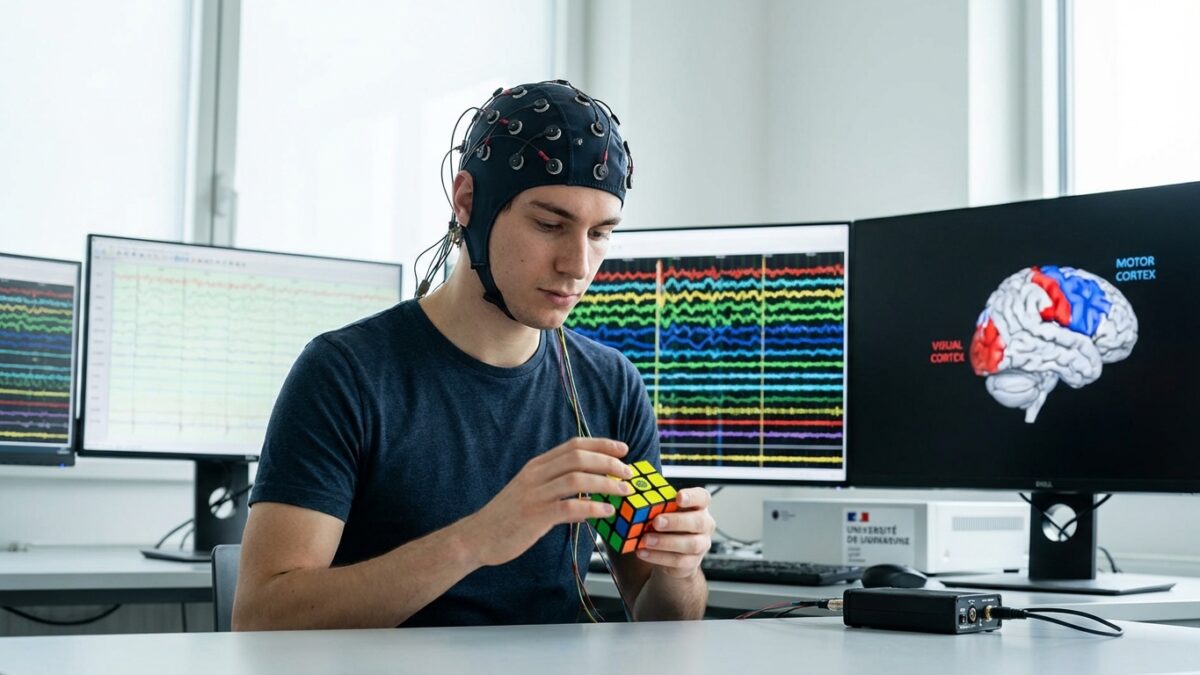
Watch a champion Rubik’s Cube in competition is something disconcerting: the fingers spin, the cube clicks, and in just a few seconds everything is aligned, whereas a beginner still struggles to memorize a first face. What exactly do these brain waves during this lightning performance?
Why do you walk slower when texting?
Humans often have difficulty performing complex mental calculations while performing precise physical movements. For example, someone who writes messages on their cell phone tends to slow down their walking because their brain is unable to effectively allocate its resources to both thinking and moving at the same time. But then what do the champions of Rubik’s Cube do, an activity that involves reflection and fine dexterity?
“Solving a Rubik’s Cube is a very difficult task, because it requires analyzing color combinations, memorizing them and anticipating their future configuration in one or more movements. When a Rubik’s Cube player gets stuck and can’t move the pieces, he thinks hard about what to do next. Rubik’s Cube athletes manage to solve the puzzle in less than a minute; their brain therefore works differently since they are able to evaluate And to move the pieces simultaneously, very quickly”.
A team from Aalborg University attempted to answer this question by recording the brain activity of 13 young men, all seasoned speedcubers capable of solving a cube in around 17 seconds, with an average of almost six years of experience. Their work, published in 2025 in the journal Experimental Brain Researchreserves a major surprise on the way in which these brains organize themselves.
Brain waves and the Rubik’s Cube: when planning is almost like taking action
The researchers fitted participants with an electroencephalography cap to track their brain waves during several tasks: actual solving of the cube, mental planning during the 15 seconds of inspection allowed in competition, but also separate tests of planning, spatial vision, working memory and fine motor skills. The idea was to dissect, brick by brick, the skills recruited by speedcubing.
“Solving the Rubik’s Cube requires strong engagement of brain areas that control memory, action planning, visuospatial manipulation of objects and fine motor skills” explained Anderson Souza Oliveira, study author and associate professor of biomechanics at Aalborg University, in an interview with PsyPost.
The study was based on four tasks designed to explore different cognitive functions. Participants had to first reproduce an image from colored rings, assessing their planning skills, then estimate angles and positions of lines to measure their visuospatial perception. A memory game then tested their working memory, while a sequence of movements on a Rubik’s Cube assessed fine motor skills. Secondly, a central test required them to observe a mixed Rubik’s Cube for 15 seconds in order to prepare a strategy, before solving it as quickly as possible.
What brain waves reveal about the mental mechanics of speedcubers
Looking at the signals in the different frequency bands, the team observed something unexpected: the brain wave profile remained almost identical when the athletes planned in their heads and when they executed the solution with their fingers.
The recordings show strong synchronization between regions involved in working memory, action planning, spatial vision and precise hand control. Alpha and beta activity remained higher during the cube than during a planning task alone, indicating increased load when quick thinking and quick gestures must combine.
Certain connections stand out clearly. Plus the power of the waves delta in the occipital lobe, dedicated to visual processing, is higher during execution, the faster the cubers, with a correlation of around 0.71. Performance on the angle vision (JLAP) and planning tests also follows these slow waves in the frontal and temporal lobes.
A brain remodeled by training, but still full of gray areas
For Anderson Souza Oliveira, this result says a lot about brain adaptation. “The main surprise is that the brain regions function very similarly when athletes mentally memorize the cube or when they physically solve the puzzle. It seems that these athletes are so adapted to solving the cube that they no longer need the ‘physical’ cube. They can solve it in their mind and simply repeat the movements on the real object“, he summarizes.
The study remains cautious: it only concerns 13 men, without beginner players to compare. It nevertheless reveals that there is still much to learn about this brain plasticity.
Understanding these neurocognitive bases could help develop training programs optimized for activities requiring advanced cognitive and motor skills. It could also help design cognitive exercises suitable for children with limited brain development or neurological disorders, with the aim of improving their mental abilities.