
Carried out among more than 1,000 women aged 15 to 29, this Ifop study for pleasurespace draws the nuanced portrait of a Gen Z who is shaking up the codes… without yet succeeding in fully freeing themselves from them.
A generation that redefines the rules of desire
It often starts with a question, launched like a game on social networks: “What is your bodycount?“. Behind this apparent lightness lies a brutal exposure of the intimate, an implicit judgment which reminds us of the extent to which female sexuality remains scrutinized, evaluated, commented on. And yet, something has changed.
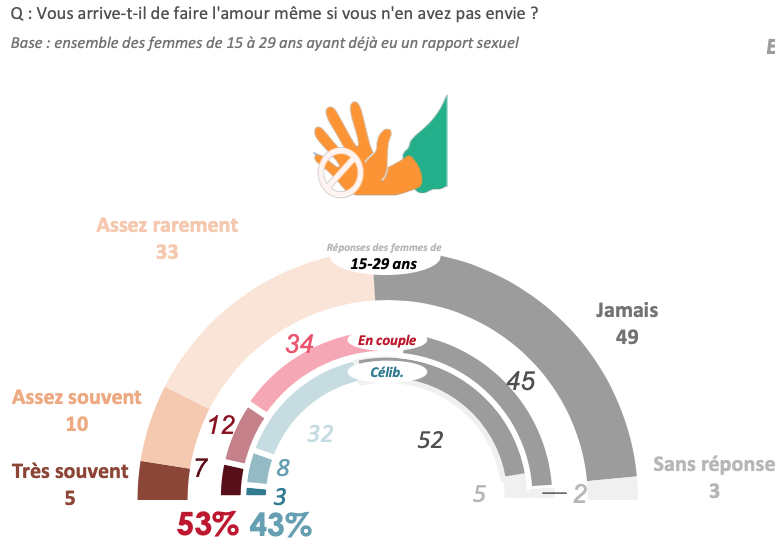
Nine years after the shock wave of #MeToo, young women seem to be regaining control over their bodies and their consent. The study is clear: 48% of women aged 18 to 24 say they have already had sex without wanting to, compared to 65% twenty years ago. A significant drop which reflects a profound evolution in the relationship to consent.
 © Ifop survey
Another shift: the very definition of sexuality. Only 23% of women aged 25 to 29 believe today that “sexual intercourse means that there is penetration”, which is half as many as thirty years ago. The traditional model, centered on penetration, is wavering.
Even the link between femininity and motherhood is changing. The idea that “a woman can truly succeed in life without having children” is now widely accepted, increasing from 53% in 1990 to 87% in 2026 among those under 25.
For François Kraus, director of the Ifop “Gender, sexualities and sexual health” division, the movement is real but still incomplete: “The revolution in the relationship to consent is clearly infusing mentalities but the deconstruction of the concept of ‘conjugal duty’ remains slow and unfinished. Submission to the desires of one’s partner is far from having disappeared, including among the most aware women on these subjects.“.
The scene is therefore set: a generation that thinks differently about sexuality. But in reality, practices tell a more complex story.
In private, the persistent weight of old scripts
Once the bedroom door was closed, the balance of power did not completely disappear. The study highlights a disturbing reality: despite talk of emancipation, 62% of young women aged 18 to 24 say they are bored during sexual intercourse, compared to 42% in 1996. An increase of twenty points in three decades. How can we explain this gap between claimed freedom and experienced dissatisfaction?
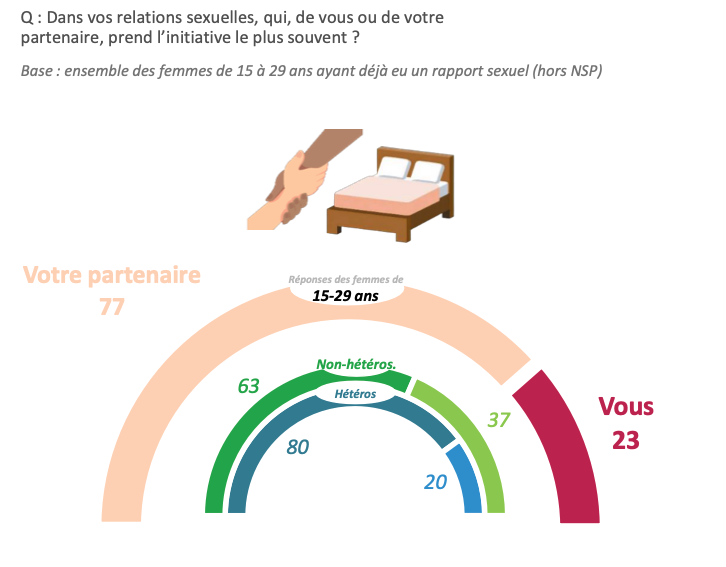
First, by the persistence of deeply anchored gender roles. Only 28% of young women take the initiative in their sexual relations, a figure barely higher than that of the year 2000. Desire still remains, often, on the male side.
 © Ifop survey
Then, by the difficulty in dissociating sexuality and feelings. If the lines are moving – 28% of women aged 18 to 24 could consider a relationship without being in love, compared to 8% in 2000 – the dominant norm remains that of sexuality linked to affect: 68% of young women say they cannot make love without feelings.
“The explosion of sexual boredom is the symptom of a contradiction between the narrative of ‘sexual liberation’ and practices that resist ongoing cultural transformations – including in a generation massively exposed to feminist discourses on sexual autonomy“.
In other words, ideas advance faster than behaviors. A silent tension then sets in: between what we think we should experience, and what we actually experience.
The weight of the gaze: the female body always under surveillance
But it is undoubtedly in the area of social judgment that the contradiction is most acute. The concept of “bodycount”, popularized on social networks, acts as a brutal revealer. 70% of women aged 15 to 29 believe that having had many sexual partners tends to devalue them in the eyes of those around them.
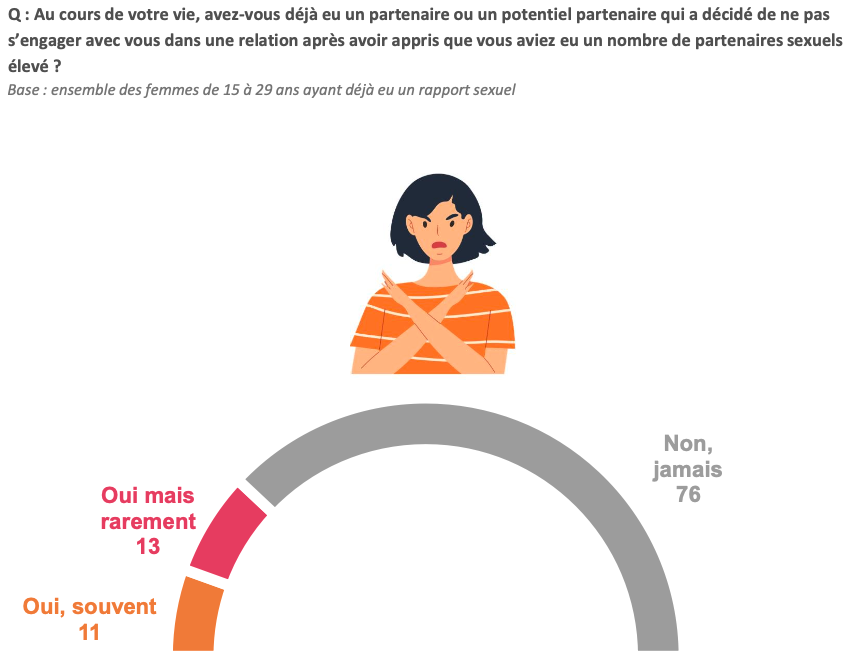
It’s not just an abstract fear: 24% of young women say they have already been rejected by a partner because of their sexual past. In this context, young women develop adaptation strategies. They are more tolerant towards their partners – 70% could get involved with someone who has had many partners – while remaining more severe towards themselves.
 © Ifop survey
Asked about the threshold not to be exceeded “so as not to be seen badly”, they set an average limit of 9 partners for a woman, compared to 11 for a man. And yet, despite these pressures, transparency is progressing: 70% of women in a relationship say they have communicated their number of sexual partners to their partner.
A way, perhaps, to regain control over an intimate story that has long been confiscated.
A freedom that is still fragile, but in motion
Young women today are neither submissive as yesterday, nor totally liberated. They advance on a crest line, between heritage and transformation.
“Everything happens as if discursive emancipation – nourished by podcasts, books or feminist accounts – was not yet translated into intimate practices. Because this is the paradox of these young women who are today freer in their heads but not necessarily in their bed…“
This observation tells of a transition. A slow, uneven, but irreversible transformation: that of a sexuality which, little by little, is written in the feminine way – between self-conquest and the gaze of others.