
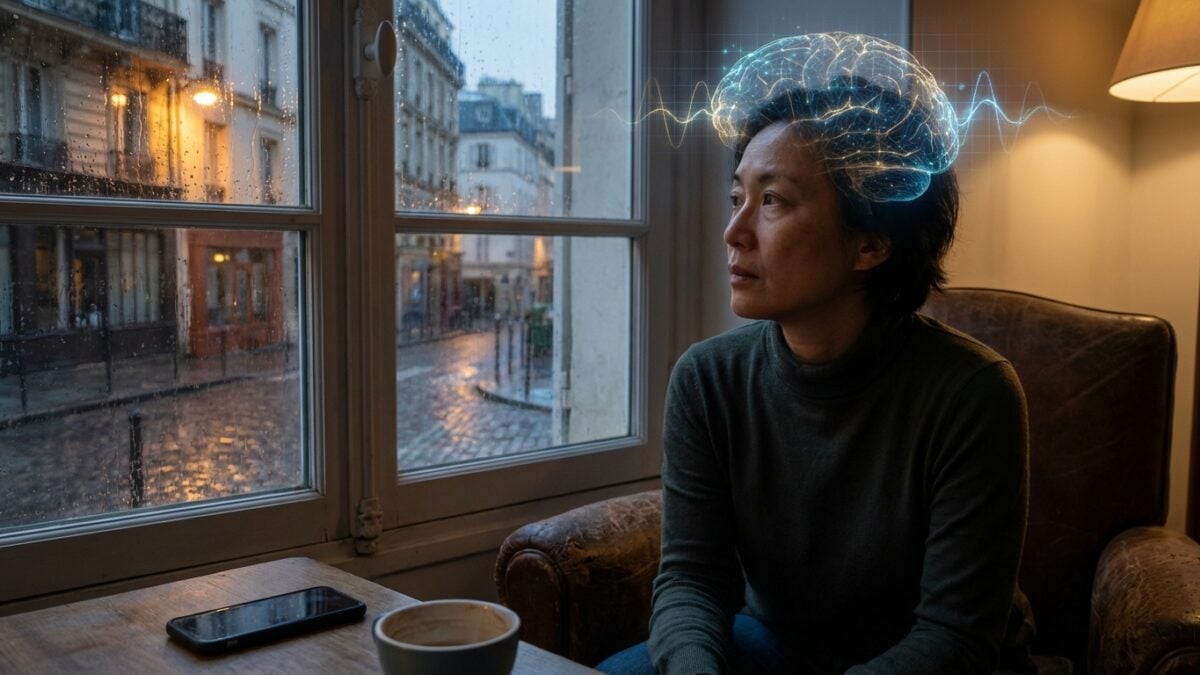
An argument, a violent email, a distressing phone call… Your heart races, your hands become sweaty, then everything goes down again. After a few minutes, your breathing calms down, as does your heart rate, and you tell yourself that the episode is behind you.
Neuroscientists tell a different story. A Japanese study published in the journal Proceedings of the National Academy of Sciences describes a “window of resilience which only appears about an hour after a acute stress : only then does the brain really begin to reorganize itself. A hidden phase that intrigues doctors.
Acute stress: when the body gets better faster than the brain
Psychological resilience is often wrongly equated with simple “strength” or an absence of sensitivity to stress. In reality, true resilience lies in the brain’s ability to adapt and recover after a stressful event. Researchers from Kochi University of Technology (KUT) and Shizuoka Institute of Science and Technology (SIST) have highlighted that this recovery process does not peak immediately; rather, it manifests as a specific “resilience window” that appears approximately one hour after the event.
Researchers from Kochi University of Technology and the Shizuoka Institute of Science and Technology exposed around a hundred adults to brief but intense stress, an ice water bath, a test well known to specialists. For an hour and a half, they followed the volunteers with different tests: functional MRI (fMRI)electroencephalogram (EEG)heart rate and rate of cortisolthe stress hormone.
The observation is clear: the heart and cortisol return fairly quickly to their usual level, as if the alarm had already been put away. Brain signals tell something else. Imaging and electroencephalograms show that the reorganization of brain networks remains in progress for much longer, with high-beta and gamma oscillations still elevated in people who are less resistant to stress.
A “resilience window” of approximately one hour after the shock
For the team, the psychological resilience cannot be reduced to simple strength of character. “Most research on resilience relies on animal models, defining it as the absence of depression-like behaviorsexplains Dr. Noriya Watanabe, one of the authors of the study. But human resilience is more complex. It involves self-efficacy and past experience, things that cannot be assessed in a mouse. To understand these mechanisms, we had to directly study the human brain in its way of adapting“.
Around the sixtieth minute, the most resilient volunteers showed a drop in activity in the salience network (associated with the detection of alarms and threats), and an increase in the default mode network (associated with introspection), as well as increased activity in the posterior hippocampus. At the same time, the EEG reveals a marked drop in the power of high beta waves, an indicator of the calming of neuronal arousal.
“After an hour, while the physical symptoms of stress had disappeared, unconscious brain changes were still occurring.”explains Dr Masaki Takeda, lead author of the study. “This precise timing helped explain individual differences in resilience much better than any immediate response“.
A key hour to better treat stress and its after-effects
These late brain signatures could become useful biomarkers for post-traumatic stress disorder and
depression. By objectifying the brain’s natural recovery speed, they would provide a benchmark for detecting people whose alert system remains blocked and who risk developing lasting disorders after a shock; and those with greater natural recovery capacity.
The authors also mention “time-sensitive” interventions: brief psychological support or non-invasive neuromodulation timed to this crucial hour, in order to promote the transition from alert mode to recovery mode. Enough to look differently at this famous hour which follows a major stress, moment when we think we have already recovered while the brain, for its part, is still silently continuing its repair work.