
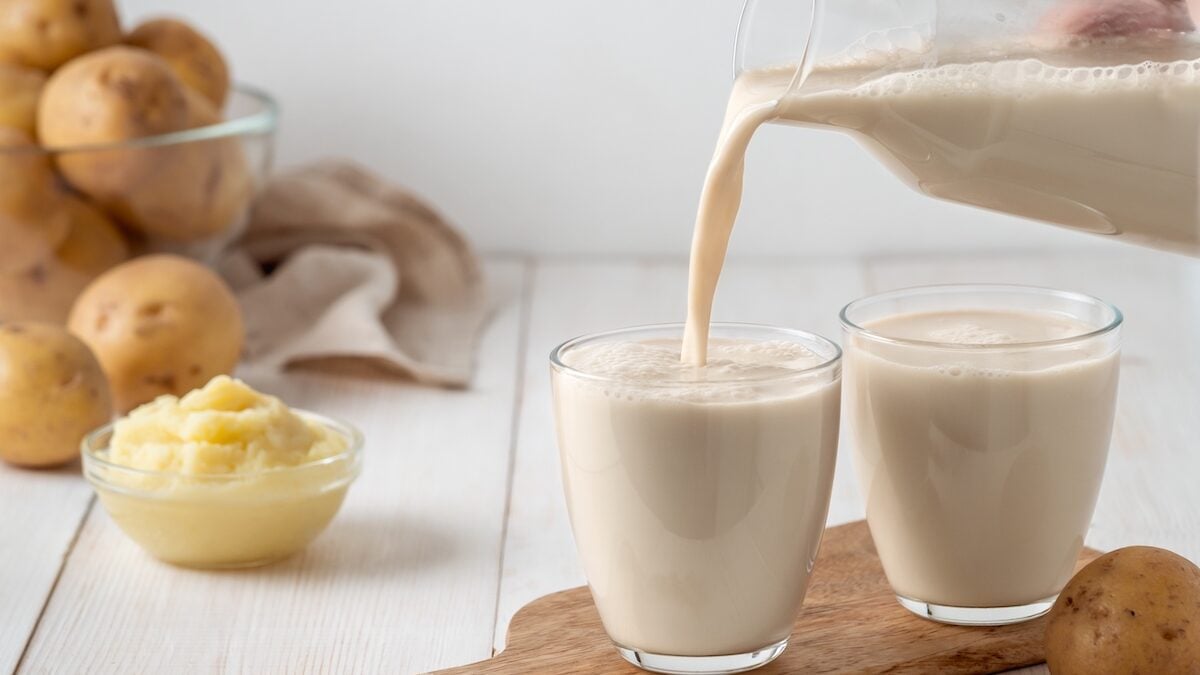
Whether for environmental reasons, to avoid lactose or to diversify your diet, plant-based drinks have established themselves in consumption habits. Almond, soy, oats… they now occupy an important place on the shelves.
In this dynamic, potato “milk”, which is more accurately called a vegetable drink, is making its appearance. Its main advantage? A neutral taste and the absence of major allergens. Without lactose, gluten, soy or nuts, it is particularly aimed at people suffering from intolerances or multiple food allergies.
Where does potato “milk” come from?
This plant-based drink was born in 2021 in Sweden, thanks to a collaboration between the start-up DUG and Lund University. Their objective: to transform a simple, accessible and inexpensive food – the potato – into a sustainable alternative to cow’s milk.
Concretely, this drink is composed mainly of water, with around 4% potatoes, to which are added rapeseed oil, pea proteins, fiber (inulin), a little sugar (maltodextrin), as well as added vitamins and minerals (vitamin D, calcium, B2, B12). The result is close to cow’s milk in texture, while remaining plant-based.
A more ecological alternative
Upon its launch, the product was rewarded at the World Food Innovation Awards as best innovation suitable for allergy sufferers. Its manufacture also requires less water and energy than other plant-based drinks, which reinforces its ecological interest.
On the DUG website, the first company to market a potato-based drink, we learn that “potato cultivation is twice as efficient as that of oats in terms of land use” and that it requires “56 times less water than almonds to grow”.
As for consumers of cow’s milk, they could reduce their climate impact by around 75% by opting for a potato-based alternative. Seriously enough to give the potato away, right?
The opinion of Pauline Pied nutritionist: strengths… but also limits
We submitted this amazing beverage to Pauline Pied, dietician and nutritionist. According to her, the main interest of potato milk lies in its hypoallergenic profile:
“This could be a good option for people who have multiple allergies. Particularly those who need to avoid nuts, soy or lactose.”
She also emphasizes that this drink can constitute a relevant alternative for people who do not consume dairy products, in particular thanks to its enrichment with vitamin D, calcium and vitamin B12.
However, she quickly qualifies the nutritional promises linked to potatoes:“There are only 4% potatoes. So we don’t really benefit from their nutritional contributions.”
In other words, potato milk is not a significant source of the nutrients naturally present in this tuber. It is above all an artificially enriched drink.
The dietician also recalls a fact: “behind the apparently healthy side, it remains a processed product, with additives such as acidity regulators. This is not problematic, but you have to be aware of it.”
Verdict: an interesting alternative… but not revolutionary
In conclusion, Pauline Pied considers that if potato milk were to arrive on our shelves, it would be of interest to people suffering from multiple allergies or intolerances:
“It would be another practical alternative for cooking and varying your diet. But you have to be careful with marketing, she adds, It’s not because we talk about potatoes that we get all the benefits.”
Potato milk will therefore not necessarily replace cow’s milk or even other already well-established plant-based drinks. But it could find its place as a complementary solution, particularly to meet specific needs. An option not to be pureed straight away.