
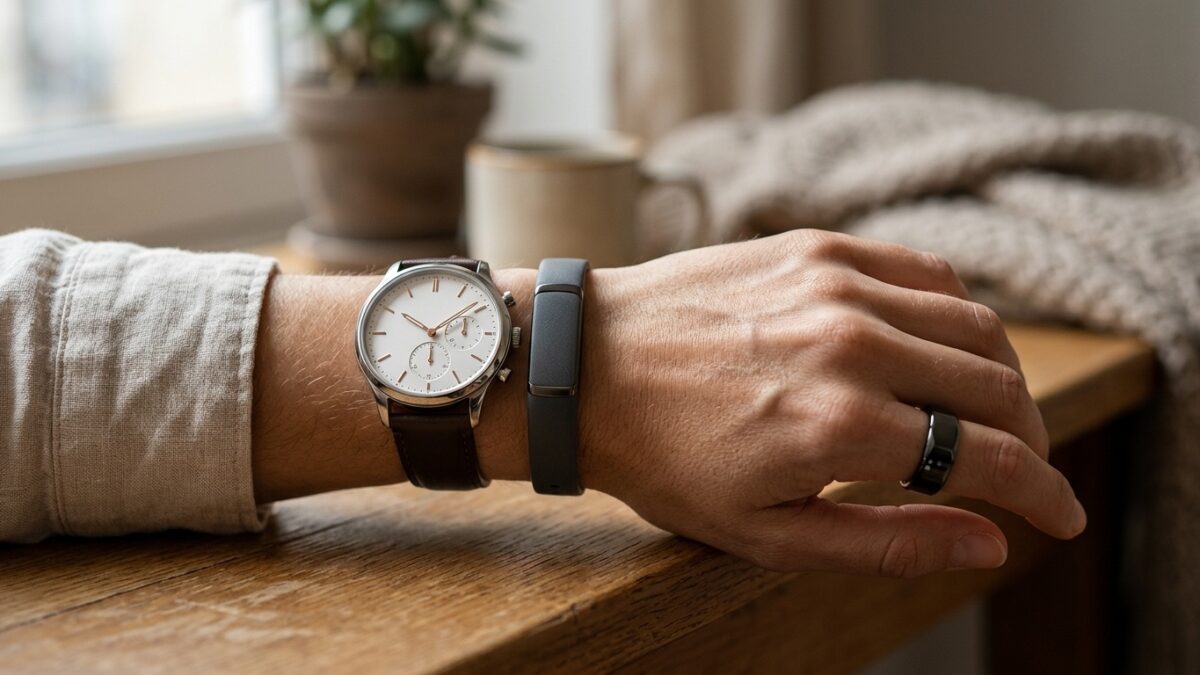
THE best fitness trackers And
connected watches are no longer just a step counter: between bracelets without a screen, discreet rings and sports watches loaded with sensors, everyone can find a tailor-made wrist companion. The 2026 market is shifting towards objects that closely monitor training, sleep and stress, while remaining pleasant to wear for several days without recharging.
This generation sees the emergence of three families: powerhouses without a screen like Whoop or the future Garmin tracker, complete sports watches for running or measuring everything, and elegant accessories such as rings or hybrid watches. In the background, researchers are already working on recharging in ambient light.
Screenless fitness trackers: Whoop 5.0 and the mysterious Garmin bracelet
Designed for bodybuilding and cross-training, the bracelet
Whoop 5.0 adopts a screen-free design that does not interfere under the bar. It tracks activity, heart rate and variability, breathing, temperature, sleep and stress, with up to 14 days of battery life. The subscription service also measures muscle load via repetitions, sets and time under tension.
Garmin is preparing its response. In a Facebook post, the brand promised that “the future of wearables is almost here“, before adding that “it will arrive faster than you think“, NextPit reported. The visuals showed a thin, curved bracelet with an LED and the slogan “Sleek. Smart.” (“Elegant. Intelligent.”). The format evokes a complete sleep or fitness tracker, similar to the Index Sleep Monitor, with advanced functions that can be placed behind a “paywall”.
Sports connected watches: from the Amazfit Balance 2 to the Garmin Forerunner 965
For a low budget, the Amazfit Balance 2 offers a 1.5-inch AMOLED screen, reliable GPS, monitoring of activity, sleep, blood oxygen or stress, and up to 21 days of battery life. The Zepp Coach AI “adjusts your workouts based on how your body feels, helping you recover smarter, progress faster, and avoid setbacks“, according to the company. Everything works without compulsory subscription, via the Zepp application.
Regular runners will aim for Garmin Forerunner 965which combines precise GPS, advanced running dynamics, training load tracking, recovery advisor and battery life of up to 23 days in watch mode.
For more general use, especially with an iPhone, theApple Watch Series 11 remains the benchmark: activity, sleep and blood oxygen monitoring, Retina screen, notifications, payments, music and security with fall detection “that really works!”, for around 38 hours of battery life.
Rings, stylish watches and the future of wearable autonomy
Oura, Ultrahuman Ring Pro and the Withings ScanWatch 2 target those who want discreet tracking or a chic analog watch with a small OLED screen. Many dream of “all-day battery life” without seeing the “low battery” warning: solar watches already exist, and perovskite cells developed at University College London for “low indoor light” could convert around 37% of ambient light to power future wearables, with an expected arrival within three years.