
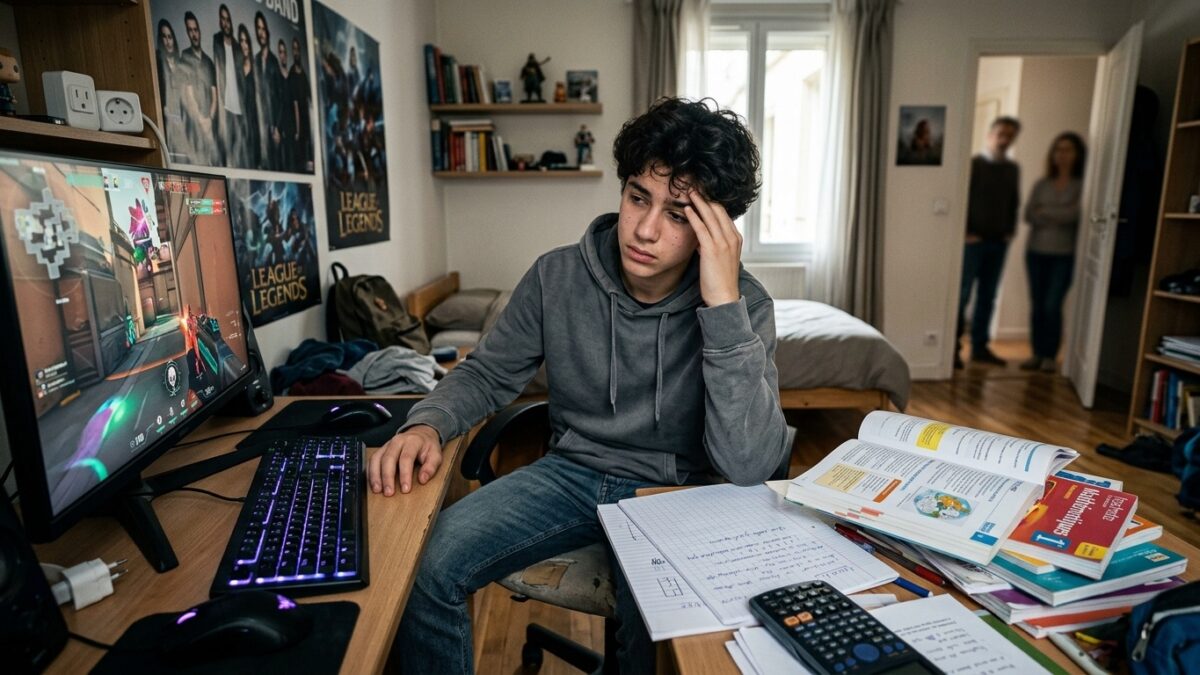
In France, surveys show an increase in school stress while almost all teenagers play video games. When a schoolboy spends his evenings in front of the screen after a day of tests, many parents wonder. Is it the game that creates the problem or the pressure of homework that pushes one to take refuge in it.
A recent study published in the journal Pediatric Investigation followed more than 2,000 Chinese students from grades 7 to 9, immersed in a very competitive education system. Researchers describe academic exhaustion which gradually empties adolescents’ psychological reserves and leads them towards online gaming. This mechanism creates a chain where mental resilience becomes weakened.
School stress and academic burnout weaken mental resilience
Fear of bad grades, orientation, homework late at night: for many middle school students, academic stress becomes an almost permanent state. When this tension sets in, it can develop into academic burnout, with extreme fatigue, loss of motivation and feeling like you’re worthless. The authors of the study speak of a chronic state of psychological exhaustion that weakens attention control and emotional balance.
Liping Jia puts it this way: “According to our research, academic burnout activates internal psychological pathways in adolescents, with affective factors, particularly depressive symptoms, playing a central mediating role in IGD. Adolescents experiencing burnout are more likely to make negative attributions about their learning and self-worth, thereby triggering or exacerbating depressive symptoms.”
Video games: from the valve to video game disorder
Researchers have observed that exhausted teens often turn to online gaming as a distraction and a way to finally feel competent. The game provides clear objectives, quick rewards and group recognition. When this use becomes a priority and uncontrollable, the World Health Organization speaks of video gaming disorder, a persistent behavior that continues despite negative consequences. In France, estimates suggest 1 to 4 percent of players affected, around 3 percent of adolescents already having problematic use.
Strengthen resilience to break the circle of school stress video games
For Guohua Lu, everything comes together for these overworked teenagers: “Adolescents, when feeling stressed academically and becoming emotionally exhausted, develop negative thinking and turn to online gaming to seek solace, which reduces their ability to handle real-life situations. This cycle continues and leads to an increase in IGD, ” she explains. The team recommends screening camps, counseling sessions and stress management programs to rebuild mental resilience.
Researchers also mention therapy sessions and training to modify the negative attention bias, in order to redirect adolescents’ gaze towards positive signals. French data indicate that daily computer gamers report poorer health and increased risk of depression, especially among girls. For many families, thinking about the meaning of play, and not just screen time, becomes a central issue of resilience.