
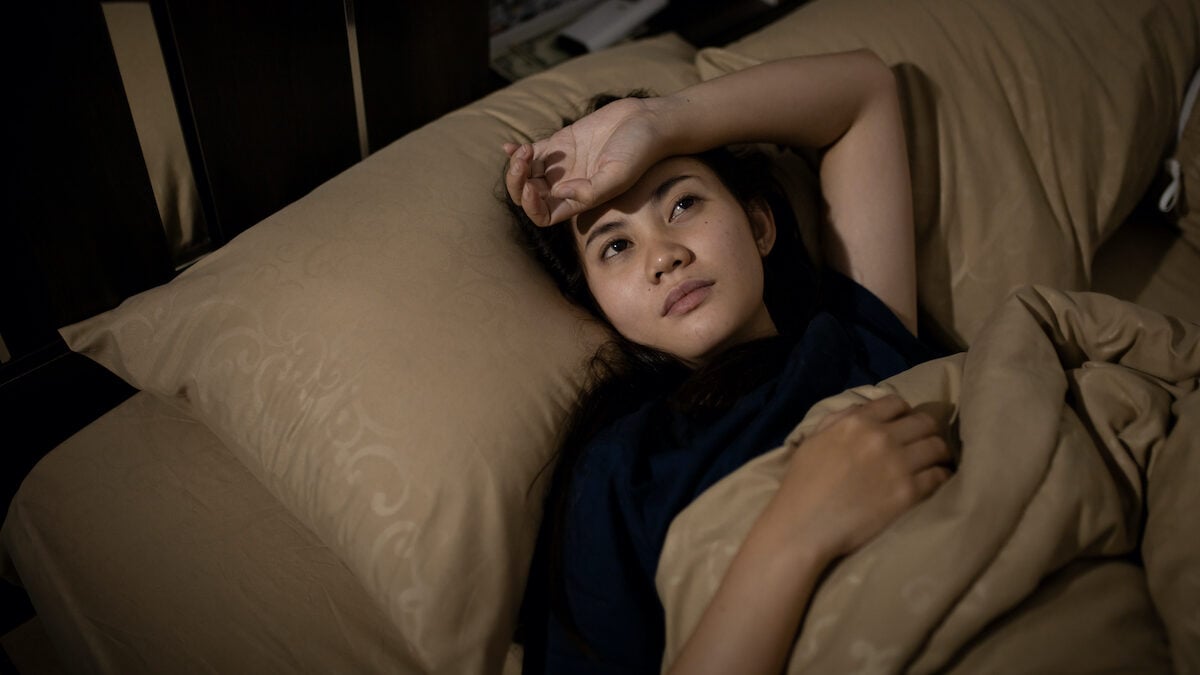
Maybe you’re one of those people: unable to really get any sleep if your partner is away — or even just in another room. His presence becomes the condition sine qua non
of a good night. Behind this habit, often perceived as endearing, a question persists: is it the sign of a healthy attachment… or of difficulty being alone?
Sleeping for two: a matter of safety… and conditioning
From a scientific point of view, the answer is reassuring: no, there is nothing abnormal about it. As explained by sleep specialist Wendy Troxel, psychologist and sleep specialist in
The Guardianhaving trouble sleeping without your partner is not a sign of a dysfunctional relationship.
According to her, over time, the brain associates the presence of the other person with bedtime. Evening rituals—chatting, watching a series, snuggling—become signals that prepare you for sleep. The neurologist Hrayr Attarian even speaks of a conditioned reflex in the same media: the partner becomes a reference point, almost a physiological trigger for falling asleep.
Without it, this marker disappears. And with it, sometimes, the ability to let go.
Sleeping together: very real benefits
Beyond the habit, sleeping together provides real positive effects. Physical contact, even light, promotes the release of endorphins and reduces stress. As Dr Jonathan Taieb pointed out in a previous article, shared sleep helps build the bond: it strengthens intimacy, trust and the feeling of security.
Some studies even show decreased levels of anxiety and depression in people who sleep with their partners. In other words, if you sleep better together, it’s not just in your head.
And yet, this proximity also has its limits: in France, almost a quarter of couples say they are incompatible when it comes to sleep. Snoring, different rhythms, insomnia… The marital bed can also become an area of tension. And some simply prefer to have a separate bed or even room, without denigrating their love story.
When absence really prevents you from sleeping
But there is another, more intimate reality, which clinical psychologist Amélie Boukhobza describes particularly well. Not being able to sleep without the other person is not always a simple habit. It may reveal something deeper.
Sleeping, she reminds us, is a moment of total letting go. “We give up control, we put ourselves in a position of vulnerability.” And for some people, this abandonment is only possible if a reassuring presence is there.
“In this case, the partner no longer represents only love or comfort. He becomes a form of emotional regulator. His presence soothes, contains, reassures. A bit like a “soft toy” for a child”. Something that is not always clearly explained, but that the body knows very well.
When absence causes anxiety, agitation or a feeling of emptiness, we move away from simple attachment. “Sleeping alone can then reactivate an older insecurity, sometimes difficult to identify but deeply rooted. We could talk about emotional lack, yes.”
“It’s not necessarily pathological. But it deserves to be heard.”
Should we be worried?
It all depends on the intensity. If you simply sleep better together, without any particular anxiety when away, there is no reason to worry. On the other hand, if the inability to sleep alone becomes a source of significant stress, it may be useful to question yourself.
“Not about your relationship, but about your relationship to security and solitude.”
As the psychologist points out, we should not judge this dependence negatively. It is often a reflection of a legitimate need for comfort. But it is important to ensure that sleep – an intimate space par excellence – does not become totally conditioned by the presence of the other.
How to sleep better when you are alone?
The good news is that the brain loves habits… but can create new ones.
If you have trouble sleeping without your partner, the goal is not to “force yourself”, but to recreate a reassuring environment. Maintaining the same rituals is essential: reading, watching a series, listening to soft music. These signals send the body the message that sleep is approaching, even in the absence of the other person.
Some experts also recommend sensory substitutes. Sleeping with clothing infused with your partner’s scent, or using a body pillow, can help maintain a sense of presence. But beyond the tips, there is more subtle work: learning to gradually tolerate being alone with yourself.
Ultimately, the question is not so much “do I have a problem?” that: “can I also feel safe without the other?”
If the answer is yes, then you can sleep peacefully… both as a couple or alone.