
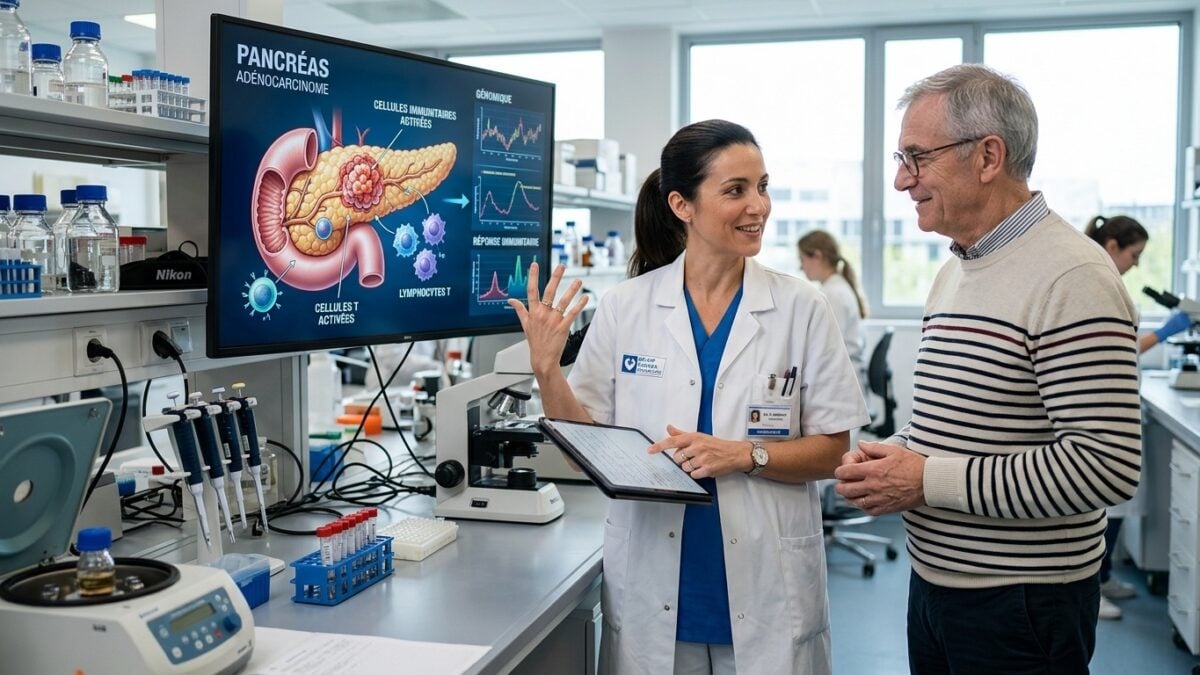
For such a lethal cancer, any lasting signal of progress attracts the attention of oncologists. THE pancreatic canceroften detected too late and sometimes nicknamed “silent killer”, remains one of the deadliest cancers, with an overall five-year survival around 13% according to the American Cancer Society, and which drops to 3.2% in advanced stages.
Very encouraging preliminary results
At the American Association for Cancer Research 2026 Annual Meeting in San Diego, US researchers presented results from a preliminary trial testing a personalized mRNA therapeutic vaccine, called autogene cevumeran. In some of the 16 operated patients, this experimental vaccine appears to maintain an unusual immune response and survival up to six years after surgery.
- In this phase 1 trial, 8 of 16 patients saw their immune systems respond to the vaccine;
- Among the 8 patients whose immune system responded to the vaccine, 7 (87.5%) were still alive 4 to 6 years after the operation;
- Of the 8 patients who did not respond, only 2 (25%) were still alive, with a median survival time of 3.4 years.
According to Dr. Vinod Balachandran, physician-scientist at Memorial Sloan Kettering Cancer Center (MSK) and director of the Olayan Center for Cancer Vaccines at MSK (OCCV), “approximately 90% of these patients who generated an immune response remain alive” four to six years after surgery, while only two of eight non-responders survived, with a median survival of 3.4 years, according to Memorial Sloan Kettering Cancer Center.
A personalized mRNA vaccine that trains T cells over time
Each dose ofautogene cevumerandeveloped by BioNTech and Genentech, is made from the removed tumor to encode neoantigens specific to each patient’s cancer. The vaccine is given with the immunotherapy atezolizumab (Tecentriq) and then chemotherapy, to hunt down any remaining cells that may cause a relapse after surgery. In responders, researchers observed CD8 T cells+ and CD4+ specific to the tumor, detectable up to six years after vaccination.
“Designing cancer vaccines is not simple: it requires a systematic approach to select the appropriate targets on each patient’s tumor and achieve a strong and durable immune response.” explains Dr. Greenbaum. “It’s much more difficult than it seems, especially for cancers where other immunotherapies have failed.”.
But for some patients, this scientific bet has changed the trajectory of life. Donna Gustafson, the first trial volunteer at age 66, received nine doses of the vaccine and lives today at age 72 without major limitations: “There are no limitations on what I can do, so for me it’s absolutely a miracle“, she says. Donald Sarcone, diagnosed in 2020, also describes a life that has become active again more than five years after his diagnosis.
Why this vaccine remains a measured hope
This vaccine remains a therapeutic treatment: it does not protect a healthy person, it aims to prevent the disease already operated on from returning by tracking down residual cells.
“These initial results show that this new immunotherapy approach has the potential to make a difference for one of the deadliest cancers. Latest data from this small study suggests that vaccines can significantly boost the immune system in some pancreatic cancer patients, and that these patients continue to do well years after vaccination“, says physician-researcher Vinod Balachandran, director of the Olayan Center for Cancer Vaccines at Memorial Sloan Kettering, who considers these results encouraging but to be confirmed in more patients.
These results are encouraging, but they come from a phase 1 trial on only 16 patients and need to be confirmed. The pharmaceutical laboratories Genentech and BioNTech, responsible for developing the vaccine, have already initiated a phase 2 clinical trial on a larger scale. Currently, Balachandran and his team are looking into an in-depth analysis of the immune mechanisms that appear to be activated.