
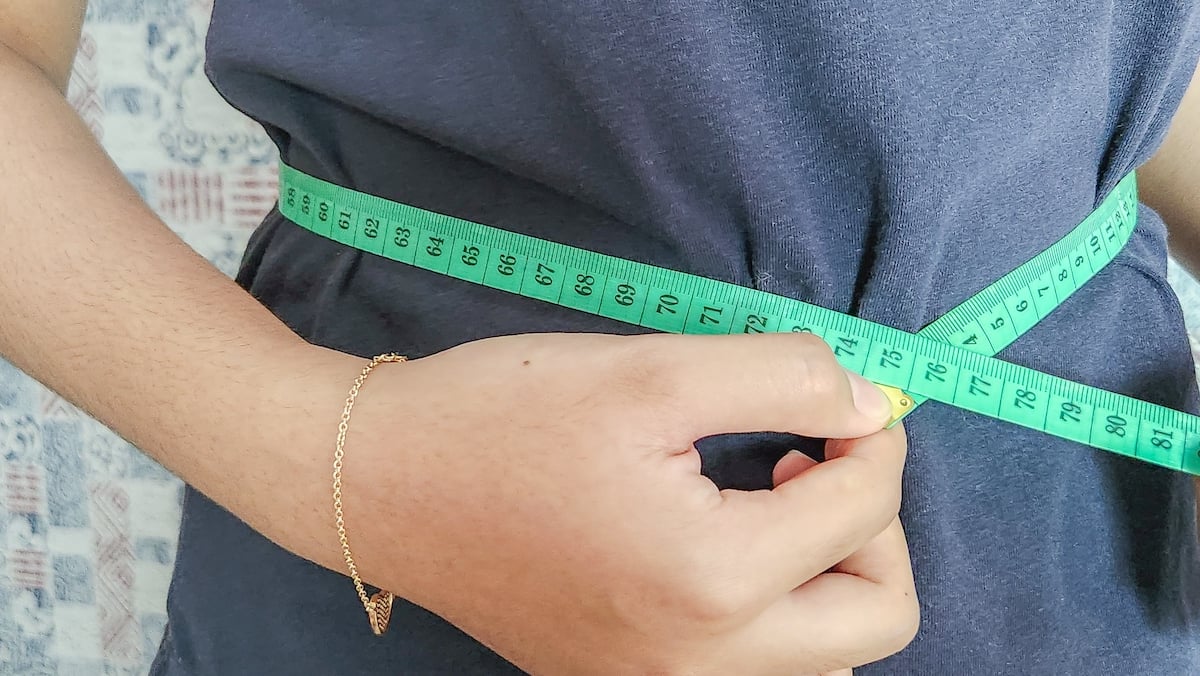
During a consultation, the doctor’s view is not limited to the analysis results. The body itself already provides many clues. The stomach, in particular, is an information-rich area.
What your doctor sees when looking at your waistline
As Gérald Kierzek explains: “We speak of auscultation when we use the stethoscope, but the rest of the consultation includes a part of inspection and palpation. It is in this context that we will observe our patient’s waist circumference.”
A high waistline can immediately point to excess abdominal fat, a well-known risk factor for many pathologies. But that’s not all.
- The presence of stretch marks can reveal rapid weight gain or past pregnancies;
- Scars indicate surgical interventions or medical history to be taken into account;
- An abnormally swollen stomach can suggest edema or ascites, sometimes linked to more serious illnesses such as heart or kidney failure or cirrhosis;
- A small bulge in the navel can signal a hernia
- Certain small red star-shaped spots, called stellate angiomas, can indicate a liver problem.
Thus, behind a simple measurement, there is a whole set of signals that the doctor interprets.
Why your waistline is directly linked to your heart
But behind the waistline is above all an indicator of your cardiovascular health. As Dr Gérald Kierzek reminds us:
“The waistline is a reflection of abdominal fat, what we call the belly, and which presents a risk factor for cardiovascular diseases.”
This abdominal fat, called visceral, is particularly active. It surrounds essential organs such as the liver or the pancreas and disrupts their functioning. It also promotes chronic inflammation in the body.
The more this fat, the more the risks increase: metabolic disorders, diabetes, heart disease, even certain cancers. Recent scientific data even suggests that every additional centimeter around the waist increases the risk of heart failure and heart attack.
In women, this risk generally remains lower before menopause, but the trend reverses quickly thereafter. This shift makes monitoring your waistline all the more important with age.
Measures you need to know to assess your risk
Health authorities have established simple benchmarks.
- In women, a waist circumference greater than 80 centimeters begins to be considered at risk, and it becomes worrying from 88 centimeters
; - In humans, these thresholds are 94 and 102 centimeters respectively..
Another rule helps refine this assessment: the waist measurement should ideally remain less than half the size. So, a person measuring 1.80 m tall should aim for a waist measurement of less than 90 centimeters.
These figures are not diagnostics, but useful indicators to alert and act in time.
How to properly measure your waistline at home
Measuring your waistline is a simple task, but it must be done precisely to be reliable over time.
As Raphaël Gruman, nutritionist, explained in a previous article, the measuring tape should be placed halfway between the last rib and the hip bone, approximately two centimeters above the navel. The measurement should be done standing up, feet together, body straight and relaxed, ideally directly on the skin.
“It is important not to tuck your stomach in or tighten the tape measure. The measurement must be taken at the end of exhalation, with a horizontal tape. To correctly follow its evolution, you must reproduce exactly the same conditions each time”
specifies the expert.
Beyond the specific result, it is above all the evolution of the waistline which should attract attention. A gradual increase, even a moderate one, may be a sign of visceral fat accumulation and metabolic imbalance.
Conversely, a slightly elevated but stable waist circumference is often less worrisome than a rapid increase.
A simple tool to prevent rather than suffer
Waist size remains an indicator that is still too underestimated. However, it offers a direct reading of what is happening inside the body, well beyond appearance.
Easy to measure, accessible to everyone, it allows you to monitor your health concretely and regularly. And sometimes, a few extra centimeters are enough to reveal a very real risk, long before it manifests itself.