

A vast global study on well-being shows that a mundane everyday gesture weighs almost as much as money or a job. From the Gallup World Poll 2022-2023, more than 150,000 people, in 142 countries, rated their lives from 0 to 10. Researchers then compare these ratings to a specific behavior and find that it explains gaps in well-being as well as income or unemployment.
Eating together, a solid indicator of well-being
This behavior is the fact of share meals. The study, published in Scientific Reportsshows that an additional shared meal during the week is associated with +0.2 points of well-being on a scale of 0 to 10. People having at least one meal in common display an average score of 5.2 compared to 4.9 for those who have none, which is already almost half of the effect of unemployment on declared well-being.
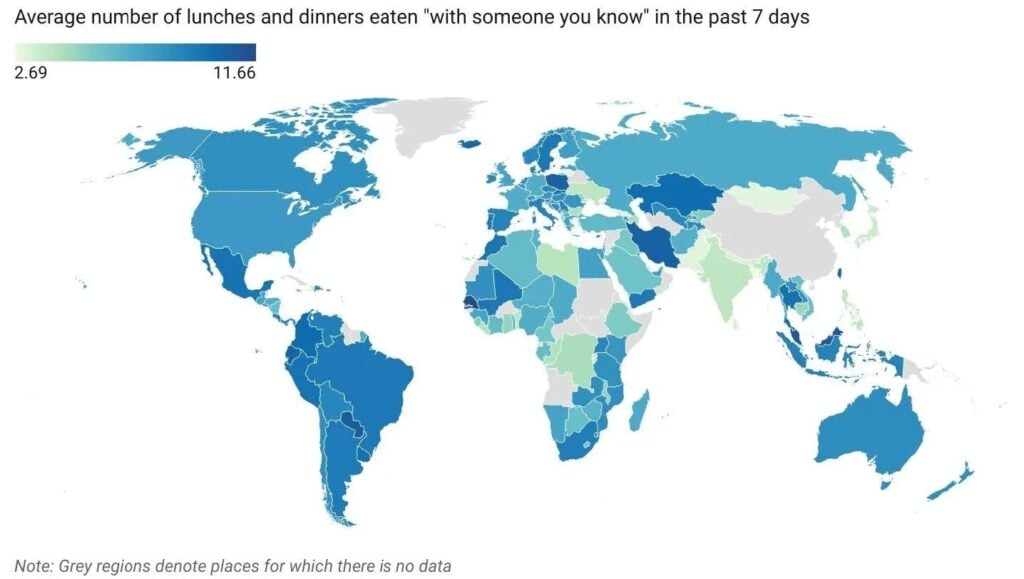
To refine this link, the authors use responses from the Gallup World Poll, where each person indicates on how many days they had lunch or dinner with someone they know during the previous week. In almost all regions, living scores increase with the frequency of shared meals.
 © Scientific Reports
Average quality of life rating based on number of meals shared in the previous week (Gallup World Poll, 2022-2023)
Another strength of the study is the American Time Use Survey 2003-2023, which tracks the daily time use and emotions of tens of thousands of Americans. Researchers note that people who eat at least once with others say they are happier that day and less stressed, painful or sad than those who systematically eat alone.
Shared meals, solitude and the rise of the “lone diner”
This same data reveals a rise in the “lone diner” in the United States. Between 2003 and 2023, the share of adults reporting eating all meals alone on a given day increased by more than 50%, reaching 26% in 2023. These people report about 0.5 points lower life evaluations and more stress, pain, and sadness than those who eat with others.
In France, the Cepremap Well-being Observatory and INSEE paint a contrasting picture. About half of those surveyed share almost all of their meals over a week, while 10% share none. Going from almost zero shared meals to more than ten per week is accompanied by a gain in life satisfaction comparable to a doubling of salary, even at equivalent age, income and household composition.
Shared meals, a new public health lever
Because eating together is almost universal and easy to measure, the authors of the article published in Scientific Reports make it a simple indicator of social connection and a point of support for well-being policies. The Well-being Observatory already suggests tracking this number of shared meals over time in France. Other work suggests that shared meals boost endorphins and reduce loneliness, sadness and emotional distress.
At a time when the number of meals taken alone continues to increase, this everyday gesture could become a real public health lever. What if the key to well-being was also played out… at the table?