
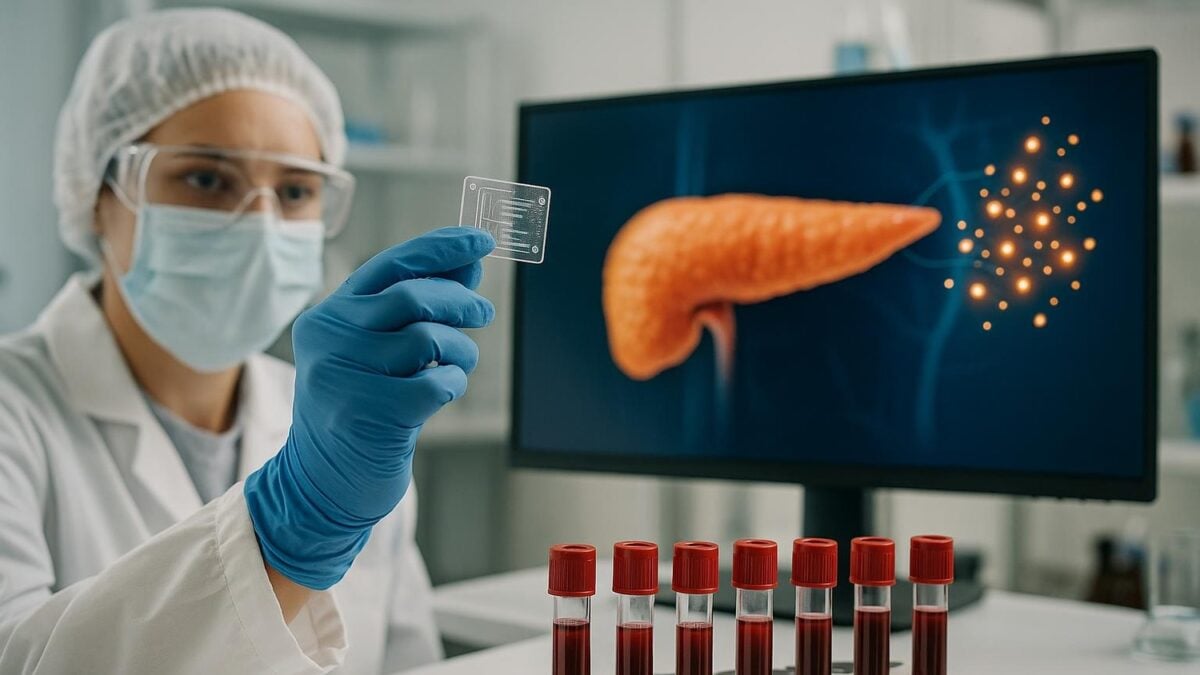
A small trial in the United States suggests that a simple blood test could detect pancreatic cancer as well as, or better than, a pancreatic biopsy. For this so-called “silent” tumor, often discovered too late, researchers report an ability to distinguish cancer and benign diseases of the pancreas with approximately 97% accuracy, when conventional biopsy only detects approximately 79% of cases.
Behind this result is an experimental microchip developed by theOregon Health & Science University
(OHSU), described in the journal Small by the team of Anna Malakian and Stuart Ibsen. Their idea: to capture, in a few drops of blood, nanoparticles released by the tumor and simultaneously measure a protein, Glypican-1, and circulating tumor DNA. This dual signal exceeds the performance of endoscopic biopsy and could, ultimately, avoid unnecessary interventions in patients with cysts or precancerous lesions.
How the nanoparticle blood test tracks pancreatic cancer
“The pancreas is buried deep in the body. It’s not like skin cancer you can see or a lump you can feel“says Stuart Ibsen, lead author of the study and associate professor of biomedical engineering at the Oregon Health & Science University Knight School of Medicine and Cancer Institute. “By the time people present with jaundice or abdominal pain, the disease has usually already progressed to an advanced stage.”.
But pancreatic tumors continually release tiny vesicles and fragments of DNA into the bloodstream. The OHSU microchip applies a gentle electrical current to attract these nanoparticles to microelectrodes, then colors them with fluorescent markers. “The more cancer biomarkers, the brighter the electrodes on the chip become“, describes Stuart Ibsen.
The study shows that combining Glypican‑1 and tumor DNA makes it possible to separate three profiles: simple benign cysts, low-grade IPMN precancerous lesions, and true invasive pancreatic cancers.
A trial on 36 patients where the microchip outperforms the pancreas biopsy
The researchers tested their liquid biopsy on blood samples from 36 people: pancreatic cancers, pancreatitis, benign cysts and precancerous IPMN lesions. The blinded protocol was based on only 30 microliters of plasma per patient and collection of nanoparticles in around fifteen minutes. According to the article from Smallthe results were found to be remarkably effective, with a 97% probability of correctly distinguishing people with pancreatic cancer from those with benign conditions.
This percentage far exceeds that of traditional pancreatic biopsies. Indeed, the invasive method, which involves taking tissue samples using fine needles under ultrasound guidance, generally succeeds in diagnosing 79% of cases of pancreatic cancer. It also poses a risk of acute pancreatitis in approximately 1% of patients, with a mortality of 10% in these rare cases. Here, a blood test would be enough to sort out the high-risk profiles, those which really justify an invasive biopsy. “Information from our blood test could help the surgeon know if the procedure really requires an extraction“, underlines Professor Stuart Ibsen, who “estimates that the technique is probably five years away from clinical use“.
What place does this blood test for pancreatic cancer have compared to other avenues?
Several teams are already working on a pancreatic cancer blood test for people at high risk: with a combination of 4 biomarkers for a team from the University of Pennsylvania and the Mayo Clinic, a Taiwanese test boosted with PanMETAI AI which displays a sensitivity of 93% and a specificity of 94% in high-risk patients…
The OHSU microarray stands out for its nanoparticle approach and direct comparison to tissue biopsy in the same cohort. The study also shows an unprecedented ability to differentiate low-grade IPMN, often simply monitored, and high-grade IPMN, closer to an early cancer. A patient classified as “cancer” by the test was also revealed, six months later, to have not pancreatic cancer but hepatocellular carcinoma, which suggests a possible role as a general warning signal of the presence of cancer, to be confirmed in larger trials.