

Each year, more than 100 million MRI exams examine our brains, but these images remain mainly anatomical photos based on magnetic resonance signals emitted by water molecules in biological tissues. For tumors or multiple sclerosis, this vision leaves gray areas. Researchers at the University of Illinois at Urbana-Champaign have developed a new approach that can map the structure, chemistry and function of the brain in one go.
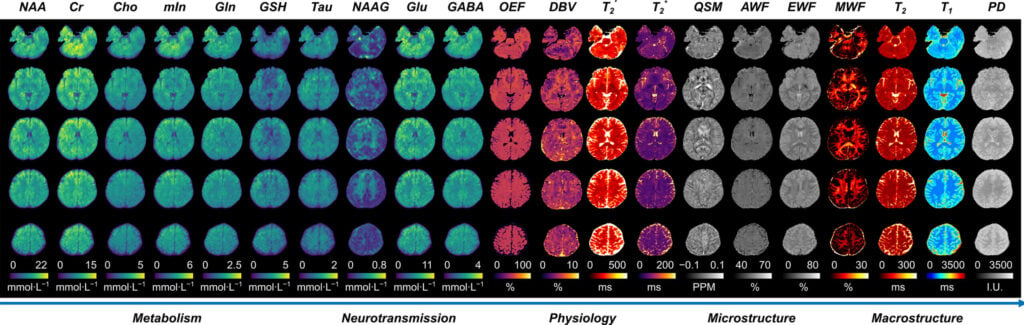
This technology, called Multiplexed MRI MRxperforms on a standard clinical device a simultaneous mapping of more than 20 biomarkers brain in high resolution. A single examination of 14 minutes
is enough to obtain maps of metabolism, neurotransmission, circulation and structure, without injected product. “MRI can be a powerful tool for non-invasive tissue characterization, helping to advance personalized, precision and predictive medicine” said Prof. Zhi-Pei Liang, professor of electrical and computer engineering and member of the Beckman Institute for Advanced Science and Technology at the University of Illinois.
How multiplexed MRI MRx sees the brain in all its facets
A typical MRI mainly measures the signal from water molecules and produces a few different sets of images, which sometimes takes almost an hour. With MRx, ultra-fast acquisition sequences capture signals from other molecules in parallel, such as metabolites and neurotransmitters in the brain. “MRx is a new artificial intelligence-based imaging framework that can measure many markers without the need for contrast agents.”said study co-author Rong Guo, a former student in Liang’s group and now a principal investigator at Siemens Healthineers.
“Through the integration of ultrafast data acquisition and physics-based machine learning methods for data processing, MRx overcomes several long-standing obstacles to rapid, high-resolution multiplexed imaging.”Ron Guo said. “This allows clinicians and researchers to better understand not only the structure of the brain, but also its physiology and molecular processes, within a single imaging framework.”.
 © Nature
This brain MRI scan can be completed in approximately 14 minutes, which is clinically very acceptable and considerably faster than traditional multicontrast clinical MRI protocols, which can take up to an hour, according to the researchers. The result comes in the form of a series of thematic maps that cover the entire brain.
What MRx changes for brain tumors and multiple sclerosis
Researchers have demonstrated the power of MRI for more precise disease characterization by applying it to patients with brain tumors and multiple sclerosis.
In the brain tumorsthe MRx protocol revealed, according to the team from the University of Illinois, metabolic alterations, edema, axonal damage and demyelination within the tumor microenvironment itself. This mosaic of information makes it possible to differentiate tumors that look similar on a classic MRI, which could help refine diagnoses and adapt treatments more precisely.
For the multiple sclerosisthe researchers followed lesions at different stages by combining markers of inflammation, demyelination, gliosis, axonal injury and metabolic activity, without contrast material. They observed that patterns of biomarkers heralded the development of a plaque.
“Diseases such as tumors, multiple sclerosis and neurodegenerative disorders are very heterogeneous. The wide range of biomarkers obtained using MRI could provide a better understanding of brain function and disease processes, while improving the sensitivity and specificity of detection and diagnosis“, summarizes Yudu Li, professor of bioengineering at the University of Illinois and first author of the article.
Towards a more complete brain MRI, ready for personalized medicine
MRx works on standard hospital MRIs and an exam remains within a usual consultation window, paving the way for a gradual move into the clinic. For now, the results published in Nature mainly concern tumors and sclerosis, plaques, but the same multi-biomarker logic is already of interest to neurodegenerative diseases.