
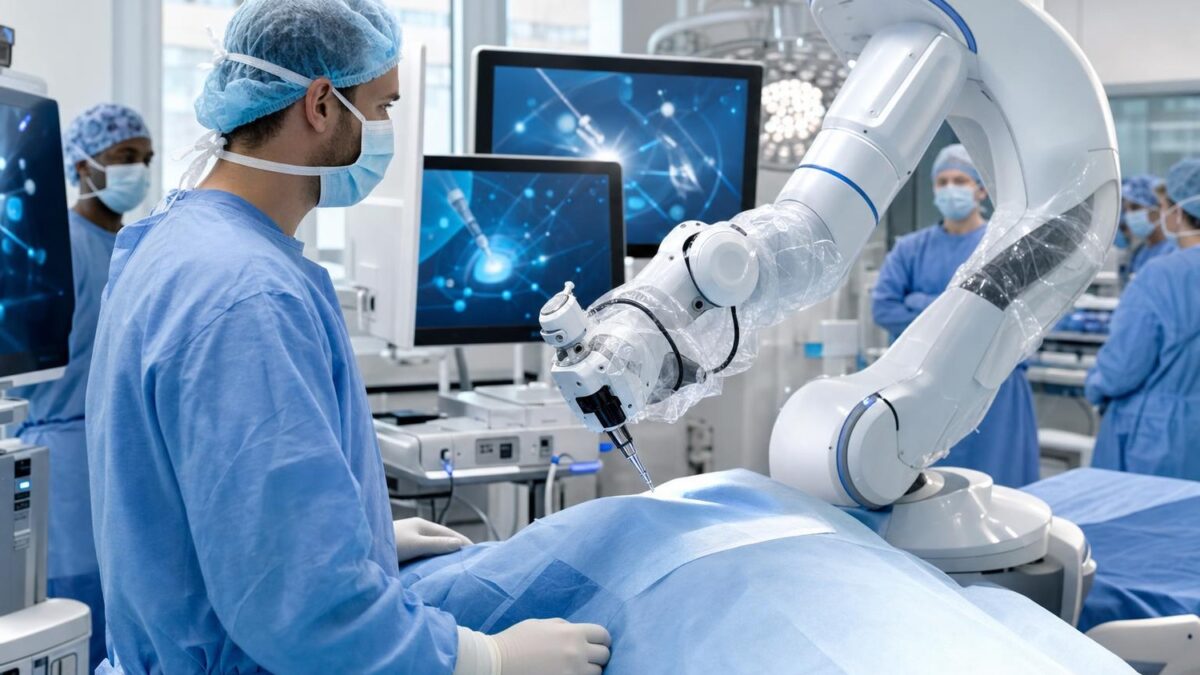
Nearly 30% of the global disease burden is caused by surgery, and there are an estimated 143.1 million necessary but unperformed procedures each year, according to an analysis published in Frontiers in Science. Faced with this pressure, a new generation of operating theaters full of sensors and algorithms could change the situation, provided that the law knows how to keep pace.
Towards a real revolution in surgery
A team of pioneering surgeons and researchers from King’s College London say AI-enhanced surgical robotics could enable “true personalized surgery” and improve the performance, situational awareness, decision-making and efficiency of surgical teams.
These artificial intelligence surgical robots are capable of transforming the robot operator into a continuously learning “co-pilot” within a hyper-sensory block. In Frontiers in Sciencethe authors led by Professor Prokar Dasgupta, urological surgeon specializing in robotics and lead author of the study, formerly of King’s College London and Guy’s Hospital in London, and Dr Alejandro Granados, first author of the study and professor at King’s College London, speak of “true personalized surgery”, where each gesture is adapted to the patient.
“The use of advanced AI and robotics in the operating room holds great promise. In the coming years, intelligent robots will impact all stages of surgery, including techniques, emergency interventions, team roles, workflows and assistive functions” says Professor Prokar Dasgupta
But they also warn: without profound reform of the
regulationthis revolution will remain largely theoretical.
AI surgical robots: from “sensorized” block to real-time decision-making
The Frontiers in Science article describes how video sensors and the movement of instruments could power AI models capable of recognizing intervention steps and suggesting the safest action in real time. Dr Alejandro Granados summarizes this shift:
“Surgery is on the cusp of a profound transformation, where technology will not only predict outcomes, but also guide clinicians towards the most optimal and personalized treatment for each patient.“.
These systems remain designed in mode human‑in‑the‑loop : the AI analyzes, simulates scenarios and suggests, but the surgeon decides. The authors anticipate a more supervisory and coordinating role for surgeons. For Professor Prokar Dasgupta, “Human surgeons must remain the primary decision-makers, and information from AI models must be presented differently to members of the surgical team, depending on their role, if we are to maintain the clear chain of authority necessary for safe surgical practice“.
A revolution slowed down by rules designed for frozen robots
The problem, the authors describe, is that most current rules still treat surgical robots as simple electrical devices. In the United States, many are classified as moderate risk and authorized under the 510(k) procedure, which allows advanced features to be added simply by claiming equivalence with an older model.
A recent analysis cited by the magazine The Week
recalls that dozens of medical devices integrating AI have already been the subject of recalls after clinical incidents, proof that these controls remain fragile. Professor Prokar Dasgupta warns: “We need a new set of frameworks – covering regulation and compliance, testing methods, reporting standards and training approaches – to ensure the continued safety and effectiveness of robotics and AI in surgery“.
Regulating surgical AI without widening inequalities in care
The article of Frontiers in Science also emphasizes the risk that models trained mainly on patients from rich countries will aggravate inequalities, or even that trials will be moved to poorly regulated health systems. Dr. Granados said: “Realizing this vision on a global scale will require rigorous management. We must ensure that healthcare professionals and patients around the world can equitably benefit from the promising potential of future innovations in artificial intelligence and robotics.”.
The authors advocate for collaborations with low-resource countries and for frugal AI technologies, capable of operating with limited infrastructure.