
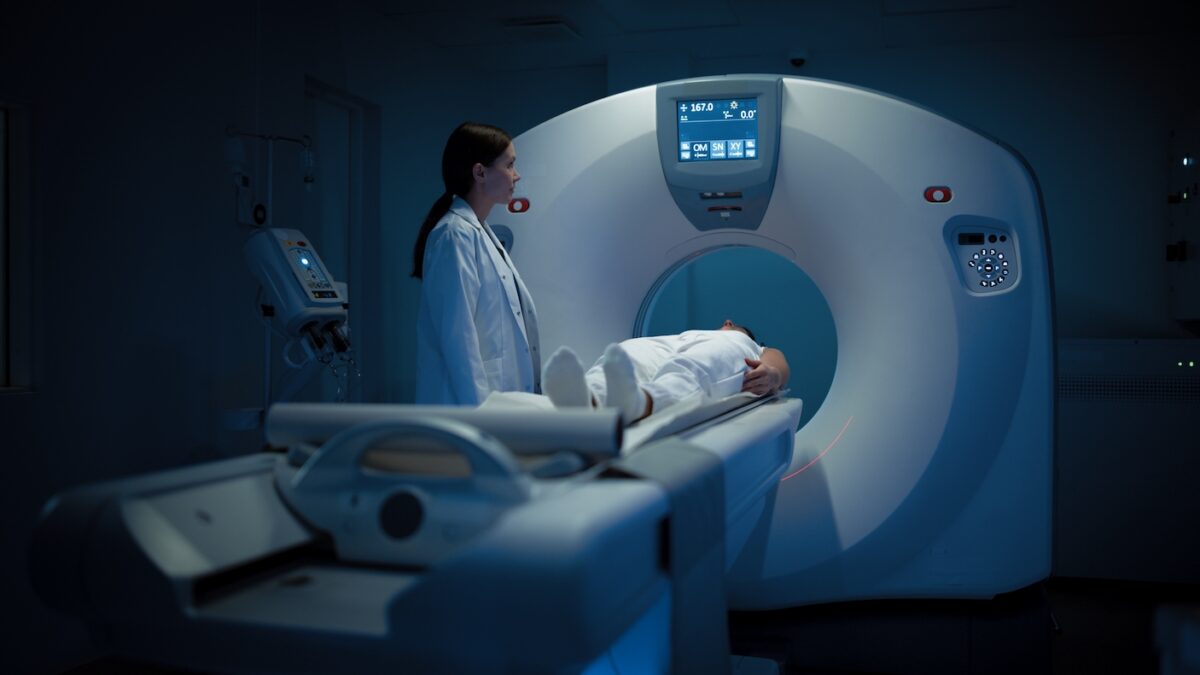
The first patient in the ELMIRA clinical study was included in February 2026 at the Nantes University Hospital. This research, carried out as part of the OPERANDI university hospital program coordinated by the AP-HP, evaluates a new so-called “multiplex” imaging technique, capable of merging two PET scans in a single visit. A world first that is still experimental, but brings hope for faster, more precise and less burdensome medicine.
Reducing the burden of examinations: an innovation designed first for patients
In oncology departments, time is rarely neutral. There is that of treatments, that of waiting for results, that of appointments which follow one another. And then there is the exhaustion, often silent, of patients who are already going through the illness.
For people with digestive cancers, imaging tests are essential. They make it possible to understand the evolution of the tumor, guide treatments and evaluate their effectiveness. But these exams are sometimes long, repeated and physically demanding.
Today, when a patient has to have two positron emission tomograms – the famous PET scans – using two different tracers, they have to return several days apart to the nuclear medicine department. Two injections, two appointments, two waiting times.
The ELMIRA study, launched at Nantes University Hospital, seeks precisely to change this reality. Its objective: to demonstrate that it is possible to simultaneously inject two different tracers and then reconstruct the images obtained during a single examination.
In other words, condensing two medical procedures into one visit.
The innovation concerns patients with hepatocellular carcinoma — the main liver cancer — as well as gastroentero-pancreatic neuroendocrine tumors, rare cancers of the digestive system or pancreas arising from cells capable of producing hormones.
Behind this technological advance, there is a simple idea: to simplify the care pathway. The Nantes University Hospital underlines that this multiplex PET will make it possible to “carry out a single examination instead of two, in a context where patients often have a significant level of fatigue and numerous medical appointments”.
For people already weakened by treatments, the benefit can be immense: less travel, less waiting, less physical and psychological constraints.
Seeing the tumor differently: the promise of more precise imaging
Beyond patient comfort, this innovation could also change the way doctors observe cancers.
Nuclear medicine is based on the use of radiopharmaceutical drugs capable of revealing the functioning of organs and the activity of tumor cells. Unlike traditional imaging which mainly shows the anatomical structures, the PET scan allows the biological activity of the tissues to be visualized.
Certain anomalies can thus be detected very early, sometimes even before the appearance of lesions visible on an MRI or conventional scanner.
With multiplex PET, researchers hope to take a new step: obtaining, in a single imaging phase, a more complete vision of tumor behavior.
The press release explains that this approach could “promote a more complete vision of tumor behavior, in a single imaging time” while decreasing “variability between examinations linked to delays between injections or different acquisition conditions”.
In practice, this means that doctors could compare different biological information under perfectly identical conditions, without the delays caused by examinations carried out several days apart.
Another major advantage: the superposition of images. Usually, merging two separate examinations requires sometimes complex computer registration, particularly in soft tissues such as the liver or pancreas. Here, the two acquisitions being carried out simultaneously, the images naturally overlap with much greater precision.
For oncologists, this finesse could improve the assessment of tumors and, ultimately, enable more personalized treatments.
The first results observed in Nantes remain cautious but encouraging. The researchers speak of a “technical feasibility confirmed”“image quality compatible with clinical interpretation” as well as “excellent tolerance” in the first patients included.
A total of 28 patients will participate in this clinical study.
French research that wants to open a new path in oncology
Behind this innovation is long-term collective work, at the crossroads of several medical and scientific disciplines.
Multiplex PET was entirely designed and developed by the medical physics research team at Nantes University Hospital. Nuclear physicians, oncologists, medical physicists, radiopharmacists, radio manipulators and clinical research teams worked together to transform a technological advance into a potentially useful tool for patients.
This research is part of the OPERANDI university hospital program, launched in 2022 and coordinated by the AP-HP. Supported to the tune of 8.55 million euros by the National Research Agency as part of the France 2030 plan, this program aims to push the current limits of the treatment of liver cancers and digestive neuroendocrine tumors.
The objective is broad: to develop new imaging biomarkers, improve diagnostic accuracy and make treatments more effective.
If the results of the ELMIRA study confirm this proof of concept, the implications could go well beyond the Nantes framework. The CHU already mentions “a new generation of oncological imaging that is more integrated, more efficient and more personalized”.
Caution nevertheless remains essential. The study is still at an early stage and will have to demonstrate, in the coming years, that this innovation really improves the clinical care of patients. But in a field where progress is often invisible to the general public, this advance tells something else: a medicine which also attempts to reduce the burden of the care pathway, to save time without losing precision, and to place the patient’s experience at the heart of innovation.