
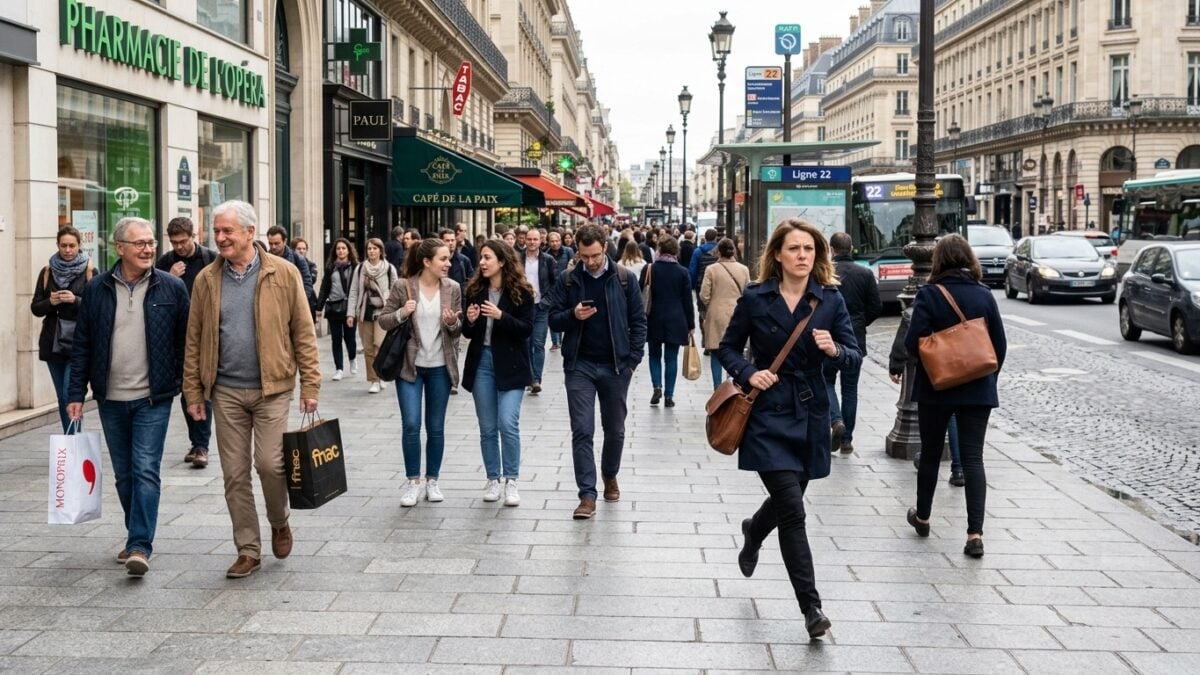
You’re crossing the sidewalk quickly, your bag on your shoulder, when someone in front of you drags their feet. Your rhythm breaks, your irritation builds in a few seconds. If this scene speaks to you, you are probably one of those people who walk quickly and don’t tolerate being slowed down.
For psychologists, this hurried step is not a simple detail of everyday life. Fast walking reflects a particular relationship with time, the body and others. Studies of up to 50,225 participants, published in the British Journal of Sports Medicine, link this brisk pace to a highly organized lifestyle and better overall health. But psychology also sees a very precise personality profile, organized around seven main traits.
Fast walking: what psychologists observe in people who walk quickly
Work inspired by the Big Five model shows that fast walkers often display strong conscientiousness: they plan, anticipate, respect deadlines. In a study of adults ages 71 to 82, those who scored highest on this trait walked at an average pace of 1.2 meters per second and slowed down only about 5 percent over three years. Their body follows the same tempo as their mind, very focused on action.
Other research points to marked extroversion, good emotional stability and real social energy. The team of psychologist Richard Wiseman, who observed pedestrians in 34 cities, also noted more signs of stress when these walkers were stuck behind slower ones. Nearly 78% of them say they feel confused or irritated when they have to slow down, as if their internal tempo is suddenly disrupted.
The 7 personality traits that fast walkers who are annoyed by slow walkers often share
First of all, these people are very goal-oriented: each journey serves a specific purpose, each detour seems like a waste of time. They value efficiency, optimize their routes, hate human traffic jams or queues. Concerned about their health, they see walking as a simple way to get active every day. Their competitive side also appears: even without an official race, they like to keep the advantage and, as summarized in a specialized article, do not necessarily seek to “win”, but to maintain their own pace.
We also find a high level of awareness of the environment, almost a hyper-monitoring of possible obstacles. These walkers appear determined and decisive, quickly make their choices and move forward without hesitation, in the street as in life. They often have a strong sense of self-awareness and a need for control, with an appearance that conveys confidence and ambition. For some, however, this energy hides a more discreet anxiety, a form of “addiction to doing” which pushes us to stay moving so as not to face emptiness.
How to enjoy your brisk walk without letting yourself be overcome by annoyance
When anger against slow people spills over to contaminate married life, outings with the children or work days, this hurried step sometimes becomes an alarm signal. Diffuse irritability, feeling of never having enough time, difficulty settling down can reflect stress that is taking hold. Some then choose to observe their own internal tempo, to identify the situations where tension escalates the fastest and to talk about it to those around them.
Others learn to play at several speeds: keep their pace fast for solo journeys, accept a slower pace with family, transform a wait into a micro-break rather than an internal battle. Deliberately walking a little more gently from time to time, just to see what it awakens, then becomes an experience in itself. This curiosity about one’s rhythm often allows one to stay true to one’s energy, without turning every sidewalk into a battlefield.