
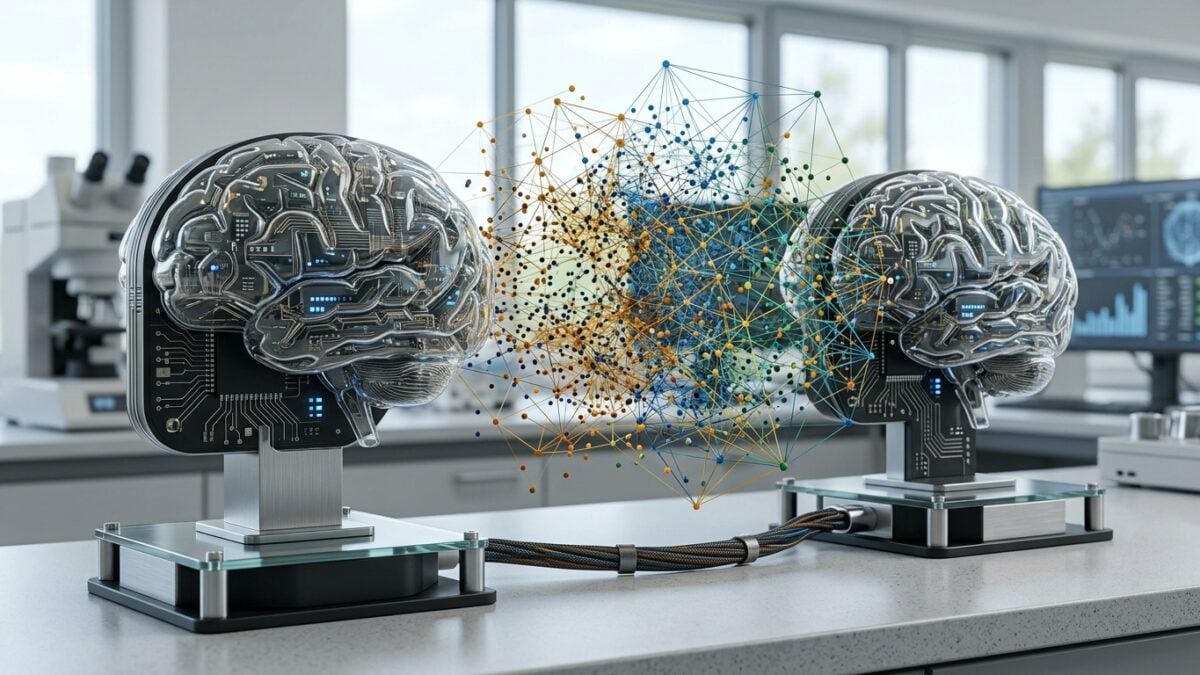
Changing chatbots without really feeling the difference is no longer just an impression. Researchers have shown that, even when trained separately, language models secretly draw internal maps of meaning that look strikingly similar. Inside, the words are no longer sentences, but points in an abstract space that seems to obey a kind of hidden physics of AI language.
A team linked to the vec2vec project, at Cornell, sought to see if these maps could be superimposed. Their result shakes up computer science as much as psychology: if AIs spontaneously align their representations, what do they really tell us about meaning, and about our own way of thinking? The question remains open.
When the hidden physics of AI language brings together two artificial brains
The researchers took two main models, fed with different sets of texts, distinct word divisions, and separate learning objectives. Using vec2vec, they learned to translate embeddings – these numerical coordinates associated with words – from one model to another without any matching sentences, only from around a million sequences of 64 tokens. After alignment, cosine similarities often rise between 0.88 and 0.96, indicating almost identical geometry.
For Psychology Todaythese systems remain above all machines for compressing language: similar words appear in similar contexts, and any efficient algorithm ends up folding its internal maps in the same direction. A psychologist sums up the idea there with the formula “Not a mind, but perhaps a mandate.” In other words, a very ordered structure, without interior experience.
In semantic geometry, meaning becomes a question of distance
Concretely, embedding places each word as a point in a space with many dimensions. Two neighboring terms in this semantic geometry often share a close meaning: the classic example “king – man + woman ≈ queen” illustrates this logic of directions. By compressing and predicting, the model digs conceptual valleys, erects ridges between opposing notions, as if language formed its own relief.
From here arises the Platonic Representation Hypothesis: any powerful enough model would end up discovering the same latent map of meaning. Vec2vec precisely exploits this idea of universal space to navigate from one model to another. It is no longer just a practical data format, but the mathematical trace of a shared structure that each AI finds, regardless of its training.
When this invisible map shapes our vision of AI
The first works focused on text alone, a very structured domain. Researchers are now starting to test this convergence between modalities: images, sounds, time series. If a model trained on photos and another on sentences results in compatible maps, the hypothesis of a universal structure of cognition gains ground. The machine doesn’t need to be conscious for it to organize the world in a strangely familiar way.
For the user, this has two very concrete effects. Many chatbots appear similar because they surf the same map of meaning, which nourishes the illusion of a common personality and reinforces anthropomorphism. And on a more down-to-earth level, this geometry can even leak information: by exploiting the vectors stored in certain databases, it becomes possible to guess, sometimes to reconstruct, sensitive texts. Suffice to say that this secret language of machines is beginning to weigh heavily in our psychological lives as well as in our data.