

In an analysis published by The Conversationdiabetologist and obesity specialist Kim Pfotenhauer of Michigan State University explains why weight loss doesn’t have a one-size-fits-all formula. Between metabolic adaptation, hormonal signals and environmental influence, medicine now understands that each trajectory is unique.
When the body interprets a diet as a threat
For decades, the message has remained the same: eat less, move more. A simple, almost moral equation, which has often left overweight people alone to face their guilt. However, in specialized consultations, doctors observe a much more confusing reality: two patients applying the same recommendations do not obtain the same results.
To understand this apparent injustice, we must look at what is happening inside the body.
Weight loss is based on an energy deficit: the body must spend more calories than it receives. But there is nothing automatic about this mechanism. The human body does not just passively “burn” its reserves. He reacts. He adapts. And sometimes he resists.
About 60 to 70 percent of our daily energy expenditure comes from basal metabolism — the energy needed to breathe, keep the heart beating, or maintain body temperature. The rest depends on digestion and physical activity, including the most ordinary everyday actions.
When food intake decreases, the body first draws on its glycogen reserves before mobilizing fat. But very quickly, defense mechanisms appear.
According to the work cited by Kim Pfotenhauer, the basal metabolism already begins to slow down after a loss of around 5% of body weight. From 10%, even the energy spent during physical activity decreases. In other words: the more a person loses weight, the more their body tries to save calories.
This adaptation is not due to a lack of will. It is organic.
The hormones involved in hunger and satiety also change. Signals that stimulate appetite increase, while those that contribute to feelings of fullness decrease — sometimes for more than a year after dieting.
In his article, Kim Pfotenhauer summarizes this reality as follows: “The body is clearly trying to regain what it has lost..
This physiological resistance helps to understand why so many people experience weight regain as a personal failure, when it is often a survival response deeply ingrained in our biology.
The “set weight”: why the brain defends certain kilos
For several years, researchers have been trying to understand why the body seems to defend a certain weight, even when it is harmful to health.
One of the main hypotheses is called “set point”, or “set point weight”. According to this model, each organism would have a sort of weight zone that the brain constantly seeks to keep stable.
To achieve this, it relies on an extremely sophisticated hormonal dialogue.
Leptin, produced by fat cells, informs the brain of available energy reserves. Ghrelin stimulates hunger. Insulin, cortisol and other hormones also participate in this delicate balance.
When weight drops below a certain threshold, the brain interprets this reduction as a potential threat of starvation. It then increases the feeling of hunger and reduces energy expenditure in order to restore lost reserves.
But this theory is not enough to explain all the complexity of obesity.
Other researchers defend the “stabilization point” modelwhich places more emphasis on the modern environment: ultra-processed food, chronic stress, lack of sleep, sedentary lifestyle, odd schedules, social pressure… Weight would then stabilize at the point of balance between what we consume and what we spend in our real lifestyle.
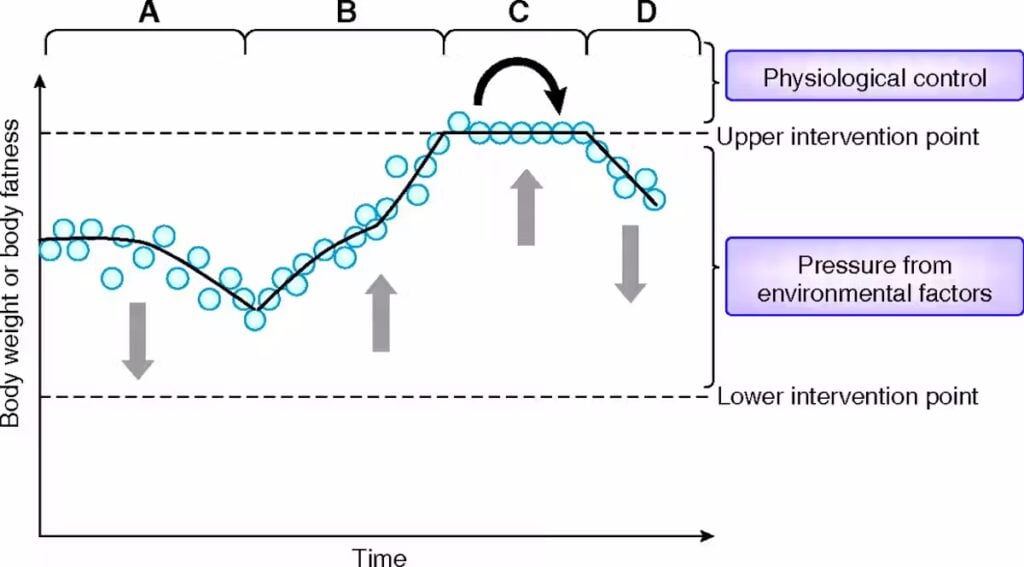
Kim Pfotenhauer also mentions a third model, called “dual point of intervention”which combines the two approaches. According to this theory, the body tolerates certain weight variations in a so-called “indifference” zone. Below a low threshold, defense mechanisms would be strongly triggered to avoid thinness. Above a high threshold, a protection system would also exist… but it would seem much less effective in contemporary human beings.
 © The Conversation
The dual point of intervention model postulates that environmental and social conditions encourage the body to lose weight (A) or gain weight (B) in order to remain in a zone of indifference.
This understanding profoundly changes the way we look at obesity. She reminds us that weight is not only a question of individual behavior. It results from a permanent interaction between biology, personal history, the social environment and sometimes even medications or associated illnesses.
Towards a more humane and more personalized weight medicine
This scientific revolution is gradually changing the way doctors treat obesity. Because not all bodies react in the same way.
Genetics, sex, fat distribution, intestinal microbiota, certain pathologies or certain treatments influence the way in which the body regulates weight. Two people subject to the same regime can therefore experience radically different trajectories.
In this context, new therapeutic approaches seek less to impose a single model than to adapt strategies to each patient.
Bariatric surgery, for example, appears capable of modifying certain biological mechanisms involved in hunger and weight regulation. Drugs from the GLP-1 agonist family, widely publicized in recent years, also act on the appetite circuits, even if they do not completely suppress metabolic adaptation.
For specialists, care is now based on several complementary pillars: a diet richer in protein and fiber, regular physical activity, improved sleep, stress management and psychological support if necessary.
Diet seems especially useful for initiating weight loss. Physical activity plays an essential role in long-term maintenance.
But beyond the numbers on the scale, this scientific development opens up a deeper reflection on our collective relationship to weight.
It invites us to move away from a guilt-inducing vision to recognize the complexity of the biological mechanisms at play. Above all, it reminds us that obesity is a multifactorial chronic disease, and not a simple lack of will.
In The ConversationKim Pfotenhauer finally formulates the central question simply: “The real question is therefore not “what is the best diet?”, but “what combination of levers suits my body and my life”“.
An intimate, often painful question, but one that medicine is finally beginning to look at with more nuance — and humanity.