

Maëva Coucke underwent emergency surgery after the PSG match: the ordeal of the ex-Miss France no longer stops
The scenario, however, had everything of a sporting fairy tale. Maëva Coucke, PSG jersey on her shoulders, shared her joy live on Instagram since the broadcast of the PSG-Arsenal final (played at the Puskás Aréna in Budapest) directly from the stands of the Parc des Princes. Videos of jubilation, cries of joy, electric atmosphere: the evening seemed perfect for the former beauty queen.
For Maëva Coucke, a not magical Pa(na)ris!
But behind the scenes of this day was much less idyllic. That same morning, the young woman had already spent four hours in the emergency room for infected stitches in her left index finger. “I had a crappy day.”she confided to her subscribers on Saturday afternoon. Despite the pain, she held on to reach the stadium on time.
But the party came at a price. As of Sunday May 31, Miss France 2018 returned to the hospital for emergency surgery. “After the party, the defeat… I’m back in the hospital because of my finger. Head to the block. I’m drunk“, she shared on her Instagram story, displaying an ironic victory “V” with her bandaged hand.
A medical ordeal that has lasted since the end of 2024
What many don’t know is that Maëva Coucke has been fighting this hand infection for many months. At the end of 2024, she underwent a first operation for a painful and seriously inflamed whitlow. At the time, she said she could no longer use her finger correctly, ironically saying that “Christmas gift than life” offered her. The consequences were particularly serious: following her treatment, she developed a severe intestinal infection
Clostridium difficilea toxigenic bacterial strain.
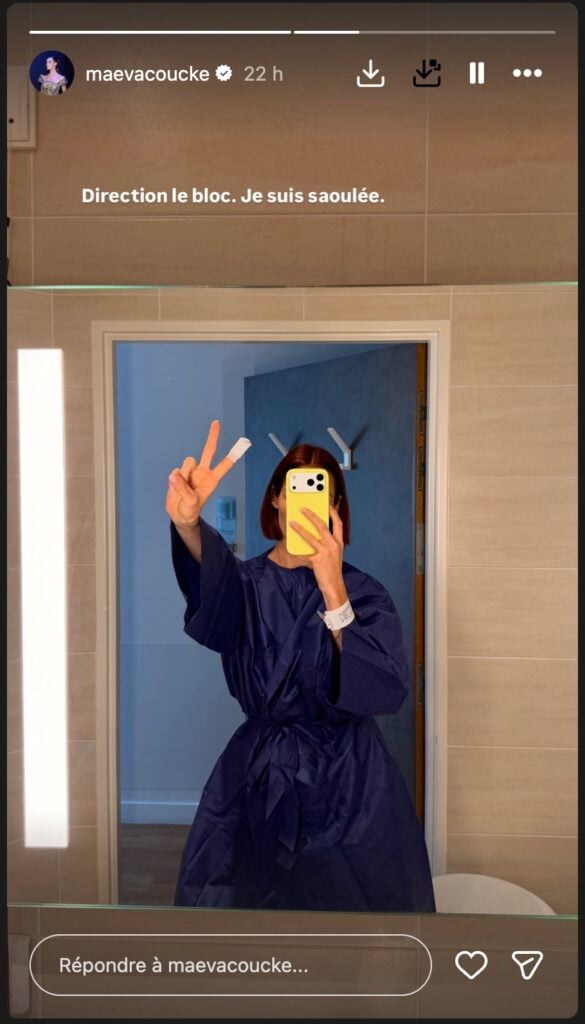 © https://www.instagram.com/maevacoucke/
Since then, the most attentive Internet users have spotted a recurring detail. Whether at the Cannes Film Festival, the Monaco E-Prix or in the stands of Roland-Garros, the former beauty queen systematically wore a discreet bandage on her index finger. This aggressive recurrence after the PSG match demonstrates how stubborn this condition can be.
What is a whitlow and what are the causes?
To understand Maëva Coucke’s situation, we must precisely define this hand pathology. Dr Gérald Kierzek, emergency doctor, explains to us that a whitlow corresponds to a “acute inflammation of the pulp of the finger (fingertip), caused by the penetration of a foreign body (a nail, a splinter, a blade of grass, a sting) or by a bacterial infection.
The culprit is almost always the same. “It is often a staph infection (staphylococcus aureus) that enters through a small wound, cut, puncture, scratch, or even a crack around the nail.
The entry points for the bacteria are multiple and sometimes microscopic. The doctor lists among the common causes:
- Minimal cuts or wounds, even invisible;
- Splinters, nails or blades of grass pricking the skin;
- Human or animal bites;
- Infected ingrown toenails;
- Nail biting or skin abrasions;
- The skin dries with cracks which greatly facilitate bacterial penetration.
“The infection develops quickly and can spread to the skin, tendons, joints and even bone, hence the importance of rapid treatment.“, warns Dr. Kierzek.
Symptoms, complications and surgery: when should you worry?
The first warning sign of a whitlow is a very characteristic pain. Dr. Gérald Kierzek describes a “sharp, lancinating and often throbbing pain, to the point that it prevents you from sleeping, especially at night. The finger becomes red (or yellow) around the infected area, swollen, sometimes with a visible pocket of pus. There is a local heat to the touch, a pulsing sensation where you “feel the abscess beating.”
In advanced forms, loss of mobility of the finger, purulent discharge and fever may appear.
Treatment directly depends on the course of the disease. At the initial stage, called inflammatory (without accumulated pus), the treatment remains medical: it combines antiseptic finger baths several times a day (diluted Dakin, Biseptine, Betadine), analgesics such as paracetamol, and sometimes antibiotics for risk profiles.
On the other hand, if the infection progresses, surgery becomes essential.
“The operation is performed at the abscess stage when pus is collected. It is done in the operating room on an outpatient basis (entry and exit on the same day), with loco-regional anesthesia where only the arm is asleep. says Dr. Kierzek.
It is precisely this protocol that Maëva Coucke had to undergo this weekend. The day after the procedure, follow-up is provided by a nurse who ensures by telephone that no adverse event has occurred.
Dr Kierzek finally reiterates an important point.
“You should consult urgently as soon as the first symptoms appear if: the pain prevents you from sleeping, you “feel” the abscess beating, you are diabetic, you are taking corticosteroid or immunosuppressant treatment, your tetanus vaccination is not up to date, you suffer from repeated nail infections, a fever appears, a red line goes up the length of the arm (sign of lymphangitis), or if the redness extends to the pulp of the finger and along the with the finger.”
Apart from these immediate seriousness criteria, a consultation with the treating physician remains essential within 48 hours.