
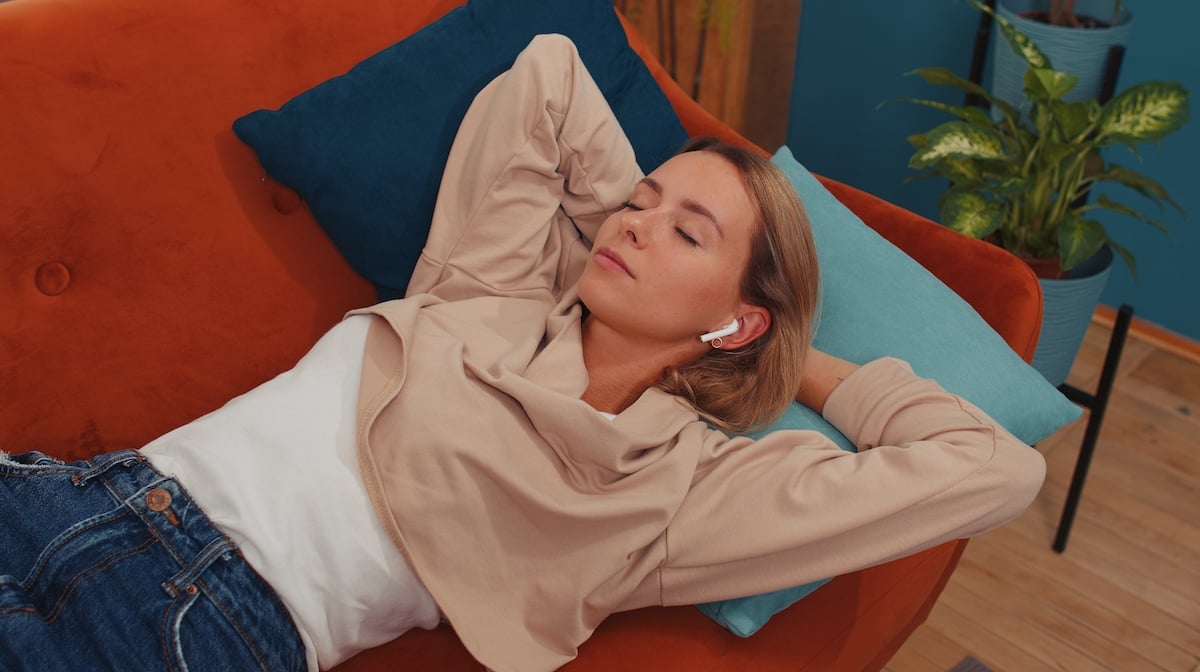
Failing to take sleeping pills, you have opted for headphones or earphones and the soft sound of a podcast, white noise or an ASMR video to sleep more easily. A good idea in theory, but what about your ears? ENT specialists have looked into the issue in the New York Times. What do they think and what do our experts say?
Sleeping with headphones: a danger for hearing?
First reflex: should we fear hearing loss? On this point, the specialists are rather reassuring. To permanently damage hearing, prolonged exposure to high volume is required. However, most people who fall asleep with headphones use relatively low sound.
As recalled by New York Times, “a normal conversation is usually around 60 or 70 decibels and is safe for any length“. In other words, listening to a quiet podcast or white noise at moderate volume does not, in itself, represent an immediate danger.
But Dr. Gérald Kierzek, medical director of True Medical, still called for caution in the long term in a previous article:
“To avoid this risk, it is important to follow the headphone safety recommendations and alerts on your phone. This includes not turning the sound higher than 60% of maximum volume. In addition, it is necessary to take breaks and limit long-term exposure”.
The doctor adds: “Too high a volume over the long term can lead to presbycusis”. This progressive and irreversible loss of hearing can appear earlier when the ears are overexposed to noise over the years.
The real problem: humidity, bacteria and ear infections
The main risk ultimately does not concern hearing so much as the ear canal itself.
The ENTs interviewed by the American daily warn especially about the humidity and heat created by headphones, particularly in-ear models equipped with silicone tips. These can promote an ideal environment for bacteria.
Jennifer Alyono, associate professor of head and neck surgery at Stanford School of Medicine, explains how headphones “can trap moisture and create an environment conducive to the growth of bacteria, potentially increasing the risk of ear infections”. Charming.
The risk increases even more if you shower in the evening before going to bed, which increases humidity.
Dr Kierzek, for his part, recalls why the ear is a favorable breeding ground for microbes: “The ear is a dark, humid environment with dead skin. It is therefore conducive to the development of internal bacteria in the ear.”
Should we be worried though? Not really, according to the doctor: “However, there is no need to worry because these are non-pathogenic saprophytic bacteria, such as staphylococci or streptococci.”
A study conducted by Manipal University in India nevertheless confirms that frequent use of headphones increases bacterial proliferation in the ear, particularly when these devices are shared between several people.
Also watch out for earwax blockages
Another often underestimated problem: headphones can push earwax deeper into the ear canal.
The Cleveland Clinic thus warns of the risk of earplugs which can lead to a blocked ear sensation, tinnitus or a temporary loss of hearing.
Sleeping with headphones can also cause mechanical irritation, especially in side sleepers. Finally, noise-cancelling headphones or earphones can prevent you from hearing important sounds like an alarm, call, or home emergency.
The right actions to continue listening without risk
Good news: you don’t necessarily have to give up your evening podcasts. A few simple precautions are enough to limit the risks.
Clean your headphones regularly. Silicone tips should be washed once a week in lukewarm water with antibacterial soap. The grills can be cleaned with a small dry brush then a cotton swab lightly moistened with 70% alcohol. As for the case, a daily microfiber cloth helps limit microbes.
Dr Kierzek insists: “Cleaning your headphones is a simple preventative measure that helps avoid the vast majority of infections linked to their use.”
Let your ears breathe. Specialists also recommend taking breaks every day to avoid constant humidity in the ear canal.
Other reflexes must become natural:
- Avoid sharing your headphones;
- Do not use headphones if irritation or ear infection occurs. Heat and humidity can slow healing and make inflammation worse;
- Watch for certain symptoms: pain, itching, discharge, feeling of blocked ear or loss of hearing should lead you to consult a health professional.
A safer alternative to falling asleep?
Finally, for ENT specialists, the best solution is often an external speaker rather than headphones directly in the ear.
Certain small flat speakers designed to fit under the pillow also allow you to listen to a podcast or white noise without compressing the ear canal. A way to continue to fall asleep lulled by your favorite playlist… without putting a strain on your ears.