

Just a few years ago, many people naturally associated love, desire and exclusivity. However, a study carried out by Ifop for Nouslib, the French application dedicated to uninhibited meetings, draws a very different landscape among 15-29 year olds. The results show that a significant part of the younger generation lives their sexual imagination outside the traditional boundaries of the couple.
Desire and love, two increasingly distinct realities among young people
The figures speak for themselves. According to the study, 46% of young people have already thought about someone else during sex. This proportion even reaches 67% among men aged 25 to 29.
At the same time, 65% of young people in relationships say they think about their old sexual experiences with an ex, a figure which rises to 74% among men in this age group.
These results reflect a reality that is often little discussed: desire no longer seems to systematically follow the rules of the exclusive couple. Being in love does not necessarily prevent projections, memories or fantasies related to other people.
The study also shows that these thoughts don’t just concern single people. They also appear in people in a stable relationship. For many young people, love and sexual imagination no longer automatically coincide.
When fantasies remain difficult to share within the couple
This trend is found in several profiles observed by the survey.
 © Nouslib
“What this study reveals is above all the existence of a parallel mental life that is much more widespread than we imagine. Fantasies, external thoughts or thinking about old experiences do not necessarily mean a lack of love or a desire to break up. Above all, it tells of a generation that experiences desire in a less binary and more complex way.“, explains Alan Bento, CEO of Nouslib.
Why the exclusive couple is losing ground with Gen Z
Beyond sexuality, the study highlights a broader evolution of relational expectations. The couple remains present in the life plans of young adults, but they no longer necessarily occupy the central place they might have had for previous generations.
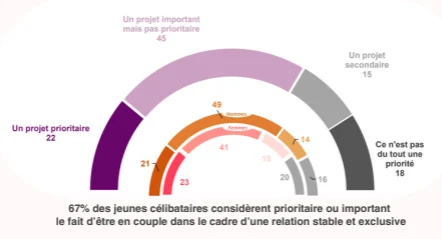 © Nouslib
For Nouslib, these figures reflect less a rejection of the couple than a desire to build relationships adapted to the emotional, sexual and personal needs of each person. This evolution outlines a more flexible relational model, where desire, autonomy and commitment no longer necessarily follow the same rules as before.