
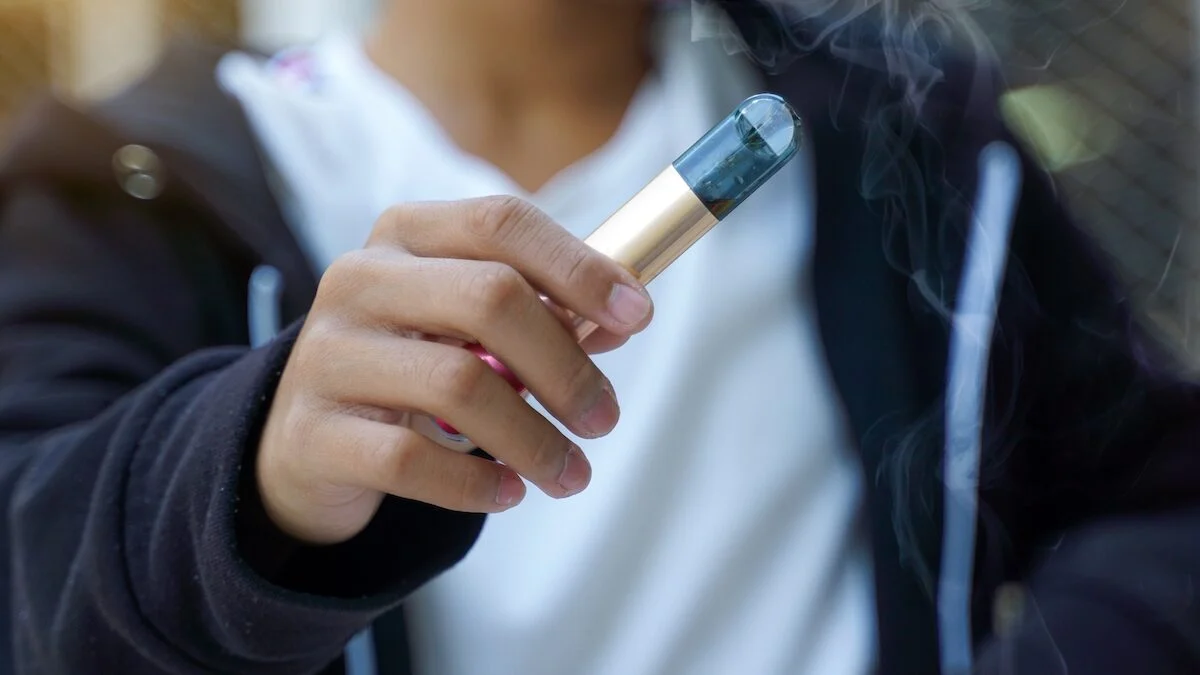
Since the start of 2025, reports linked to synthetic cannabinoids have increased in France. Convulsions, hallucinations, coma, suicidal ideas: the consequences observed in adolescents, sometimes very young, worry doctors. The Directorate General of Health (DGS) calls on professionals, families and the educational world to pay greater attention to a rapidly expanding phenomenon.
Behind simple vaping, substances are much more dangerous than they seem
For many parents, the scenario often begins the same way. A teenager vapes a product presented as legal, sometimes purchased online, sometimes obtained through a friend. Nothing, apparently, suggests danger.
However, health authorities have observed for several months a worrying increase in poisonings linked to synthetic cannabinoids, chemical substances designed to reproduce the effects of THC, the main psychoactive compound of cannabis. In its alert message addressed to doctors, the Directorate General of Health emphasizes that “a worrying increase in poisoning linked to synthetic cannabinoids has been observed since the start of 2025, mainly among adolescents“.
Often known under the names “PTC”, Buddha Blue, Spleen or K2, these products can be incorporated into colorless and odorless e-liquids. They are sometimes sold as CBD or as supposedly legal products, even though they contain substances classified as narcotics.
The main danger lies in the ignorance of consumers themselves. As the DGS reminds us, “users are often unaware of the real composition of the products consumed“. This lack of knowledge is all the more problematic as synthetic cannabinoids can be much more powerful than traditional cannabis. Their composition varies considerably from one product to another, making the effects particularly unpredictable.
The figures illustrate the scale of the phenomenon. Since the start of 2025 and until April 30, 2026, the National Agency for the Safety of Medicines and Health Products (ANSM) has identified around 500 reports transmitted to the addictovigilance network. More than 70% concerned young people aged 13 to 18. Even more worrying, 71% of cases were considered serious. Two deaths were also reported.
This development marks a change in the nature of risk. Long confined to certain consumption environments, the phenomenon now affects minors who sometimes have no awareness of the product actually inhaled, and the health consequences it can have.
Convulsions, hallucinations, coma: when intoxication becomes a medical emergency
One of the major difficulties for doctors is the diversity of symptoms observed. Unlike many poisonings which present relatively characteristic signs, synthetic cannabinoids can cause very varied manifestations, affecting several organs simultaneously:
- Neurological disorders are among the most common: significant agitation, confusion, convulsions, alteration of consciousness which can go as far as coma;
- Particularly worrying psychiatric manifestations: hallucinations, panic attacks, suicidal ideas or even withdrawal symptoms have been reported in the cases recorded;
- The cardiovascular system is not spared: some patients experience a significant increase in heart rate, chest pain or rhythm disturbances that could be life-threatening;
- Digestive symptoms, including nausea and vomiting;
- In the most severe situations, doctors observe simultaneous damage to the brain, heart and metabolism. These acute decompensations can lead to intensive care treatment.
“The clinical manifestations are varied and not very specific. They can associate neurological, psychiatric, cardiovascular or digestive disorders and delay the identification of exposure“.
This absence of characteristic signs partly explains why some cases still go under the radar. Synthetic cannabinoids are not systematically looked for during traditional toxicological analyses. Some emerging molecules even escape the detection methods used in hospitals.
Result: faced with an adolescent suddenly experiencing convulsions, a state of confusion or extreme agitation, the link with a synthetic cannabinoid is not always immediately established.
Urgent mobilization of families, schools and professionals
Faced with this emerging threat, health authorities wish to strengthen vigilance well beyond the medical world alone.
The General Directorate of Health insists on the need to quickly identify risk situations and to refer young people to emergency services without delay when signs of seriousness appear.
“In the presence of serious signs or a worrying clinical situation, urgent treatment is necessary.“, underlines the DGS.
But the answer also involves prevention. The authorities are asking health professionals to raise awareness among adolescents and their loved ones of the dangers of these substances, including when they are consumed in the form of vaping or presented as legal products.
The school environment is particularly concerned. The DGS calls for “increased attention” in educational and extracurricular establishments, taking into account the high exposure of minors.
Families also have a vital role to play. A sudden change in behavior, unexplained discomfort after vaping, or sudden neurological or psychiatric disorders should prompt consultation.
To better understand the extent of the phenomenon, health authorities are finally emphasizing the importance of reporting. Each suspected case makes it possible to identify the substances currently circulating and to adapt prevention measures. In this context, doctors are invited to report any suspected or confirmed cases via the national portal for reporting adverse health events.
Because behind each statement there is a collective issue. Better identifying these products, understanding their effects and identifying new molecules in circulation constitutes one of the essential conditions for protecting adolescents today.
The alert launched by the authorities recalls a reality that is often overlooked: behind the innocuous appearance of an electronic cigarette can sometimes hide a substance whose potency and toxicity far exceed those of cannabis. A discreet but very real threat that families, teachers and health professionals now face together.