
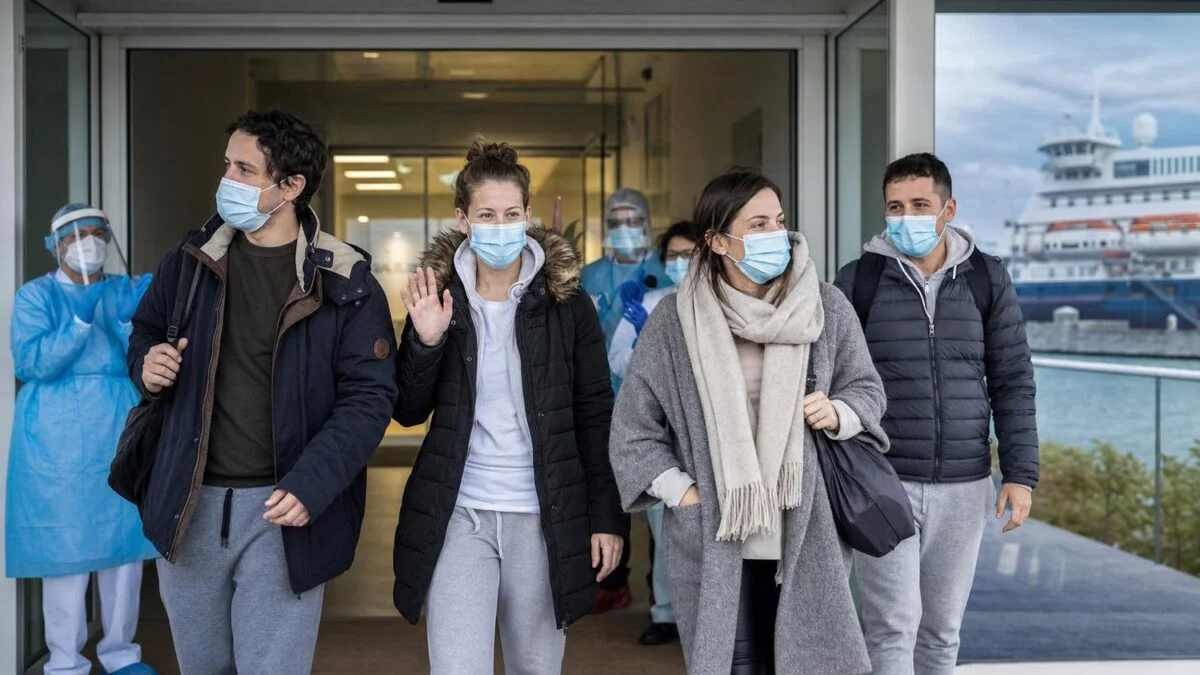
After six weeks of strict isolation at Bichat hospital in Paris, the four French passengers exposed to the hantavirus aboard a liner finally found the open air on Sunday June 21, 2026. These ex-cruise passengers from MV Hondius
had been repatriated on May 10, after the discovery of an outbreak of Andes hantavirus on the ship, which infected 13 people and caused three deaths. A fifth French woman, infected, remains in intensive care. For France, this release marks the end of the most visible quarantine of this episode, without additional worrying signals.
The World Health Organization has been following this issue from the beginning. Thursday, its director general Tedros Adhanom Ghebreyesus recalled that “With no new cases reported or deaths reported since May 2, the situation remains stable“. Almost all passengers and crew members of the MV Hondius were allowed to return home, while the ship, cleaned and disinfected in the Netherlands, returned to sea on May 30. Virologist Nicole Tischler, president of the International Hantavirus Society, believes that “we can consider that the episode is probably over” if no new cases appear by Tuesday – the end date of confinement decided by most countries.
End of isolation in Bichat for four French people from the MV Hondius
The five French cruise passengers had landed urgently in Bichat, in negative pressure rooms, with PCR tests every three days. Two of them had asked to complete the quarantine at home, without success. In a daily newspaper, they described a “fairly prison” daily life. But over the 42 days, none of them developed symptoms, which allowed their isolation to be lifted this Sunday.
The case of the fifth passenger remains heavier. This French woman showed signs of infection on the repatriation plane, before testing positive on arrival. Her condition quickly worsened and she was placed in intensive care. The Ministry of Health speaks today of a stable condition, and Didier Lepelletier, Director General of Health, assured parliamentarians: “She is doing better”. According to infectious disease specialist Xavier Lescure, who heads the high isolation unit in Bichat, “We have worked a lot on the isolation of patients and the protection of caregivers“.
Why six weeks of quarantine for Andes hantavirus
The strain in question, thehantavirus Andesis the only one known to be transmitted from human to human and causes serious pulmonary infections, with mortality estimated between 30 and 40%. In a closed environment like the MV Hondius, the conditions were truly an accelerator of viral particles, despite limited contagiousness: only 13 cases were recorded. The French authorities still retained a quarantine of 42 days, the maximum duration considered to be risky for incubation.
A French strategy of “maximum security” in the face of limited risk
Regarding the management of contact cases, France has chosen strict hospital isolation, when other countries, such as the United Kingdom, have authorized home isolation. “It was really a line of conduct that we all shared: politicians, central administration, experts.“, explained Didier Lepelletier. For him, “The aim of the game was really to have maximum security around contacts.“, even though “hantaviruses do not currently represent a very significant health risk in France“.
As a backdrop, this episode recalls the rise of
zoonosesthese diseases which pass from animals to humans. Most of the tens of thousands of hantavirus cases reported each year worldwide are linked to contact with rodents, not person-to-person transmission. The MV Hondius will therefore remain as a rare textbook case, where maximum vigilance was deployed to contain a dangerous virus, but remained confined to the ship and its passengers.