
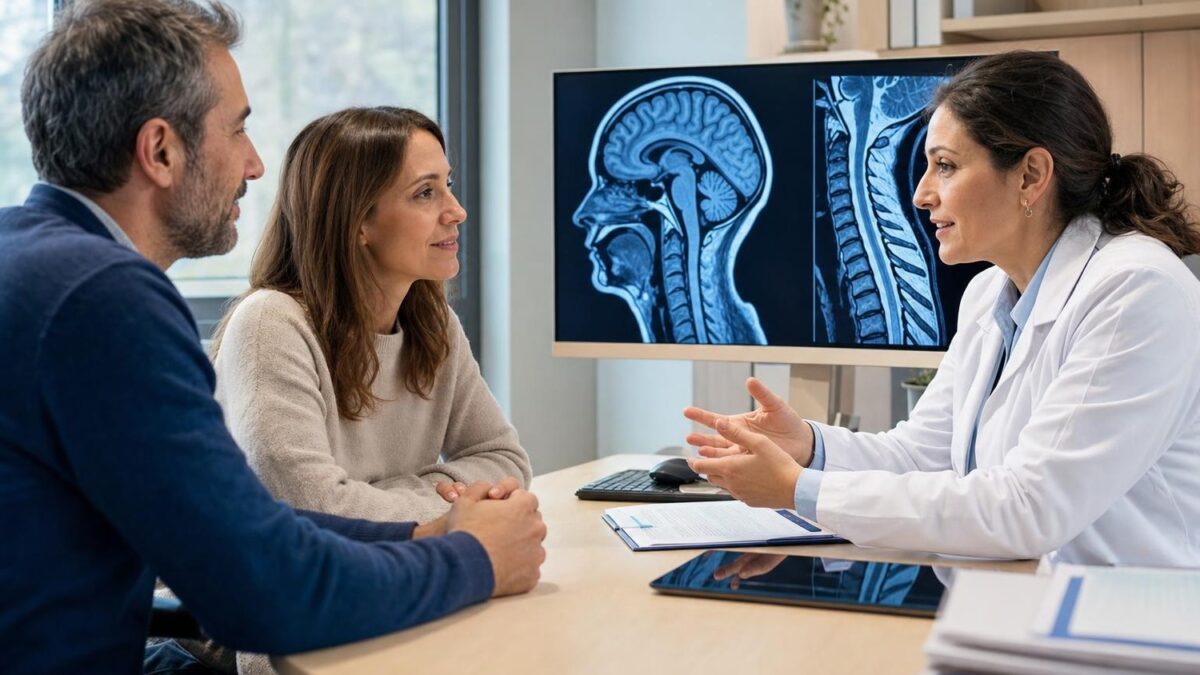
For years, their daily lives were punctuated by the threat of a new flare-up, loss of vision or irreversible disability. Two patients suffering from neuromyelitis optica, a rare and often debilitating autoimmune disease, have not experienced any relapse for more than fifteen years after an experimental stem cell transplant carried out in Italy. An exceptional remission which opens a new avenue for medicine… while reminding us of the risks of such radical treatment.
Neuromyelitis optica: the immune system becomes the enemy
For these two patients, the disease was not a simple succession of symptoms. She was a constant threat. Neuromyelitis optica with spectrum (NMOSD, for Neuromyelitis optica spectrum disorder) is a rare autoimmune disease in which the immune system mistakenly attacks certain structures of the central nervous system, including the optic nerves and spinal cord.
The consequences can be brutal: intense eye pain, visual disturbances which can lead to blindness, vomiting, muscle weakness, paralysis. Each flare-up can leave permanent after-effects.
Despite recent therapeutic advances, the disease remains difficult to control. Researchers at IRCCS San Raffaele Hospital point out that 60 to 98% of patients can still experience relapses despite available treatments. Today, no approved therapy makes it possible to obtain lasting remission without immunosuppressive treatment, with prolonged disappearance of the antibodies responsible for the disease, in particular AQP4-IgG.
Faced with this reality, two patients whose disease was resistant to all existing strategies accepted an experimental approach: replacing their failing immune system with a new one.
A “reset” of the immune system thanks to a transplant
The strategy used is allogeneic hematopoietic stem cell transplantation (alloHCT). Unlike an autograft, where you reinject your own stem cells after having taken them, this technique uses cells from another donor.
The objective is ambitious: destroy a large part of the old immune system to allow the installation of a new system, which would no longer carry the memory of the autoimmune attack.
The first patient received the transplant in 2009 with stem cells from his sister. The second patient was transplanted in 2010 thanks to an unrelated donor. Before the infusion, doctors used several treatments (fludarabine, treosulfan, rituximab) in order to eliminate as much of the old immune system as possible, in particular the B lymphocytes involved in the production of AQP4-IgG antibodies. The analyzes carried out subsequently showed a complete replacement of the immune cells by those from the donor. The researchers observed no signs of graft-versus-host disease (GVHD), a potentially serious complication of transplants.
The new immune system also seemed to function differently: patients found a balance between different populations of T and B lymphocytes, including an increase in regulatory T cells (Tregs), known for their role as a natural brake against autoimmune reactions.
“I don’t think you could call it a cure, but it still took care of the problem that the disease caused over this very long period of time.”explains Jiao Jiao Li, biomedicine at the University of Technology Sydney, interviewed by Nature.
A cautious formulation, which well summarizes the current state of knowledge: the disease seems to have been permanently neutralized, but science does not yet have all the answers.
Fifteen years without a relapse: two lives getting back on track
The result remains spectacular. After 15 and 16 years of follow-up, neither patient presented a new relapse of NMOSD. None required maintenance immunosuppressive treatment. Imaging tests showed stability of the brain and spinal cord lesions, sometimes even improving.
Even more remarkable: the AQP4-IgG antibodies, characteristic markers of the disease, disappeared shortly after the transplant and remained undetectable.
Behind these figures, there are above all two disrupted human trajectories. According to researchers, the man returned to a life considered normal and became the father of two children. The woman regained some of the mobility of her arms and was able to stop her symptomatic treatments.
These pathways illustrate what the possibility of no longer living waiting for the next attack represents for patients suffering from severe autoimmune diseases. But they remain two special cases, obtained in a very specialized medical context.
A promising step forward, but an intervention that is not without danger
The enthusiasm around these results must be accompanied by caution. An allogeneic stem cell transplant is not a trivial treatment. It involves a phase where the immune defenses are profoundly weakened, exposing one to potentially serious infections.
In this study, researchers report several complications, including antibody deficiency requiring treatment, swollen lymph nodes and bladder cancer. They point out that secondary cancers are “not rare” after a transplant and that infections constitute a major cause of death in this context.
For the authors, this study represents above all a “proof of concept”: it shows that a profound modification of the immune system can, in certain situations, interrupt the autoimmune mechanism responsible for the disease.
But this strategy could only concern a very restricted group of patients: young people, suffering from particularly aggressive forms of NMOSD, who do not respond to available treatments, and only in the context of clinical trials intended to better measure the relationship between benefits and risks.
A new frontier for autoimmune diseases?
This observation goes beyond neuromyelitis optica alone. It fuels a question that runs through research today: can we, in certain autoimmune diseases, rebuild an immune system instead of simply trying to calm it down?
The answer is still under construction. Transplantation will never be a universal solution and will not replace existing treatments for the majority of patients. But these two stories show that another path is possible: that of a medicine capable, in certain extreme cases, of profoundly changing the course of an illness.
For the patients concerned, the challenge is not only to gain years without relapse. It’s about finding a life that is no longer organized around the fear of the next outbreak.