
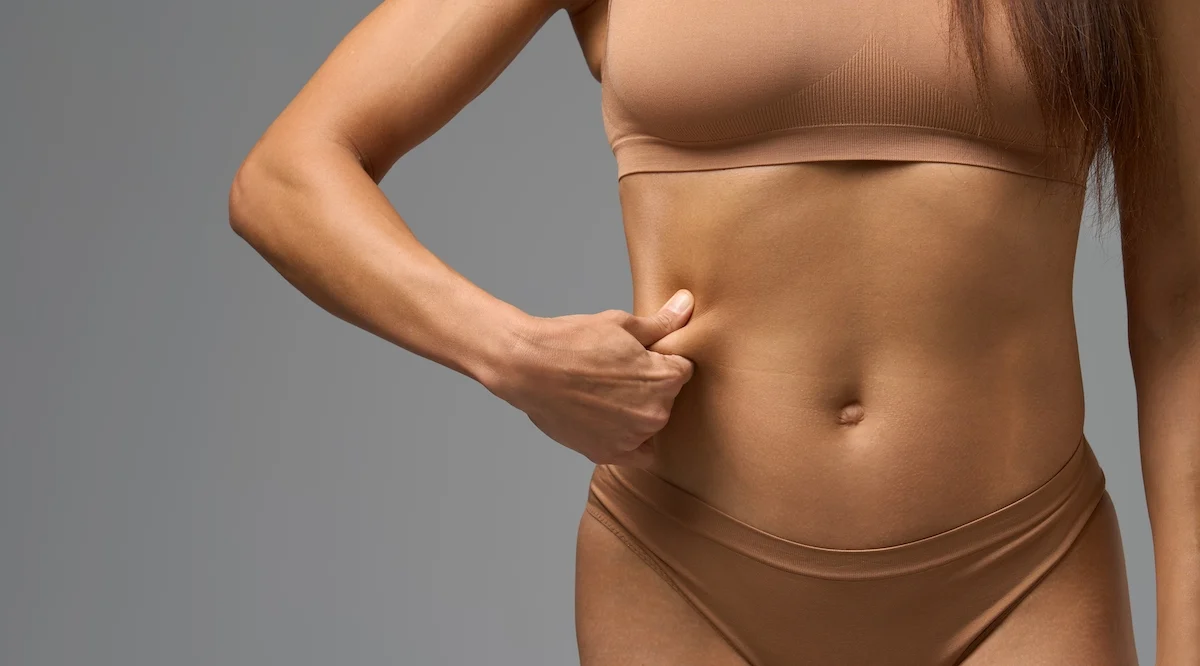
The body positivity movement is not yet the norm. Proof of this is, in recent months, with the appearance of a new term to describe people who are thin, certainly, but who dare to still have a little localized fat: to be skinny fat.
A medical term hijacked by social networks
Originally, the term skinny fat designates a very specific medical reality. It describes a person whose body mass index (BMI) is considered normal, but who has excess fat mass associated with insufficient muscle mass. This body composition can actually increase the risk of certain health problems, particularly cardiovascular or metabolic.
But on social networks, this scientific definition has been widely distorted.
Today, be skinny fat simply means being thin… without having a sufficiently sculpted body. Videos are multiplying to explain how to avoid being “skinny fat”, with promises of a perfectly flat stomach, defined abs, firm arms or even legs without the slightest wrinkle.
In a few months, aesthetic criteria have become even tougher. Being thin is no longer enough: you now have to be dry, toned and perfectly proportioned. An ideal that is ever more difficult to achieve.
A new injunction which maintains the complexes
For Julie Boët, dietitian nutritionist, this trend is particularly worrying.
“The term skinny fat has widely spread on social networks to designate people who appear thin but who retain a certain amount of body fat. Behind this expression, however, hides a very reductive vision of the human body, which suggests that one should not only be thin, but also present a perfectly shaped body, without any roundness.”
According to the specialist, this new label feeds a permanent feeling of dissatisfaction. This injunction fosters unnecessary guilt and pushes some people to believe that they are never “good enough,” even after significant weight loss.
In other words, even when the slimming goal is achieved, a new standard immediately appears, making satisfaction ever more inaccessible.
No, retaining some fat is perfectly normal
This quest for a perfectly dry body, however, forgets an essential biological reality: our body needs fat to function.
“In reality, retaining body fat after weight loss is completely normal.”recalls Julie Boët.
Adipose tissue is not a simple “stock” that should absolutely be gotten rid of. It constitutes an energy reserve, protects the organs, helps maintain body temperature and plays a fundamental role in the production and regulation of numerous hormones.
Wanting to eliminate all traces of fat is therefore not a health objective. On the contrary, a percentage of fat mass that is too low can sometimes have serious consequences.
“In women in particular, an insufficient amount of body fat can cause hormonal disruptions, irregular menstrual cycles or even the disappearance of periods. In both men and women, it can also affect energy, bone health, immunity and even physical performance.“
Why losing weight doesn’t automatically transform the body
Many people are surprised to lose several kilos without obtaining the very muscular physique highlighted on TikTok. The explanation, however, is simple.
“Weight loss doesn’t just mean fat loss.”underlines Julie Boët. Without appropriate physical activity, particularly muscle strengthening, part of the loss also concerns muscle mass. “Weight decreases, but body composition sometimes changes little, which can give the impression that certain areas remain fatter despite the efforts made.”
This phenomenon is common and absolutely does not mean that weight loss has failed.
To preserve muscle mass, the specialist recommends combining a balanced diet, rich in proteins, fiber and good fats, with regular physical activity.
“The goal is not just to lose weight, but to maintain strength, metabolism and overall health.”

Beware of unrealistic advice circulating on the networks
The problem is that many videos presented as “well-being” advice encourage risky behavior: significant dietary restrictions, excessive sports sessions or even the constant hunt for even the slightest gram of fat.
For Julie Boët, this search for an ever drier body can quickly become an endless spiral.
“Beauty standards are constantly evolving and images posted on the internet are often retouched, selected or taken in very specific conditions. Comparing one’s body to these unrealistic models often leads to permanent dissatisfaction, even when one’s health is good.”
Added to this is another often forgotten factor: we are not all equal when it comes to fat distribution.
“This largely depends on genetics, age, hormones and lifestyle. Two people of the same weight and height can have very different body shapes. It is therefore impossible to completely control the way our body stores or loses fat.”
A healthy body is not a fat-free body
If certain areas of fat persist despite a balanced diet and regular physical activity, this does not mean that you need to increase your diets or restrict your diet even further.
On the contrary, this obstinacy can promote frustration, eating compulsions, fatigue and deterioration of the relationship with the body.
For the dietitian, the message is clear: “Fat is not an enemy, neither in our diet nor in our body. Lipids are essential nutrients and body fat is a tissue essential to our balance.”
Ultimately, the real trend should not be to chase down every bulge, but to seek a body that can function properly, move, recover and live fully. Because being in good health is not measured by the visibility of your abs, but by the balance between diet, physical activity, mental well-being… and acceptance of a body which does not need to be perfect to be in great shape.