
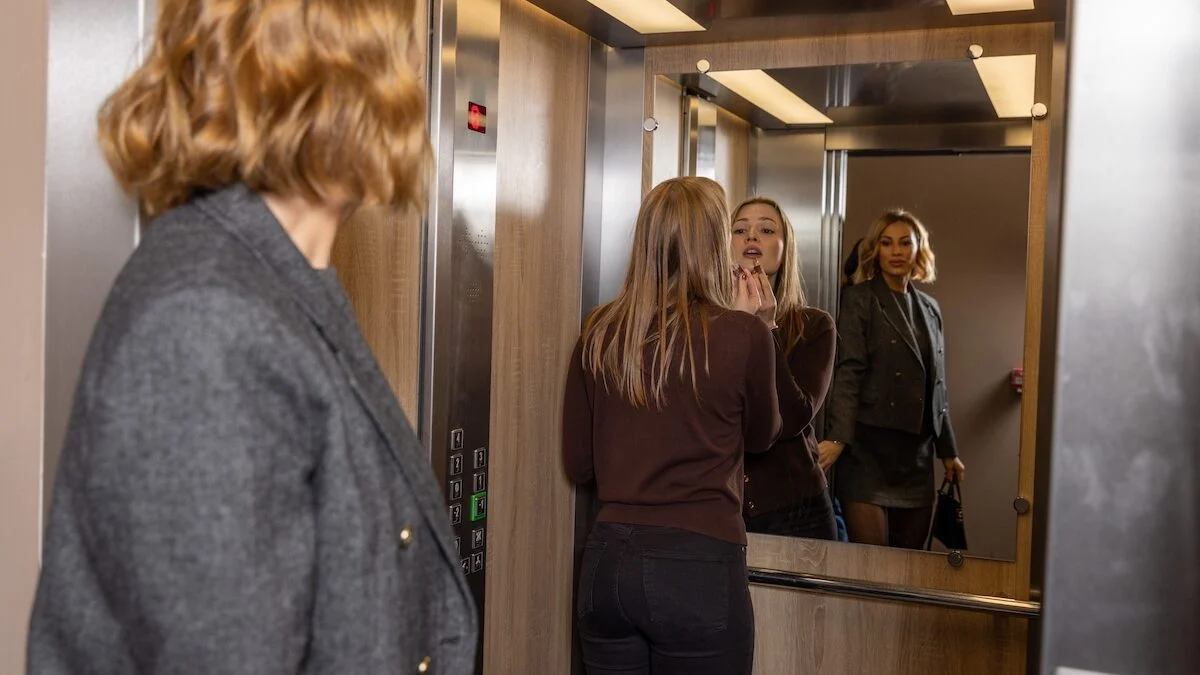
In most modern buildings, an entire wall of the cabin is covered with a large mirror, to the point that you almost forget that it is part of the equipment. We look at each other absently, we fix our hair, we wait between two floors… However, this very common device is not there to allow you to get a makeover. It first responds to issues of security, accessibility and psychological comfort in a closed space.
The elevator mirror actually serves several things at the same time: making it easier for users with reduced mobility to maneuver, increasing the field of vision so that everyone can see what is happening behind them, and making the cabin visually larger. The Pressesanté site recalls that its use became established at the end of the 1950s in the United States, while Linternaute already mentions ice cream in a public elevator in 1857, at the time of Elisha Otis.
Accessibility: the first use of the elevator mirror
For a person in a wheelchair, getting out of a narrow cabin without being able to turn around completely can quickly become complicated. The accessibility guide from the Association of Hospital Engineers of France (IHF) specifies that a mirror must be provided opposite the door to allow people in wheelchairs to move backwards safely. Thanks to this reflection, the user sees the door frame, any obstacles and other passengers without having to pivot.
The European standard EN 81-70, synthesized by the elevator manufacturer KONE, requires a mirror in several types of accessible cabins, notably types 1, 2 and 3. In a type 2 cabin, the same standard provides for example interior dimensions of approximately 1100 mm by 1400 mm, with a door of 900 mm. The mirror then compensates for the limited space by providing a clear visual cue to users when seated.
Safety and well-being: what a mirror in the elevator changes
Environmental safety specialists also emphasize another point: the mirror improves vigilance. At a glance, everyone sees who is entering or standing behind them, which limits blind spots. This additional visibility can discourage theft or aggressive behavior, an effect close to what psychologists call the Hawthorne effect, when we adopt more correct behavior because we know we are being observed.
On a psychological level, the media Pressesanté also reminds us that staring at your reflection offers a focal point which distracts attention from the anxiety of the journey. For people prone to claustrophobia, the reflective wall gives an illusion of depth and makes the cabin appear larger, reducing the feeling of suffocation. Many passengers also say that it helps time pass more quickly, keeping their eyes focused on something familiar.
When the elevator mirror becomes useless… or almost
In the panoramic glass cabins, described by Pressesanté, the view of the outside already plays the role of distraction and spatial reference, which makes the mirror less essential. Some hospitals also limit these facilities, while other very spacious buildings consider them optional, because the risk of claustrophobia is lower. But in the end, this mirror reflects much more than just your image.