
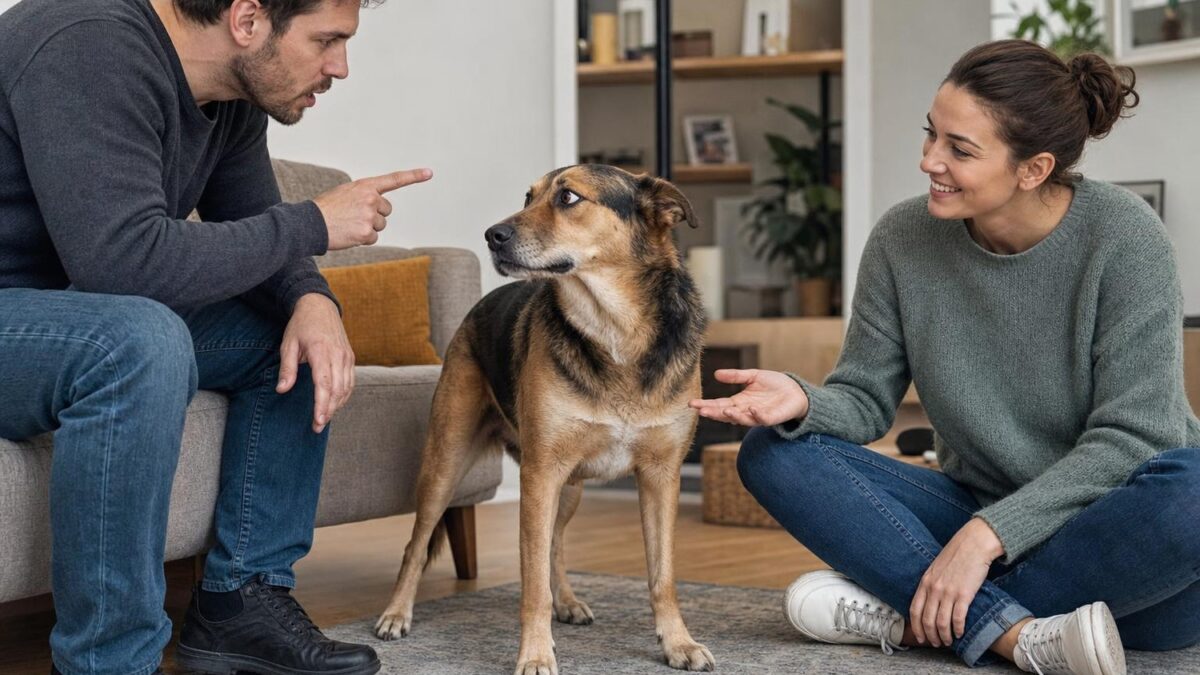
A study published in 2025 in Animal Cognition shows that dogs do not seem to pass moral judgment on humans as we often imagine. On the other hand, other work reveals that they are capable of perceiving many social and emotional cues. An essential difference to better understand their behavior.
When a simple grunt feeds an old myth
Who has never heard this phrase: “Trust the dog, he smells bad people” ?
This conviction crosses generations. When a dog greets a stranger with enthusiasm but is wary of another, it is tempting to see it as an almost infallible form of intuition. However, behind this impression lies a question that scientists have been trying to elucidate for several years: are dogs really capable of judging the moral value of a human being?
To answer this question, a team from Kyoto University and the Clever Dog Lab at Vetmeduni Vienna decided to put this belief to the test under rigorous experimental conditions.
A study of 40 dogs that challenges preconceived ideas
Published in 2025 in the journal Animal Cognitionthis study observed 40 dogs confronted with two strangers: one adopted generous behavior, the other showed selfishness. The researchers wanted to know if the animals would spontaneously favor the most cooperative person.
As Hoi-Lam Jim, first author of the study, explains: “Many people believe that dogs carefully observe social interactions and infer with whom it is worth cooperating.”.
The result surprised the researchers: of the 40 dogs tested, only three showed a consistent preference for the same person: two chose the generous individual, while a third preferred the selfish person.
The authors summarize their observations unambiguously: “Their behavior towards the two people did not exceed the level expected by chance.”.
In other words, in this specific protocol, there is nothing to confirm that dogs spontaneously distinguish “good” from “bad” humans.
But this conclusion is not the end of the story.
Researchers remain cautious: the protocol could mask certain capabilities
For Hoi-Lam Jim, these negative results do not necessarily mean that dogs are incapable of evaluating humans.
She emphasizes: “It is possible that methodological difficulties in the experimental protocol, in particular the use of a two-choice test, explain our negative results..
The team believes that new research is necessary, particularly with dogs with very different backgrounds: stray dogs, assistance dogs, police dogs or animals living in varied environments. Their life history could influence the way they interpret human interactions.
This scientific caution is all the more important since an older study had reached significantly different conclusions.
What dogs really seem to observe about us
In 2015, another team from Kyoto University studied 54 dogs in a now famous experiment called Helper – Nonhelper – Control.
The animals observed a scene in which a person helped — or refused to help — their owner. This time, the dogs were significantly less inclined to accept food from the individual who had refused to help.
Researchers saw it as a form of “social listening” (social eavesdropping): dogs would be able to take into account the way a human treats their master.
Placed side by side, these works paint a much more nuanced picture than a simple “sixth sense”. Above all, dogs seem to combine several mechanisms: their emotional reaction to the way their owner is treated, their preference for cooperative people, but also the associations that they build through their experiences based on a smell, a posture, a voice or an attitude.
Some specialists also point out that our own perception can mislead us. Other analyzes suggest confirmation bias: we retain more of the situations where the dog “was right” than all those where its behavior revealed nothing particular.
If your dog avoids someone, he is mainly expressing his own feelings
So, should we be wary when a dog growls at a person? Current knowledge calls for caution. A dog is extremely sensitive to the signals we emit: body tension, voice intonation, facial expressions and, according to some studies, even certain odors linked to stress or emotions.
His behavior reflects above all his own emotional state and his past experience. A stranger may remind him of a bad encounter, adopt a posture that he finds worrying or simply release tension that makes him uncomfortable.
In other words, when a dog distances itself from someone, it is probably not rendering a moral verdict. Above all, it expresses a discomfort that should be listened to and respected. This distinction is essential: it reminds us that our companions are not detectors of good or evil, but animals extraordinarily attentive to their environment, whose sensitivity continues to fascinate researchers today.