
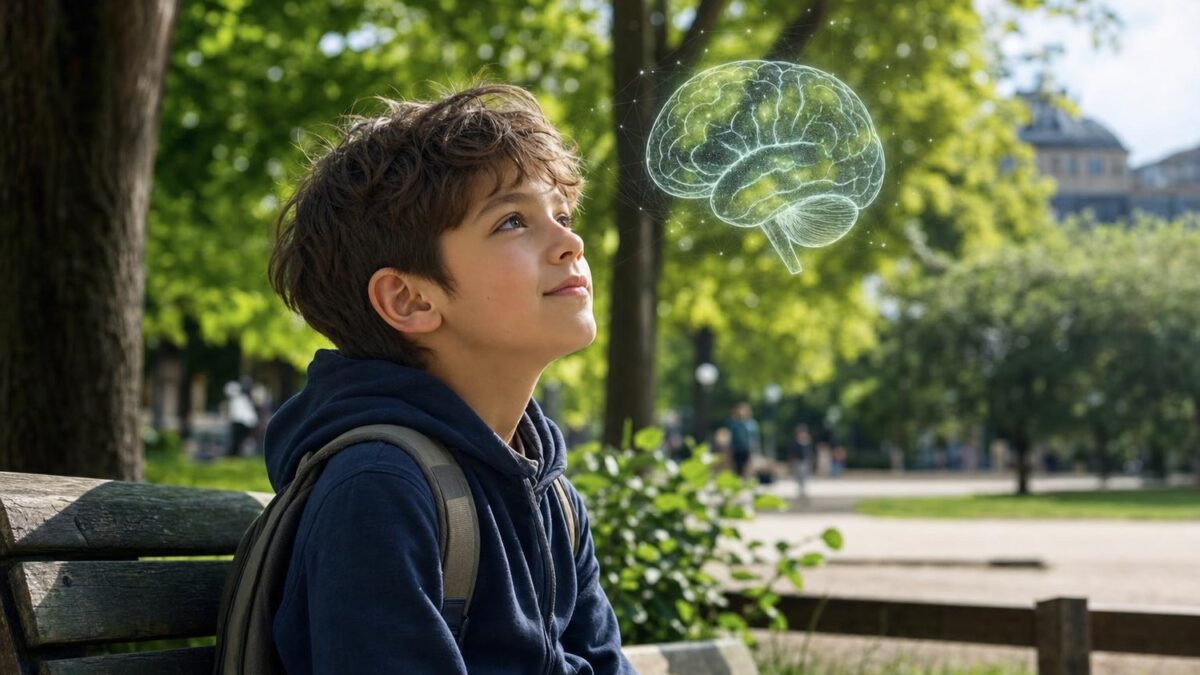
MRI scans carried out in a cohort of 8,430 children aged 9 to 10 show that living surrounded by trees leaves a mark in the brain. According to this research on green spaces and children’s brain development, nature seems linked to better abilities. A key question remains: what exactly do these square meters of green change in a growing brain?
The study conducted by Jia Liu and his colleagues goes further than simple tests. The researchers combined nine indicators of greenness around the home (tree canopy, forest types, NDVI index) with measurements of surface area, cortical volume and white matter. Their goal: to understand how the neighborhood environment can support or hinder children’s cognitive abilities and mental health.
MRI and green spaces: what children’s brains show
In the ABCD cohort, approximately 8,430 children aged 9 to 10 years underwent MRI of cortical structure, and 8,161 of white matter measurements, the differences being explained by the availability of imaging data depending on the analyses. Exposure to nature was estimated from land use maps and satellite images, making it possible to measure the quantity and type of vegetation around the home.
The authors observe an association between the presence of green spaces and certain indicators of brain structure in children. Greater exposure to urban greenery, including tree canopy and mixed vegetation, is associated with differences in cortical surface area and white matter integrity.
Green spaces beneficial to cognitive development
These brain changes are accompanied by very concrete differences. In the ABCD cohort, children from greener neighborhoods had fewer emotional disturbances or aggressive behaviors and better crystallized intelligence scores, linked to vocabulary. More efficient white matter is also associated with higher fluid intelligence.
This table is consistent with the theories of Restoration of Attention and Stress Reduction (Attention Restoration and Stress Reduction)who propose that nature restores attention and lowers chronic stress levels.
Not all green spaces help children’s brains equally
This research suggests that children living near green spaces have better attentional performance. However, a large study carried out on American children qualifies this observation: very strong exposure to dense forest areas would be associated with certain slightly less favorable brain indicators, particularly at the level of white matter and fluid intelligence.
The authors point out that these results are only correlational, based on satellite data, and emphasize the need for longitudinal studies to better understand these effects over time.