
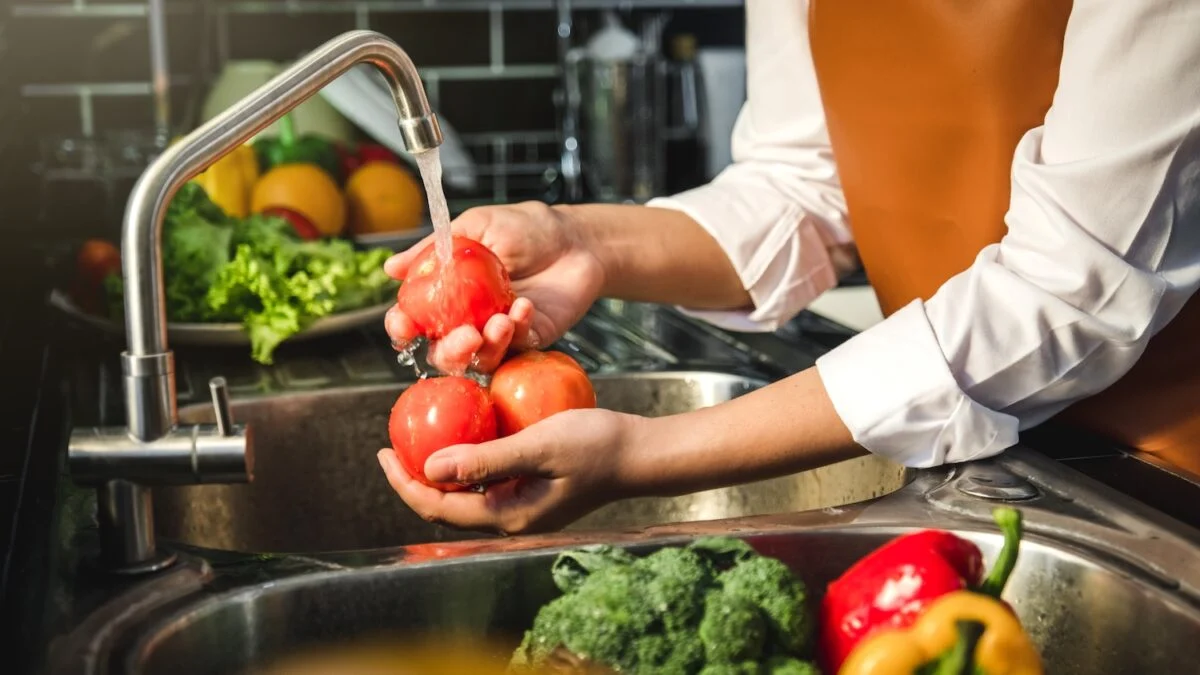
Pesticides, bacteria, successive manipulations… Contrary to popular belief, organic products do not need to be washed under water. And no need for vinegar or bicarbonate: the most effective action is also the simplest.
This fruit seems impeccable… but its story doesn’t end at the supermarket aisle
An organic tomato, an apple bought at the market, a freshly harvested salad. Their appearance inspires confidence. For many consumers, the organic label or the prospect of peeling a fruit is enough to eliminate any risk.
However, before arriving in our kitchen, these foods have traveled a long way. They have been grown, harvested, transported, stored, manipulated several times. At each stage, they can accumulate residue or microorganisms invisible to the naked eye.
In a video published on her Instagram account, microbiologist Dr Océane Sorel aka @thefrenchvirologist reminds us why systematic washing of fruits and vegetables should be a reflex, whatever their origin or method of cultivation.
Because this action, which only takes a few seconds, constitutes one of the simplest ways to reduce the risk of food contamination.
Organic does not mean risk-free: three reasons to never skip washing
The specialist first dismantles a stubborn preconceived idea: an organic product is not a product free of residues.
First argument: pesticides.
Organic crops also use substances intended to protect the crops. They are of natural origin, but that does not mean that they are without effect, as Dr Océane Sorel reminds us: “Natural does not mean harmless. There are a lot of natural things that can kill you.”.
Second reason: germs.
Fruits and vegetables, whether organic or conventional, can be contaminated by different bacteria during their production or distribution. Among the best known are
Escherichia coli Or Listeriaresponsible for sometimes serious infections, particularly in vulnerable people. With her deliberately direct tone, the microbiologist reminds us that these bacteria: “I love poorly washed salads.
Finally, third element often forgotten: human manipulation.
From the field to the consumer’s basket, fruits and vegetables pass through many hands. “They were picked up, transported, groped”recalls Dr Océane Sorel.
So many steps likely to deposit dust, dirt or micro-organisms.
No need to take out the vinegar: tap water already does the job
Faced with these risks, many people think that they should disinfect their food with white vinegar, baking soda or other homemade preparations. The reality is much simpler.
According to Dr Océane Sorel, careful rinsing with drinking water is sufficient in the vast majority of situations.
“No need to take out the vinegar or bicarbonate, tap water (if it is drinkable) is more than enough.”.
This washing eliminates a significant part of the soil, dust, pesticide residues as well as many micro-organisms present on the surface of the food.
This recommendation applies both to fruits that you bite with their skin on and to those that you plan to peel. Indeed, when cutting, contaminants present on the skin can be transferred to the flesh by the knife or the hands.
A gesture of a few seconds that protects the whole family
Washing fruits and vegetables is one of these prevention reflexes whose benefits far outweigh the time it requires.
At a time when consumers are looking to eat healthier, favoring fruits and vegetables remains an excellent habit. But their nutritional quality does not exempt them from respecting some basic hygiene rules.
Systematically running fruits and vegetables under tap water before cooking or consuming them helps reduce the risks linked to residues, bacteria and contamination linked to the numerous handling they have undergone.
A discreet, almost banal gesture, but which reminds us that when it comes to food safety, the simplest habits are often the most effective.