
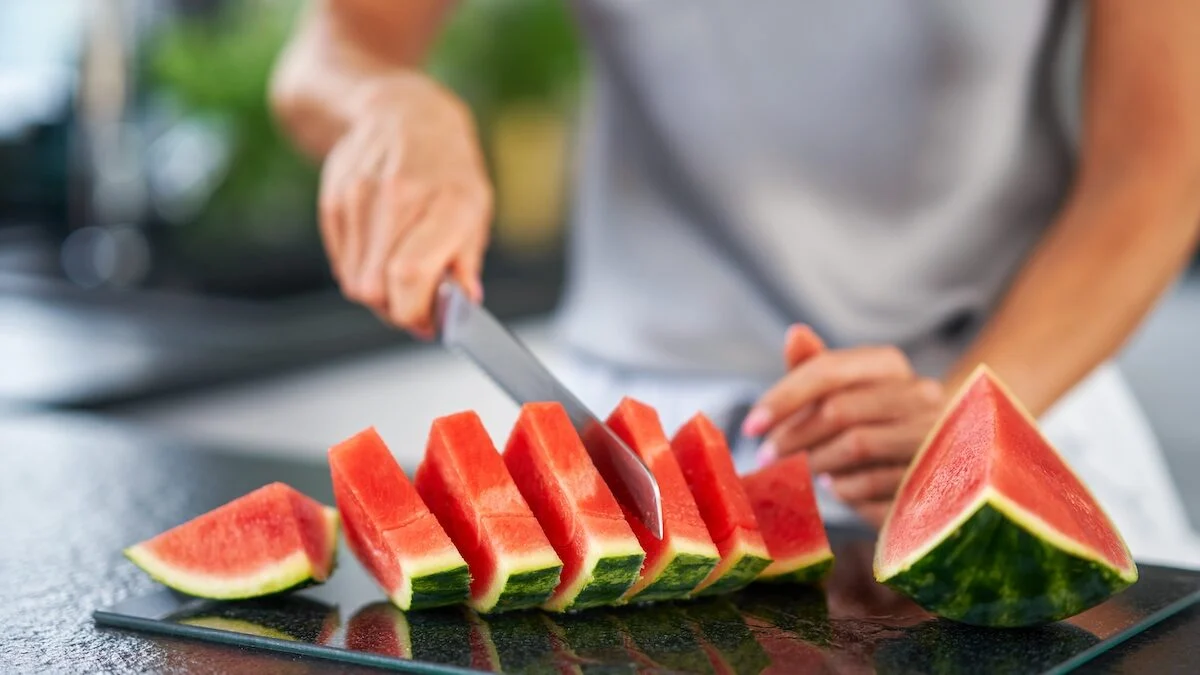
Watermelon is one of the star fruits of summer. Refreshing, rich in water and naturally sweet, it accompanies sunny meals and picnics. But until when can we really enjoy it in France? If you can still find it in supermarkets, does that mean it’s still in season?
Watermelon season officially ends at the end of September
In France, the seasonal fruit and vegetable calendar published by the Ministry of Agriculture is clear: watermelon is considered a seasonal fruit from June to September.
The first ones generally arrive in June, but it is in July and August that they offer their best flavor.
The month of September marks the last French harvests before the official end of the season.
This period corresponds to the production schedule observed in France. According to the latest data from Agreste, the statistical service of the Ministry of Agriculture, we harvest around 26,000 tonnes of watermelons per year. Production remains relatively limited and is mainly concentrated in Guyana (24% of national production), Provence-Alpes-Côte d’Azur (22%) and Guadeloupe (17%). Once these harvests are over, French watermelons become much rarer.
Why are we still finding watermelons after September?
If the shelves continue to be well stocked beyond summer, even in winter, it is thanks to imports. When the French season ends, distributors take over with fruits grown in countries where temperatures remain high for longer.
This operation is observed in many producing countries. In the United States, for example, the USDA Economic Research Service indicates that production generally extends from April to October, with a peak in the middle of summer. The USDA Agricultural Marketing Service also shows that imports increase whenever domestic production slows, to ensure a continued presence of watermelon on shelves. The same principle applies on the European market: when the French harvest ends, other countries take over.
Result: it is possible to buy a watermelon almost all year round, but it is no longer produced in France and its taste can vary depending on its origin and harvest date.
How do you know if you are buying a watermelon that is in season?
For French consumers, the benchmark is simple:
- June: arrival of the first French watermelons.
- July and August: peak season, with fruits generally sweeter and more fragrant.
- September: the last French harvests are still available.
- From October: the watermelons sold are most often imported.
Even if an imported watermelon can be of good quality, favoring the peak season generally allows you to enjoy a tastier fruit, while promoting local production and limiting the transport footprint.